
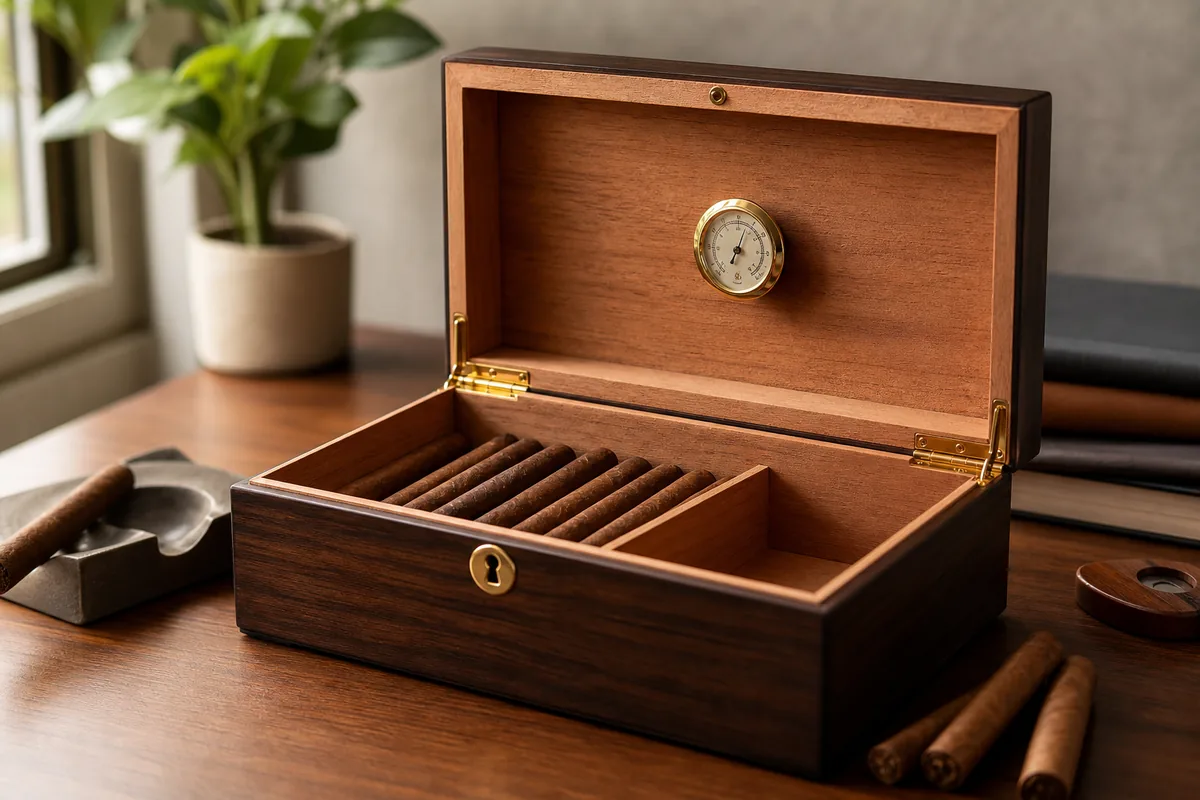
What Is a Cigar Humidor and Do You Need One?
A humidor is any container that maintains humidity around 62-70% RH — the range that keeps cigars fresh, flexible, and smokeable. Without humidity control, cigars dry out within days to weeks (depending on your climate), becoming brittle, harsh, and losing flavor permanently. If you plan to keep cigars longer than a week before smoking, you need some form of humidity-controlled storage. Whether that's a traditional wooden humidor is a separate question.
What a Humidor Does
Three things:
- Maintains humidity. Cigars need 62-70% relative humidity. Too dry (below 55%) and wrappers crack, tobacco becomes brittle, flavor flattens. Too wet (above 75%) and mold grows, burn becomes poor, and tobacco beetles can hatch.
- Provides stable temperature. Ideally 65-72°F. Below 55°F, aging stops. Above 75°F, tobacco beetles can hatch and wrapper oils degrade.
- Protects from physical damage. Cigars are fragile — they crack, tear, and compress easily. A container provides physical protection from handling and environmental hazards.
Do You Actually Need One?
Yes, If:
- You buy cigars more than one at a time
- You don't smoke your purchases within 2-3 days
- You want to keep a rotating selection available
- You plan to age cigars (weeks to years)
- You live in a dry or extremely humid climate
No, If:
- You buy one cigar at a time from a shop and smoke it that day
- You smoke so infrequently that buying in advance doesn't make sense
Most people who try cigars and like them will eventually want 5-20 cigars on hand for convenience. At that point, some form of humidor is necessary.
Types of Humidors
Traditional Wooden Humidor
What: Wooden box (usually Spanish cedar-lined) with a humidity device inside.
Cost: $30-500+ depending on size, materials, and brand.
Capacity: 20-150 cigars (desktop models).
Pros: Beautiful, aromatic cedar, traditional ritual, displayable.
Cons: Requires seasoning (3-7 days before first use), seal quality varies wildly, more maintenance than alternatives, cheap ones leak humidity.
Tupperdor
What: Airtight food-storage container (rubber gasket seal) with Boveda humidity pack.
Cost: $12-25 total.
Capacity: 10-100+ cigars depending on container size.
Pros: Best seal (truly airtight), zero maintenance, cheapest option, no seasoning needed, works in any climate.
Cons: Plastic container — no aesthetic appeal, no cedar aroma (unless you add cedar strips), not displayable.
Coolerdor
What: Igloo/Coleman cooler repurposed as large-capacity humidor. Same principle as tupperdor but bigger.
Cost: $20-60 for cooler + Boveda packs.
Capacity: 100-500+ cigars.
Pros: Massive capacity at low cost, great insulation (temperature stable), airtight seal.
Cons: Bulky, not attractive, needs a closet or garage corner.
Wine Cooler / Wineador
What: Thermoelectric wine cooler converted to cigar storage with cedar shelves and Boveda.
Cost: $150-400 for cooler + $50-100 for cedar shelves/drawers.
Capacity: 200-500+ cigars.
Pros: Temperature AND humidity control, large capacity, looks good in a room, display potential with glass door.
Cons: Expensive, requires modification (shelves, humidity devices), uses electricity continuously.
Travel Humidor
What: Crush-proof case (usually hard plastic) with small Boveda pack for 2-10 cigars.
Cost: $15-60.
Capacity: 2-10 cigars.
Pros: Portable, protective, airline-friendly.
Cons: Small capacity, for transport rather than long-term storage.
The Humidity Source: How It Works
Boveda Packs (Recommended)
Two-way humidity control — adds moisture when too dry, absorbs when too wet. Maintenance-free until the pack hardens (3-6 months). Available in precise RH levels (62%, 65%, 69%, 72%). The modern standard. Use 65% for most situations.
Sponge/Foam Humidifiers (Not Recommended)
Green foam in a plastic tray. Requires manual re-wetting with distilled water. Imprecise, promotes mold growth, can over-humidify. These come included with budget humidors — throw them away and use Boveda instead.
Gel/Crystal Humidifiers
Polymer crystals that absorb and release moisture. Better than sponge but less precise than Boveda. Require occasional recharging with distilled water. A middle-ground option that some long-time collectors prefer for large humidors.
Starting Simple
If you're new: buy a 5-liter airtight container ($8-12) and one Boveda 65% 60-gram pack ($5-7). Total: $15. This stores 15-25 cigars perfectly for months with zero maintenance. If you later decide you want a wooden humidor for aesthetics, you'll already understand humidity management from the tupperdor experience.
For the tupperdor build guide: how to build a tupperdor. For choosing a wooden humidor: choosing your first humidor. For climate-specific challenges: managing humidity in different climates.
Frequently asked questions
Can I just put cigars in a ziplock bag?
Short-term (2-3 days), a ziplock with a small Boveda pack works for transport. Long-term, ziplock bags aren't airtight enough — they allow slow moisture exchange through the plastic. Use a gasket-sealed container for anything longer than a few days.
What happens if I don't use a humidor?
Cigars dry out. Timeline depends on your ambient humidity: in dry winter air (20-30% RH), cigars become unsmokeable in 1-2 weeks. In moderate environments (40-50%), you have maybe a month. Dried cigars crack when handled, burn hot and fast, and taste flat. Damage is permanent below about 50% moisture.
How many cigars should I keep on hand?
Personal preference, but a practical starting point: 10-20 cigars in rotation. Enough variety to match moods and occasions, not so many that you're managing a collection rather than smoking. Buy what you'll smoke in 2-3 months unless you're intentionally aging.
Is it worth spending $200+ on a premium humidor?
For humidity function alone? No — a $15 tupperdor performs equally or better. For aesthetics, cedar aroma, display value, and the pleasure of ownership? That's personal. Premium humidors are furniture pieces. Buy one because you want a beautiful object on your desk, not because cigars need expensive wood.
Community tasting notes
No community notes yet. Be the first to share how this smoked for you.
Log in to share your tasting notes and photos.