
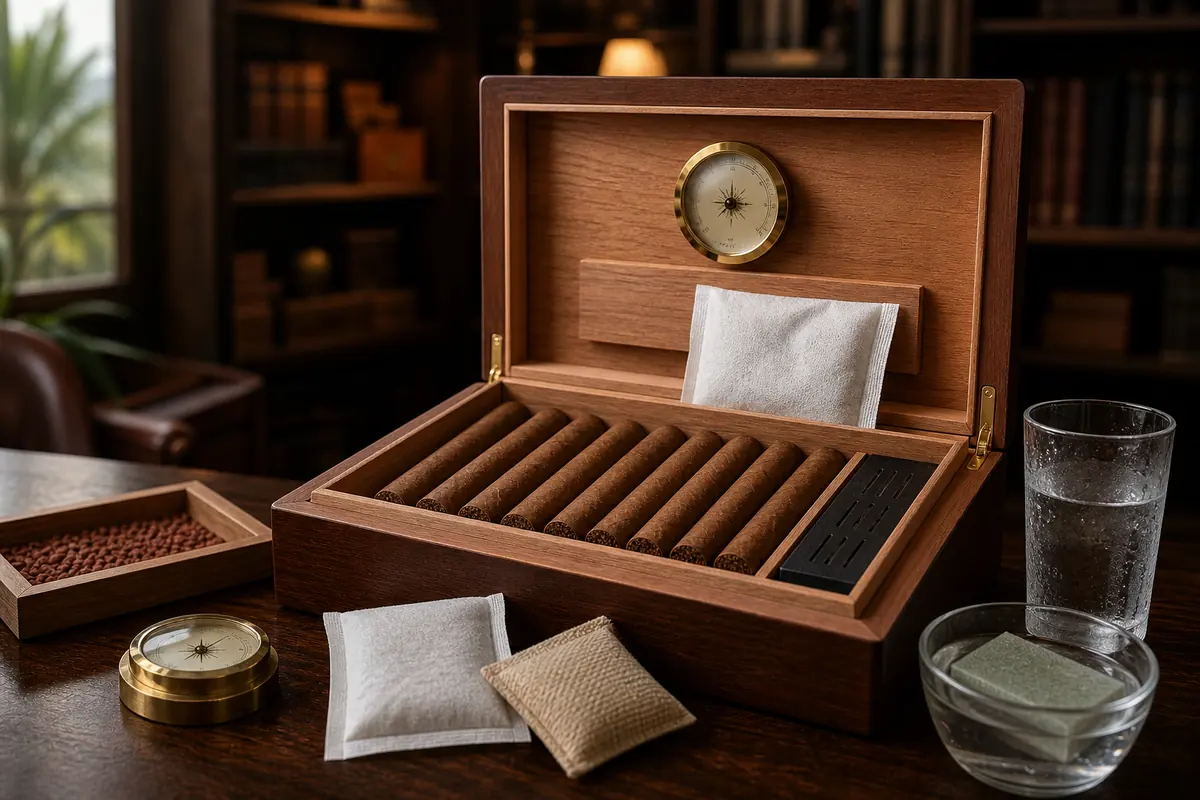
How to Manage Humidor Humidity in Different Climates
If you live somewhere with stable 40-60% ambient humidity and 65-75°F temperatures year-round, a Boveda pack in a sealed container is all you need. But most of the world isn't that convenient. Dry winters, tropical summers, and seasonal swings all challenge cigar storage. The solution isn't exotic — it's understanding which direction your environment pushes and compensating accordingly.
Dry Climates (Under 30% Ambient RH)
Deserts, high-altitude areas, and winter-heated homes with forced air. Your environment actively pulls moisture from your humidor through any imperfect seal.
Problems
- Wooden humidors lose humidity faster — the dry ambient air draws moisture through wood grain
- Boveda packs deplete in 3-4 weeks instead of 2-3 months
- Cigars dry out progressively from the outside in — wrappers crack before you notice draw changes
Solutions
- Use airtight containers. Tupperdors and coolerdors with rubber gasket seals outperform wooden humidors in dry climates because they have zero air exchange. Wood breathes — that's a feature in moderate climates but a liability in dry ones.
- Double up Boveda packs. Use 2x the recommended number of packs to provide buffer against rapid depletion.
- Check weekly. In dry climates, monthly checking isn't enough. Your hygrometer might show 65% on Monday and 55% by Friday if a Boveda pack dies between checks.
- Add humidity to the room. A standalone room humidifier near your humidor reduces the humidity differential — your humidor works less hard to maintain internal levels.
Humid Climates (Over 70% Ambient RH)
Tropical regions, coastal areas, and summer in the American South. Your environment pushes excess moisture INTO your humidor.
Problems
- Cigars absorb excess moisture — soft and spongy feel, poor burn, muted flavor
- Mold risk increases exponentially above 72% RH
- Wooden humidors absorb ambient humidity through the wood and transfer it inside
- Boveda packs become less effective — they absorb excess moisture but have capacity limits
Solutions
- Airtight containers again. Seal keeps ambient humidity out. A tupperdor in Manila works the same as one in Phoenix — the interior environment is independent.
- Use lower Boveda (62-65% instead of 69%). In humid climates, the ambient air sneaking in through any gap adds humidity. Starting lower gives you buffer.
- Store in air-conditioned rooms. AC both cools and dehumidifies. A humidor in an air-conditioned room (68-72°F, 40-50% RH) is in ideal conditions regardless of what's happening outside.
- Inspect for mold monthly. In tropical climates, check every cigar visually once monthly. White fuzzy spots (mold) vs white powder (plume/bloom) — mold has a three-dimensional fuzzy texture, plume is flat and crystalline. When in doubt, isolate the affected cigar.
- Desiccant packs as emergency backup. If humidity spikes above 75%, small silica gel packs can absorb excess temporarily while you correct the root cause.
Seasonal Swing Climates
Most temperate regions: dry winters (heated homes at 20-30% RH) and humid summers (60-75% RH). Your humidor faces opposite problems depending on the month.
Strategy
- Winter: Treat as dry climate — extra Boveda packs, airtight containers, check weekly
- Summer: Treat as humid climate — lower Boveda target, check for mold, keep in AC rooms
- Transition months (spring/fall): Easiest period — ambient conditions often match cigar storage ideals
The simplest seasonal approach: airtight tupperdor with Boveda 65% year-round. The sealed container isolates your cigars from ambient swings entirely. Swap Boveda packs more frequently in winter (they work harder absorbing dry air through micro-gaps), less frequently in summer.
Hot Climates (Above 75°F Consistently)
Heat is a separate risk from humidity — even at perfect humidity levels, temperatures above 75°F create problems:
- Tobacco beetle eggs hatch above 72-75°F. These tiny beetles eat through cigars, leaving pinhole-sized tunnels and fine powder. An infestation can destroy an entire collection in weeks. This is the #1 storage risk in hot climates.
- Wrapper oils bleed. Heat causes wrapper oils to migrate, creating blotchy spots and reducing flavor.
- Accelerated fermentation. Your cigars continue fermenting — faster in heat. This isn't always bad (it mellows the cigar) but it's uncontrolled and irreversible.
Solutions
- Air conditioning is mandatory, not optional. Keep your storage room below 72°F. If AC fails, move cigars to the coolest interior closet.
- Freeze new purchases. Many hot-climate smokers freeze all new cigars for 3 days (then 24 hours in fridge, then return to humidor) to kill any beetle eggs before they enter the collection. Preventive measure worth the minor effort.
- Wine cooler conversion. A temperature-controlled wine cooler set to 63-67°F is the gold standard for hot climates. Add Boveda packs inside for humidity. Your cigars stay at perfect temperature regardless of room conditions.
Cold Climates (Below 50°F Storage)
Less dangerous than heat but still problematic. Cold slows aging to a near-halt and can cause wrapper cracking if cigars are brought from cold storage directly to warm smoking temperature.
Solutions
- Don't store in unheated garages or basements. Below 55°F, Boveda packs stop functioning correctly. Below 40°F, wrappers become brittle.
- Warm up gradually. If storing in a cooler room (60-65°F), bring cigars to room temperature for 30 minutes before smoking. Going cold-to-hot directly can crack wrappers from thermal shock.
For the storage containers themselves, our tupperdor guide covers the airtight solutions that work best in challenging climates. And seasoning a humidor properly in your specific climate is the first step to stable long-term storage.
Seasonal Adjustment Protocols
Most climates require different humidor management approaches in summer versus winter. Summer brings higher ambient humidity that seeps into humidors even through closed lids, pushing internal humidity above targets. Winter heating systems dry indoor air to 20-30% humidity, causing humidors to lose moisture rapidly through lid gaps and wood absorption. A humidor that holds perfect 65% in spring may read 72% in August and 58% in January without any adjustment to the humidity control system itself.
Summer management: switch from 65% Boveda packs to 62% when ambient room humidity exceeds 65%. Open your humidor lid for 30-60 seconds daily to allow excess moisture to escape. If readings consistently exceed 70% despite these measures, remove the active humidity source entirely and let ambient room moisture maintain the humidor through summer months. In extreme humidity climates, a small container of dry rice or silica gel inside the humidor absorbs excess moisture without chemical contamination.
Climate-Specific Solutions
Tropical and subtropical climates with year-round 70-plus percent ambient humidity face constant over-humidification risk. Strategies: store cigars in air-conditioned rooms where humidity drops to 50-60%, use tighter-sealing storage like tupperdors that resist ambient infiltration better than wooden humidors, and check readings twice weekly during rainy seasons when ambient humidity can spike above 80%. Some tropical cigar smokers abandon traditional humidors entirely in favor of sealed containers with 62% Boveda packs that create a controlled micro-environment regardless of external conditions.
Arid desert climates with ambient humidity below 30% face opposite challenges. Wooden humidors lose moisture rapidly through their porous cedar, requiring frequent Boveda replacement or refilling of traditional humidification systems every 3-5 days rather than the standard monthly maintenance schedule. Consider sealing your humidor's exterior with beeswax or choosing airtight containers over traditional wooden boxes. Double-wrapping cigars in cellophane provides an additional moisture barrier for individual sticks even within a properly maintained humidor, adding insurance against the rapid moisture loss that desert environments impose relentlessly.
The single best investment for climate-challenged humidor management is a digital hygrometer with Bluetooth connectivity and logging capability. SensorPush and Govee both make affordable models that record humidity readings every minute and alert your phone when levels move outside your configured safe range. This continuous monitoring catches seasonal drift within hours rather than discovering problems days later when cigars have already absorbed excess moisture or dried beyond recovery. The thirty-dollar sensor investment protects potentially thousands of dollars in cigar inventory from silent climate-driven damage that periodic manual checks inevitably miss between readings.
Frequently asked questions
What temperature kills tobacco beetles?
Freezing at 0°F (-18°C) for 72 hours kills beetle eggs and larvae. The standard preventive protocol: 3 days in freezer, 24 hours in fridge (gradual transition), then return to humidor. Many hot-climate collectors freeze every new cigar purchase as standard practice.
Is 60% humidity too low for cigars?
60% is the lower acceptable bound. Cigars won't be damaged but may smoke slightly dry and burn faster. Many collectors prefer 62-65% for storage (especially long-term aging). Below 55% for extended periods causes wrapper cracking and irreversible dryness.
Can I store cigars in the fridge?
Not recommended. Refrigerators dehumidify aggressively (to prevent food mold) and typically run at 35-40°F — too cold and too dry. The food odors also transfer to cigars. Wine coolers at 60-65°F are the correct appliance if temperature control is needed.
My humidor reads 72% — is that too high?
Yes. Above 70%, mold risk increases significantly and cigars absorb excess moisture (spongy feel, poor burn). Target 65-69%. If reading 72%: remove one Boveda pack, crack the lid for 30 minutes daily until levels drop, or switch to a lower-strength Boveda (65% instead of 69%).
Community tasting notes
No community notes yet. Be the first to share how this smoked for you.
Log in to share your tasting notes and photos.