
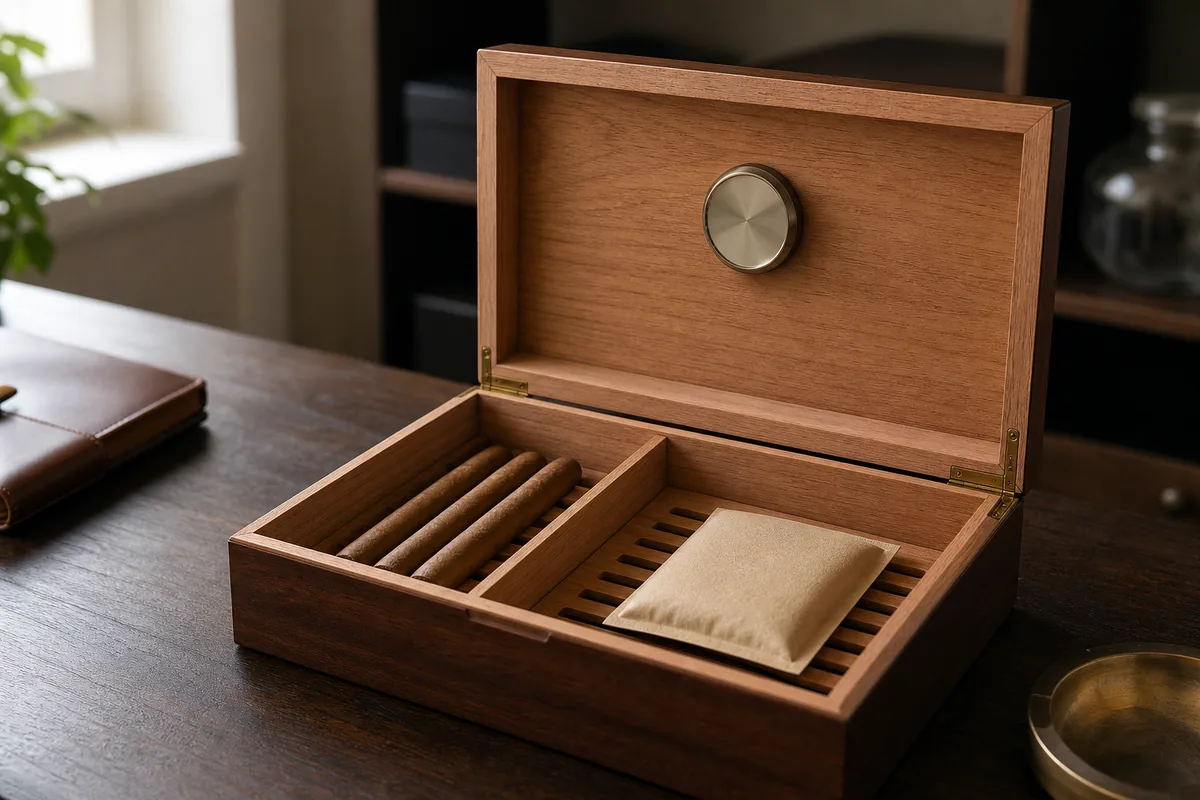
How to Choose Your First Humidor
A 50-count Spanish cedar humidor with a reliable seal is all a new cigar smoker needs. Anything smaller and you'll outgrow it in months. Anything larger and you're spending money on empty space. The brands that consistently deliver at this size: Quality Importers (Capri, Milano), Adorini, and Savoy. Budget: $50–100. Skip the $200+ options until your collection demands it.
Your humidor has one job: maintain 65-70% relative humidity around your cigars. Every feature, every material choice, every design decision either helps or hinders that single purpose. Understanding this makes the buying decision simple.
What Actually Matters
The Seal
This is the most important feature and the one most cheap humidors get wrong. Close the lid and lift the humidor by the lid alone — if it holds for a second before dropping, the seal is adequate. If air rushes in immediately when you close it, reject it. A poor seal means your humidification system fights a losing battle against constant air exchange.
The "whoosh" test: close the lid quickly. You should hear a slight resistance or feel a cushion of air — that's the seal compressing. No resistance means no seal.
Spanish Cedar Lining
Non-negotiable. Spanish cedar (cedrela odorata) absorbs and releases moisture, acting as a buffer that smooths humidity fluctuations. It also repels tobacco beetles and imparts a subtle aroma that complements aged tobacco. Humidors lined with generic wood, felt, or nothing at all will have wild humidity swings that damage your cigars.
Check that the cedar is real, not a veneer or sticker. Real cedar has visible grain, smells distinctly aromatic when scratched, and has actual thickness (at least 2-3mm). Paper-thin cedar-scented linings don't buffer humidity.
Size: The 50-Count Sweet Spot
"50-count" is a marketing number — it means 50 Churchills laid flat in rows. In practice, with dividers and varied sizes, you'll fit 30-40 cigars comfortably. That's perfect for a growing collection: enough room to stock favorites, experiment with new brands, and age a few special sticks.
A 25-count sounds reasonable but fills up after two online orders. You'll be shopping for a second humidor within six months. A 100-count costs twice as much and sits half-empty for a year — dead air space actually makes humidity harder to maintain, not easier.
Humidity Systems
Boveda Packs (Recommended)
Two-way humidity control that requires zero maintenance. Drop a 69% Boveda pack (or two for a 50-count) inside the humidor and forget about it. Replace every 2-3 months when the pack hardens. No filling, no guessing, no risk of over-humidification. This is the answer for anyone who doesn't want humidity to be a hobby within a hobby.
Foam/Sponge Humidifiers (Avoid)
The green foam bricks that come pre-installed in most humidors. They work by absorbing distilled water and releasing it through evaporation. The problem: they have no regulation mechanism. In summer they release too much moisture (mold risk). In winter they dry out fast. They breed mold if you use tap water. If your humidor came with one, replace it with Boveda immediately.
Crystal Gel / Silica Beads
Better than foam, worse than Boveda. Silica beads absorb and release moisture more evenly than foam. They need recharging with distilled water every 1-2 weeks. A decent middle ground if you enjoy the ritual of humidor maintenance. Heartfelt Industries makes the standard product.
Seasoning Your New Humidor
New Spanish cedar is dry. If you load cigars immediately, the wood will steal moisture from your cigars rather than buffering humidity. Season first:
- Place a Boveda 84% seasoning pack inside the empty humidor
- Close the lid and leave it for 14 days
- Remove the seasoning pack, add your regular 69% Boveda packs
- Wait 24 hours for humidity to stabilize, then add cigars
Alternative method: wipe the interior cedar with a lightly damp cloth (not dripping), close the lid, repeat daily for 5-7 days. Less reliable than the Boveda method but faster. Never pour water into the humidor — standing water warps the wood and grows mold.
What to Skip
Built-in analog hygrometers. Every humidor includes one. Almost all are inaccurate by 5-15% out of the box. Buy a separate digital hygrometer ($15-25) from Boveda, Xikar, or Caliber. Place it inside after calibrating with a Boveda 75% calibration kit.
Glass-top humidors. They look nice on a desk. They also leak at the glass-to-wood junction and let UV light degrade your wrappers over time. If you want a display piece, buy a glass-top for your desk cigars. But store your collection in a solid-lid humidor.
Electronic humidity systems. Overkill for a 50-count humidor. These make sense for walk-in humidors or 500+ count cabinets. For a desktop humidor, Boveda packs do the job for $5 every three months.
The Recommendation
Buy a 50-count humidor ($50-100) from Quality Importers, Adorini, or Savoy. Throw away the foam humidifier that comes with it. Season with a Boveda 84% pack for two weeks. Add two Boveda 69% packs and a digital hygrometer. Load your cigars. Check humidity weekly — it should hold 65-70% with minimal intervention. That's it. Your cigars are safe.
Once you have storage sorted, build out the rest of your accessories and start exploring our beginner cigar picks.
Size Recommendations by Smoker Type
The universal advice is to buy bigger than you think you need because every cigar smoker's collection grows over time. A once-weekly smoker thinks they need a 25-count humidor but within six months of buying cigars they've accumulated 40-50 sticks. The minimum practical humidor size is a 50-count desktop that accommodates growth without immediate upgrading pressure. If budget allows, start with a 75-100 count that provides years of expansion room and better humidity stability due to larger air volume buffering against environmental changes.
For smokers who already know they'll commit to the hobby through previous experience at lounges or with friends, skip desktop humidors entirely and invest in a 200-300 count cabinet or end-table humidor. The per-cigar storage cost of large humidors is dramatically lower than small ones, and the improved humidity stability from larger internal volume means less maintenance, fewer dried-out cigars, and the ability to buy in boxes rather than restricting purchases to singles that fit limited space.
Features That Matter vs. Marketing Gimmicks
Essential humidor features: Spanish cedar lining (absorbs and releases moisture, adds aroma, deters tobacco beetles), tight-fitting lid that passes the dollar-bill test (a bill should resist pulling when trapped in the closed lid), and adequate depth to store cigars without stacking too high. Quality hinges, whether quadrant or piano-style, prevent the lid from falling backward and cracking.
Features that don't justify premium pricing: glass tops (reduce insulation and allow UV damage to cigars), digital built-in hygrometers (often inaccurate and non-replaceable), built-in lighting (generates heat near cigars), locks (when would you lock your humidor?), and exotic wood exteriors that look beautiful but don't improve the humidor's core function of maintaining stable internal humidity. Spend your budget on cedar quality and seal integrity rather than aesthetic upgrades that Instagram well but do nothing for your cigars' actual storage conditions.
Consider where you'll physically place the humidor before purchasing. Desktop models need a location away from direct sunlight, heating vents, and exterior walls that experience temperature swings. A bookshelf, interior closet shelf, or corner of a home office works well. If floor space is available, end-table style humidors serve dual function as furniture while providing larger capacity and better humidity stability than desktop alternatives. Whatever location you choose, ensure it's accessible enough that you'll actually open the humidor regularly rather than forgetting about cigars stored in a closet you rarely visit, which leads to both neglected inventory and missed humidity maintenance that dried-out or moldy cigars will eventually reveal when you finally remember to check on them.
Frequently asked questions
How much should I spend on a first humidor?
$50-100 for a desktop 50-count. Below $50, seal quality drops significantly. Above $100 you're paying for aesthetics and brand name, not better humidity control.
Can I use a Tupperware container instead?
Yes — a 'tupperdor' with a Boveda pack works perfectly for humidity control. You lose the cedar buffer and the aesthetics, but functionally it maintains humidity as well or better than a poorly sealed wooden humidor. A legitimate option for budget-conscious beginners.
What humidity level should I target?
65-69% for best smoking results. The old 70/70 rule (70% humidity, 70°F) over-humidifies cigars for most smokers, causing burn problems. Modern consensus favors 65-67% for optimal burn and flavor.
How often do I need to check my humidor?
Weekly is sufficient with Boveda packs. Glance at the digital hygrometer, confirm it reads 65-70%, and close the lid. Replace Boveda packs when they harden (every 2-3 months). That's the entire maintenance routine.
Community tasting notes
No community notes yet. Be the first to share how this smoked for you.
Log in to share your tasting notes and photos.