
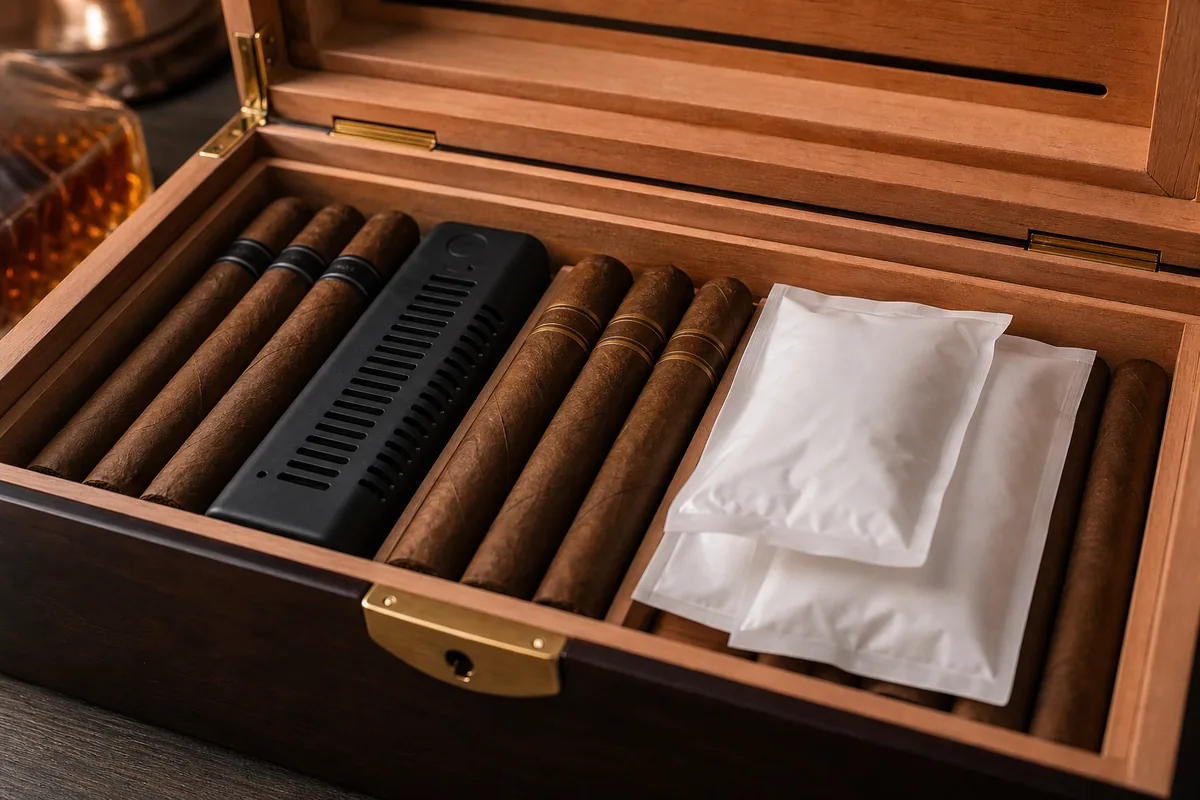
Cigar Oasis vs Boveda: Electronic vs Passive Humidity
Boveda wins for 90% of cigar smokers. If your humidor holds under 150 cigars, has a decent seal, and lives in a reasonably climate-controlled room, passive two-way humidity packs do the job with zero maintenance anxiety. The Cigar Oasis earns its place in larger cabinets, leaky humidors, or extreme climates where passive packs can't keep pace.
That's the short answer. Here's why, and how to figure out which camp you fall into.
How Each System Works
Boveda (Passive Two-Way)
Boveda packs contain a saturated salt solution sealed in a semipermeable membrane. The salt chemistry dictates a specific equilibrium RH—65%, 69%, 72%, depending on the pack you choose. The membrane allows water vapor to pass in both directions: if your humidor's air is too dry, the pack releases moisture; too humid, it absorbs.
No batteries, no wires, no settings. You place packs in the humidor and forget about them until they harden (meaning the water content is depleted). Replacement every 2-4 months in a standard humidor.
Cigar Oasis (Electronic Active)
The Cigar Oasis is an electronic humidification device with a built-in fan, water reservoir, and humidity sensor. You set your target RH on the digital display, fill the reservoir with distilled water, and the unit activates its fan to disperse moisture when humidity drops below your set point.
Models range from the Cigar Oasis Plus (up to 300 cigars / 4 cubic feet) to the Cigar Oasis Ultra 3.0 (up to 1500 cigars / 10 cubic feet). Higher-end models include Wi-Fi monitoring through a smartphone app.
The Real Differences
Accuracy
Boveda maintains RH within ±1% of its rated value in a sealed environment. That's tighter than any electronic device. The limitation: in a leaky humidor or one that's frequently opened, Boveda packs deplete faster trying to compensate, and you may see fluctuations of ±3-4% between pack replacements.
Cigar Oasis maintains RH within ±2-3% of your set point in ideal conditions. The sensor reads ambient humidity and activates when needed. In practice, you'll see more cycling—humidity dips, fan activates, humidity rises slightly above target, then slowly drifts back down. The swing is usually 3-5% around your set point.
Winner: Boveda for steady-state precision. Cigar Oasis for recovery speed after the door opens.
Maintenance
Boveda: check monthly, replace when packs feel rigid. In a well-sealed humidor, that's every 3-4 months. Total time: 5 minutes per quarter.
Cigar Oasis: refill the water reservoir every 1-3 weeks depending on model and conditions. Monitor the sensor accuracy periodically (electronic sensors drift over time and need recalibration). Clean the unit's wick/cartridge every few months. Total time: 10-15 minutes monthly.
Winner: Boveda by a wide margin on maintenance simplicity.
Cost Over Time
Boveda annual cost for a 50-count humidor: 4-6 packs per year at $4-5 each = $20-30/year.
Boveda annual cost for a 150-count humidor: 8-12 packs per year at $4-5 each = $40-60/year.
Boveda annual cost for a 300+ count cabinet: 20-30 packs per year = $100-150/year.
Cigar Oasis Plus (initial): $100-130. Annual maintenance (replacement cartridges, distilled water): $20-30. Amortized over 5 years: ~$45-55/year total.
Cigar Oasis Ultra (initial): $150-200. Annual maintenance: $25-35. Amortized over 5 years: ~$60-75/year total.
The crossover point: once your humidor exceeds roughly 200 cigars capacity, the Cigar Oasis becomes cheaper long-term than scaling up Boveda pack quantity.
Reliability
Boveda has no moving parts, no electronics, no failure modes beyond depletion—which is visible (the pack hardens) and gradual (not a cliff-edge failure).
Cigar Oasis introduces electronic failure points: the sensor can drift or die, the fan can fail, the reservoir can run dry if you forget to refill. Wi-Fi models add firmware bugs and connectivity issues. None of these are common, but any of them can result in your cigars sitting at 50% or 80% RH until you notice.
Winner: Boveda for reliability. Cigar Oasis mitigates this with smartphone alerts on Wi-Fi models, but alerts don't help if the sensor itself has drifted without triggering an alarm.
Capacity and Recovery
This is where Cigar Oasis earns its keep. In a large cabinet humidor (300+ cigars, 6+ cubic feet), opening the door drops RH significantly. Boveda packs respond passively—they'll recover the lost humidity, but it takes time. Hours, potentially.
A Cigar Oasis detects the drop immediately and actively pumps moisture until the target is reached. Recovery time: 15-30 minutes for a well-sized unit. For a retail shop humidor that opens constantly, or a large personal cabinet you access multiple times daily, this active recovery matters.
Winner: Cigar Oasis for large volumes and frequent access.
When to Choose Boveda
Your humidor holds under 150 cigars. You open it once or twice a day. The room temperature stays between 65-75°F. You prefer zero maintenance. You want set-and-forget with no electronics to troubleshoot. Your humidor has a solid seal.
Use 65% packs if you live in a warm/humid climate or prefer a slightly drier smoke. Use 69% if your environment is moderate. Avoid 72%—it's too high for most situations and increases mold risk without meaningful benefit to cigar performance.
When to Choose Cigar Oasis
Your humidor holds 200+ cigars. You open it frequently throughout the day. Your room experiences significant temperature or humidity swings. Your humidor's seal isn't perfect and you can't easily replace the unit. You want smartphone monitoring and alerts.
Pair it with a standalone digital hygrometer as a cross-reference. Don't rely solely on the Cigar Oasis's built-in sensor for your readings—calibrate the external hygrometer separately and use it as ground truth.
The Hybrid Approach
Some cigar enthusiasts run both: a Cigar Oasis for active humidification and recovery, plus a few Boveda packs as a passive safety net. If the Cigar Oasis malfunctions or runs dry, the Boveda packs maintain minimum humidity until you notice and fix the issue.
This is belt-and-suspenders, but for a collection worth thousands of dollars, the $20/year insurance of a few backup Boveda packs makes sense. Place the Boveda packs on a different shelf than the Oasis unit so they serve different zones.
What About Other Options?
Heartfelt Beads (silica-based): A middle ground between passive and electronic. They're rechargeable with distilled water, two-way like Boveda, but higher capacity per unit. Good option for medium humidors (100-200 count) where Boveda cost is adding up but you don't want electronics. Less precise than Boveda (±2-3% RH).
Sponge/foam humidifiers: The green foam that comes with cheap humidors. Throw it away. It's one-way (only releases, never absorbs), breeds mold, and provides zero precision. There's no scenario where this is the right choice in 2024.
Gel crystals/beads (generic): Better than sponge, worse than Boveda or Heartfelt. Inconsistent quality between brands. If you're considering these, just buy Boveda instead.
The Bottom Line
Match the system to the humidor, not to marketing hype. Small to medium humidor with a good seal: Boveda 65% and check it monthly. Large cabinet or commercial walk-in: Cigar Oasis with a Boveda backup layer. Anything in between: Boveda still wins on simplicity unless you specifically need active recovery speed.
Start with Boveda. If you find yourself replacing packs too frequently or can't maintain stable RH despite correct pack count, then evaluate whether your problem is the humidification method or the humidor itself. A leaky humidor defeats any system—fix the container before upgrading the humidity source.
Community tasting notes
No community notes yet. Be the first to share how this smoked for you.
Log in to share your tasting notes and photos.