
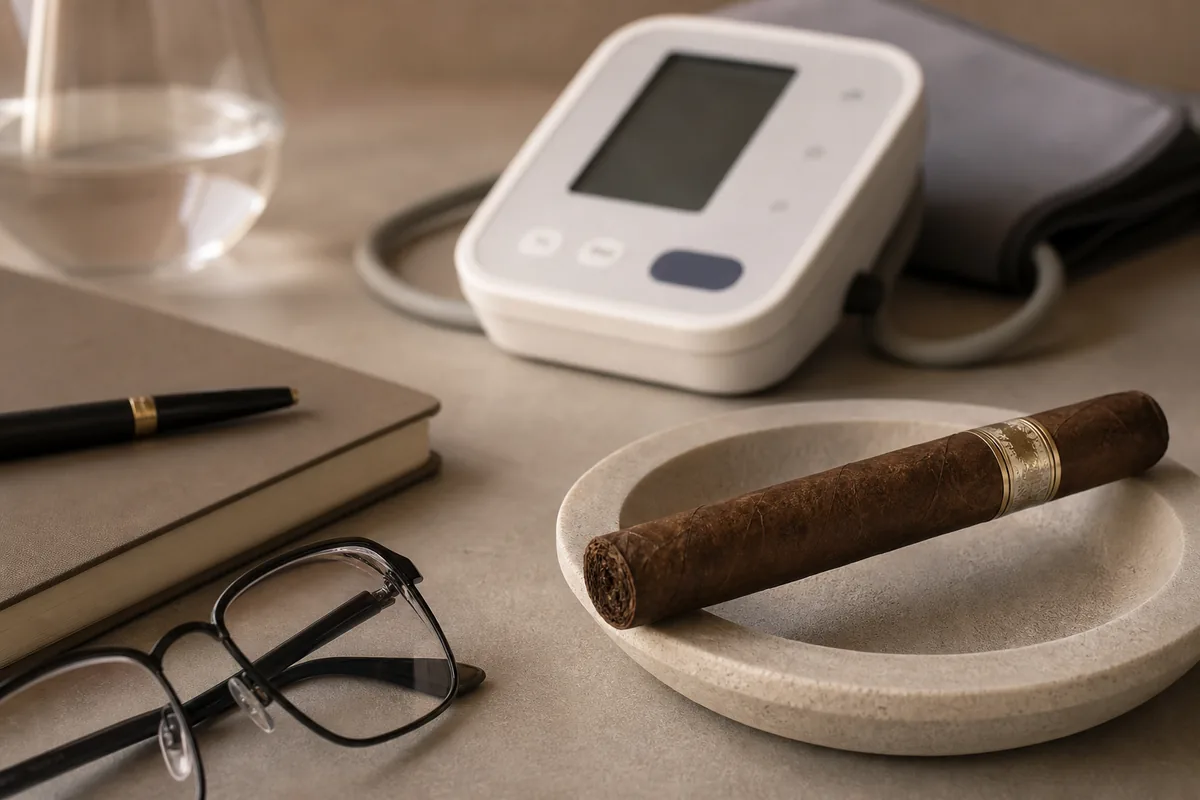
Cigars and Blood Pressure: What Research Shows
Cigar smoking raises your blood pressure. Every session. The nicotine you absorb — even without inhaling — enters your bloodstream through oral mucosa and triggers measurable cardiovascular responses within minutes. For occasional smokers, these are temporary. For daily smokers or those with existing hypertension, the picture is more complicated.
The Acute Response: What Happens During a Cigar
Within 5-10 minutes of starting a cigar, nicotine absorption begins producing cardiovascular effects:
- Systolic blood pressure increases by roughly 5-20 mmHg (the exact amount varies by individual, tolerance, and cigar strength)
- Diastolic blood pressure rises by approximately 5-15 mmHg
- Heart rate elevates by 10-20 beats per minute
- Peripheral blood vessels constrict, increasing vascular resistance
- Cardiac output increases as the heart works harder against constricted vessels
These effects peak during the smoke session and persist for 20-30 minutes after you finish as nicotine metabolizes. For a 90-minute cigar, you're experiencing elevated blood pressure for roughly two hours total.
The mechanism is straightforward: nicotine stimulates the sympathetic nervous system, triggering adrenaline and noradrenaline release. This is the "fight or flight" system — it raises blood pressure because that's what it evolved to do in response to stimulants.
Does Cigar Smoking Cause Chronic Hypertension?
This is the critical question for long-term cigar smokers, and the answer requires nuance.
Occasional smokers (1-2 per week or less): Blood pressure returns to baseline between sessions. At this frequency, research doesn't show significant development of chronic hypertension attributable to cigar smoking alone in otherwise healthy individuals. Your cardiovascular system recovers fully between acute exposures.
Daily smokers: Research shows associations between daily cigar smoking and sustained elevation in resting blood pressure. The repeated stimulation and vessel constriction creates cumulative arterial stress. Over years, this contributes to arterial stiffening and may push borderline individuals into hypertensive ranges.
The distinction matters: occasional cigar smoking creates transient spikes that resolve. Daily smoking creates a pattern of chronic vascular stress that parallels (though may be less severe than) what daily cigarette smoking produces.
Nicotine Without Inhalation Still Affects Your Heart
A common misconception: "I don't inhale, so my heart is fine." Incorrect. Nicotine's cardiovascular effects don't require lung absorption. The nicotine that absorbs through your mouth enters the same bloodstream and reaches the same heart and blood vessels as inhaled nicotine.
The difference is quantity and speed. Oral absorption delivers nicotine more slowly and in smaller total amounts than inhalation. Your cardiovascular system still responds — the response is just somewhat less intense per session. This is a reduction, not an elimination, of cardiovascular impact.
Carbon monoxide from cigar smoke also absorbs somewhat even without deliberate inhalation (from ambient exposure and minor inadvertent inhalation). CO reduces blood oxygen-carrying capacity, forcing the heart to work harder. This adds to the cardiovascular burden beyond nicotine's direct effects.
If You Already Have High Blood Pressure
For people with existing hypertension (readings consistently above 130/80 mmHg), cigar smoking deserves serious consideration:
Acute risk: Starting from an already-elevated baseline, the additional 5-20 mmHg spike from nicotine pushes you further into dangerous territory. Blood pressure above 180/120 mmHg constitutes a hypertensive crisis requiring medical attention. If your resting pressure is already 150/95, a cigar could theoretically push you near crisis levels.
Medication interactions: Some blood pressure medications work by opposing the exact mechanisms nicotine activates. Smoking may partially counteract your medication's effectiveness during and shortly after a cigar. This doesn't mean your medication stops working, but it does mean the acute spike occurs on top of whatever baseline your medication achieves.
Long-term progression: Hypertension tends to worsen over time. Adding regular vasoconstriction from cigar smoking accelerates this progression. Research shows that tobacco users with hypertension face higher rates of cardiovascular events than non-smoking hypertensives at equivalent blood pressure levels.
If you have hypertension and smoke cigars, your physician needs to know both facts. They may adjust monitoring frequency, medication choices, or recommend specific limitations on your smoking pattern.
Arterial Stiffness and Long-Term Vascular Health
Beyond acute blood pressure spikes, chronic nicotine exposure contributes to arterial stiffness — the gradual loss of elasticity in blood vessel walls. Stiff arteries don't expand and contract efficiently with each heartbeat, leading to higher systolic pressure and greater cardiac workload.
This is a slow process measured over years. Occasional cigar smokers likely experience minimal arterial stiffening compared to daily smokers. But it's cumulative and largely irreversible — once arteries stiffen, they don't return to youthful elasticity.
Arterial stiffness also increases heart attack and stroke risk independent of blood pressure numbers. Your vessels become less able to handle sudden pressure changes, making cardiovascular events more likely even if your resting blood pressure appears controlled.
The Interaction with Other Risk Factors
Blood pressure doesn't exist in isolation. Cigar smoking's cardiovascular impact compounds with:
High cholesterol: Nicotine promotes atherosclerotic plaque development, and existing high cholesterol accelerates this. The combination is worse than either factor alone.
Diabetes: Diabetics already face accelerated vascular damage. Adding nicotine-induced vasoconstriction and arterial stress compounds their cardiovascular risk substantially.
Obesity: Excess weight elevates blood pressure independently. Cigar smoking spikes on top of weight-related hypertension create higher peak pressures.
Sedentary lifestyle: Exercise is protective for cardiovascular health. Lack of physical activity removes a major buffer against tobacco's vascular effects.
Stress: Chronic stress elevates baseline blood pressure. While some smokers cite cigars as stress relief, the physiological reality is that nicotine adds acute stress to your cardiovascular system regardless of psychological relaxation.
Monitoring Recommendations for Cigar Smokers
If you smoke cigars regularly, monitoring your blood pressure gives you data to make informed decisions:
- Home blood pressure monitor: Take readings at the same time daily, before smoking, to track your baseline over time. Morning readings before any nicotine are most useful for detecting trends.
- Know your numbers: Normal is below 120/80. Elevated is 120-129/<80. Stage 1 hypertension is 130-139/80-89. Stage 2 is 140+/90+. Know where you fall.
- Track changes: If your baseline creeps upward over months, that's information worth discussing with your physician.
- Pre- and post-smoking readings: Occasionally measuring before and 20 minutes after a cigar shows you your personal acute response magnitude. This helps you understand your body's specific reaction.
Can You Smoke Cigars with Controlled Hypertension?
This is a conversation for you and your physician, not a generic article. What we can say: people with well-controlled hypertension (reaching target ranges with medication) who smoke cigars occasionally are adding acute cardiovascular stress that temporarily exceeds their controlled baseline. Whether this matters clinically depends on your specific target organ health, medication regimen, and overall cardiovascular risk profile.
What your physician will likely tell you: less is better, don't inhale, monitor your pressure, and come in if you notice symptoms during or after smoking (chest pain, severe headache, visual changes, significant shortness of breath). These could indicate your body isn't tolerating the acute stress well.
Blood pressure is one piece of your cardiovascular picture. It interacts with everything else — cholesterol, weight, activity level, genetics, stress. Understanding how cigars fit into that complete picture requires medical evaluation, not generalized reassurance. Give your doctor honest information about your smoking patterns and let them assess your specific situation.
Frequently asked questions
How long does blood pressure stay elevated after smoking a cigar?
Blood pressure typically returns to baseline within 20-30 minutes after finishing a cigar as nicotine metabolizes. For a 90-minute cigar, this means approximately two hours of total elevated blood pressure. Individual recovery time varies based on metabolism, tolerance, and overall cardiovascular health.
Can cigars cause a heart attack?
Daily cigar smoking is associated with increased risk of cardiovascular events including heart attack. The acute blood pressure spike during smoking could theoretically trigger an event in someone with significant existing arterial disease. Occasional smoking in healthy individuals carries much lower acute risk, but it's not zero. Any chest pain during or after smoking warrants immediate medical evaluation.
Should I avoid cigars if I take blood pressure medication?
Discuss this specifically with your prescribing physician. Cigar smoking temporarily works against some blood pressure medications' mechanisms. Your doctor can assess whether occasional smoking is acceptable given your specific medication, blood pressure control, and overall cardiovascular profile.
Does cigar smoking affect blood pressure if I only smoke once a month?
Yes, each session produces an acute blood pressure elevation regardless of frequency. At once monthly, these are isolated events with full recovery between sessions and likely no contribution to chronic hypertension in healthy individuals. The acute spike still occurs — it's just temporary and infrequent.
Community tasting notes
No community notes yet. Be the first to share how this smoked for you.
Log in to share your tasting notes and photos.