
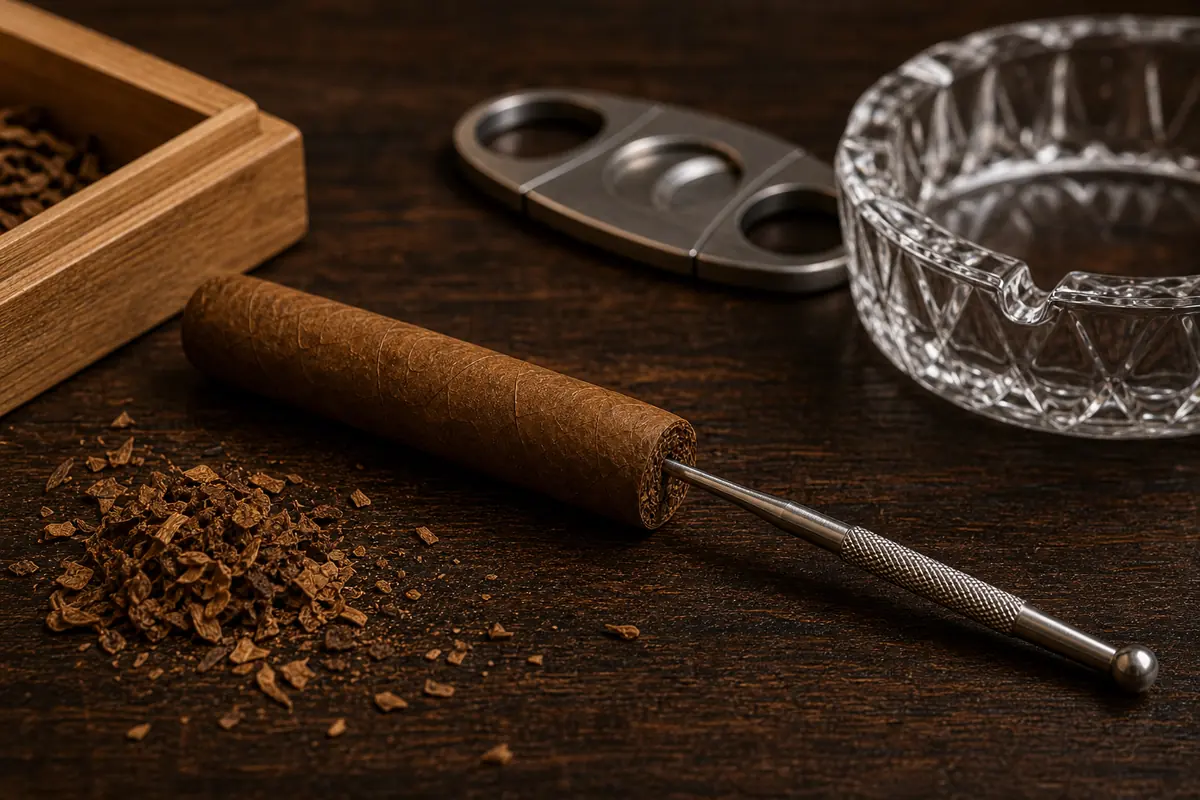
How to Fix a Plugged Cigar
Push a draw poker (thin metal or bamboo skewer) through the cigar from the cut end, gently twisting as you advance 2-3 inches into the filler. This creates a small air channel through the plug point, restoring draw immediately in most cases. If you don't have a draw poker, a wooden toothpick or the thin end of a bamboo skewer works — anything food-safe, thin, and rigid enough to penetrate rolled tobacco.
A plugged cigar has restricted airflow — you pull hard and get little or no smoke. It's a construction defect where filler tobacco is bunched too tightly in one section, blocking air from passing through. It happens to all brands occasionally, even premium ones. The good news: most plugs are fixable without ruining the cigar.
Method 1: Draw Poker (Most Effective)
What You Need
A cigar draw poker tool ($5-10 at any cigar shop), a bamboo skewer, a long wooden toothpick, or a straightened paperclip (less ideal — metal can tear the filler rather than pushing through it).
Technique
- Insert the poker into the cut end (head) of the cigar
- Push gently while twisting — don't force it straight through or you'll tear the binder
- Advance 2-3 inches, or until you feel resistance lessen
- Pull back slightly, then re-advance at a slightly different angle if needed
- Remove the poker and test the draw — you should feel a noticeable improvement
- If still tight, repeat from the same end at a different angle to create a second channel
Don't push through the entire length — you only need to breach the plug point, which is usually 1-3 inches from the head. Pushing all the way through can create too much airflow (cigar burns hot and fast) or tear the binder in the middle.
Method 2: Massage / Roll
When to Use
For mild plugs where the draw is tight but not completely blocked. Also useful as a first attempt before resorting to the draw poker.
Technique
- Gently roll the cigar between your fingers along its full length
- Find the "hard spot" — where you feel denser, firmer tobacco compared to the rest
- Apply gentle squeezing pressure to that spot, rolling and compressing slightly
- Rotate and repeat from different angles
- Test the draw — the loosened filler often allows enough airflow
Be careful: too much pressure cracks the wrapper. You're not crushing the cigar — you're gently persuading the filler to shift. If you hear cracking, stop. The cigar's wrapper is more fragile than the filler inside.
Method 3: Cut More Off the Head
When to Use
When the plug is located right at the cap end — within the first half-inch. Sometimes the roller packed the head too tightly during construction.
Technique
Cut another 2-3mm off the head (below your original cut). This removes the densest part of the cap area and can open up a plug that's located right at the top. Risk: cutting too deep unravels the wrapper. Only cut one additional time — if two cuts don't fix it, the plug is deeper.
When to Give Up
Not every plug is fixable. Move on when:
- You've poked through with a draw poker and the draw is still completely blocked — the plug extends most of the cigar's length (rare but happens)
- The wrapper has cracked during repair attempts — a cracked wrapper means unraveling and uneven burn for the rest of the smoke
- You're already frustrated — a cigar is supposed to be relaxing. If fixing it has killed your mood, light a different one
Keep the plugged cigar's band information for next time — if the same brand/vitola plugs repeatedly, it's a batch or blend issue, not bad luck. Contact your retailer; most will replace consistently plugged cigars.
Prevention
Pre-draw before lighting. After cutting, pull air through the unlit cigar. The draw should feel like drinking through a medium straw — moderate resistance. If it feels like sucking a milkshake through a coffee straw, it's plugged. Better to discover this before you light up and waste the first third troubleshooting.
Buy from reputable brands. Premium brands (Padrón, Fuente, Oliva, My Father) have lower plug rates because their QC is rigorous. Budget brands and bundles have higher plug rates because QC is looser. Accept the tradeoff or spend more.
Store at proper humidity. Over-humidified cigars (75%+) swell, compressing the filler and creating artificial plugs. Keep your humidor at 65-69% to prevent humidity-related draw issues.
Once your cigar draws properly, make sure you're lighting it correctly — an even light prevents the burn issues that people sometimes confuse with plugs. And if uneven burn is your problem instead of draw restriction, check our uneven burn fix guide.
Prevention Through Selection and Storage
Certain cigar characteristics predict higher plug risk. Extremely tight construction visible as a very firm feel when squeezed, cigars stored at high humidity above 70% where filler swells, and cigars with high ligero content that produces thick dense leaves all increase plugging likelihood. Before lighting, always perform a cold draw test by sucking gently through the unlit cigar. Airflow should feel like drinking through a wide straw. If it feels like sucking through a coffee stirrer, the cigar is likely plugged and should be addressed before lighting rather than discovered frustratingly mid-smoke when options become more limited.
Storage humidity directly affects draw resistance. Cigars at 65% humidity draw noticeably easier than identical cigars at 70% because lower moisture content means less swollen filler pressing against the binder. If you consistently experience tight draws across multiple cigars from different brands, your humidor humidity is likely too high rather than every manufacturer having construction problems. Drop your target humidity by 3-4% and reassess draw quality after a week of acclimation time for the tobacco to release excess moisture.
The PerfecDraw and Similar Tools
The PerfecDraw tool costs approximately 25 dollars and has saved more cigars from the trash than any other accessory. It works by inserting a thin steel needle with a small corkscrew tip into the cigar from the head end and physically pulling out small amounts of compressed filler that create the blockage. The tool is narrow enough to create a channel without disturbing surrounding filler architecture. Insert, twist, extract a small plug of tobacco, and test the draw. Repeat if still tight. Most plugs resolve within 2-3 extractions removing a total of perhaps one-tenth of a gram of tobacco from the blockage point.
Without a PerfecDraw, a thin bamboo skewer or straightened paperclip can create a relief channel through plugged filler. The technique is less precise than the dedicated tool but works in emergencies. Push gently through the center from the head toward the foot, stopping about an inch from the burning end if the cigar is already lit. This creates an airflow bypass around the plug. The cigar may smoke slightly differently with a channel bored through its center, but differently while smokeable beats perfectly constructed but impossible to draw through.
If you encounter frequent plugging across different brands, evaluate your cutting technique. An overly shallow cut leaves too much cap material restricting airflow at the entry point. Cut slightly deeper next time, removing the full cap rather than just the very tip. This alone resolves what many smokers diagnose as plugging when the actual obstruction is at the cut surface rather than deep in the filler. Test draw resistance immediately after cutting and before lighting to distinguish between a tight cut (easily fixed by cutting again) and a genuine filler plug requiring internal intervention with tools.
Step by step
- Test the draw before lightingAfter cutting, pull air through the unlit cigar. If it feels completely blocked or extremely tight, you have a plug.
- Try massage firstRoll the cigar gently between fingers, find the hard spot, apply light squeezing pressure to loosen the filler.
- Use a draw poker if massage failsInsert a poker/skewer into the head end, twist gently while advancing 2-3 inches. Pull back and test draw.
- Try a different angleIf first poke didn't work, try again at a slightly different angle to create a second air channel.
- Accept or abandonIf draw is improved but not perfect — light it and see if it improves as the cigar heats up (it often does). If still completely blocked after two attempts, move to a different cigar.
Community tasting notes
No community notes yet. Be the first to share how this smoked for you.
Log in to share your tasting notes and photos.