
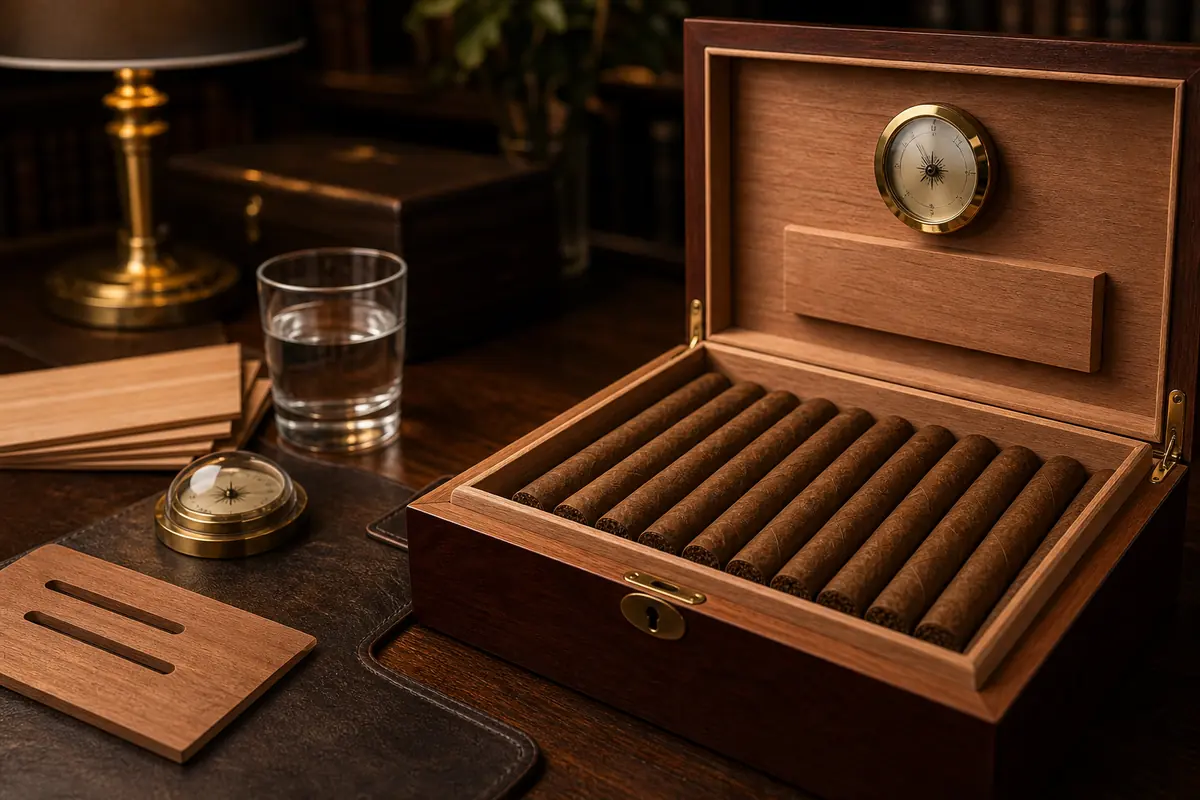
How to Age Cigars at Home
Aging cigars is simple: maintain 65-67% humidity at 65-70°F in a dark, sealed container with Spanish cedar, and wait. The minimum useful aging period is 6 months. At 2-3 years, transformation becomes obvious — pepper mellows, sweetness deepens, and flavors marry into something more cohesive than the cigar's original release. No special equipment needed beyond what you already use for storage.
Aging works because tobacco is a fermented product that continues evolving after the cigar is rolled. Oils migrate between filler leaves, ammonia and harsh compounds dissipate, and complex flavor molecules develop through slow oxidation. A cigar aged 3 years tastes noticeably different from the same cigar smoked fresh — smoother, rounder, with flavors that blend rather than compete.
The Conditions
Humidity: 65-67% RH
Slightly lower than the 69-70% most smokers maintain for daily-smoking inventory. Lower humidity slows mold risk during long storage and produces slightly firmer cigars with more concentrated flavors. Boveda 65% packs are ideal for aging containers. The difference between 65% and 69% is subtle over months but meaningful over years.
Temperature: 65-70°F (18-21°C)
Cooler temperatures slow aging (more control, less risk) while warmer temperatures accelerate it (more risk of beetles and mold). Above 75°F, tobacco beetle eggs can hatch — destroying entire collections. Below 60°F, aging essentially pauses. A climate-controlled room or basement works. Avoid garages, attics, or any space with temperature swings.
Darkness
UV light degrades wrapper oils over time, bleaching color and reducing flavor. Opaque containers are better than glass-top humidors for long-term aging. If your humidor has a glass top, keep it in a closet or cover the glass.
Airflow
Minimal but not zero. A sealed container prevents drying but stagnant air risks localized moisture buildup. Opening your aging container once a month for inspection provides enough air exchange. Don't ventilate actively — you'll lose humidity.
Which Cigars Age Well
Best candidates for aging:
- Full-bodied cigars with pepper and spice — these mellow dramatically, revealing underlying sweetness
- Well-constructed cigars from established brands — cheap cigars with poor filler selections don't improve
- Maduro-wrapped cigars — the sugar-rich wrapper continues developing caramel notes
- Cuban cigars — historically the benchmark for aged cigars, many peak at 5-10 years
- Limited editions and special releases — often blended with aging in mind
Poor candidates for aging:
- Infused/flavored cigars — artificial flavoring dissipates over time, leaving bland tobacco
- Mild Connecticut-wrapper cigars — already smooth and mild, aging just makes them thinner and less flavorful
- Cheap machine-made cigars — no amount of time fixes bad leaf selection
- Cigars you didn't enjoy fresh — aging mellows but doesn't fix fundamental blend problems
The Timeline
- 0-6 months: "Sick period" — newly purchased cigars may have been stressed from shipping and temperature changes. Rest them in your humidor for at least 2-4 weeks before smoking. This isn't aging — it's recovery.
- 6-12 months: Subtle smoothing. Ammonia and harshness dissipate. The cigar you buy today is slightly better in 6 months.
- 1-2 years: Noticeable mellowing. Pepper recedes, creaminess increases. Flavors start marrying. Worth the wait for premium sticks.
- 2-5 years: The sweet spot for most premium cigars. Significant transformation — harsh young cigars become smooth and complex. Flavors fully integrated.
- 5-10 years: Peak for many Cuban and full-bodied Nicaraguan cigars. After this point, some cigars begin losing vibrancy — flavors that were once bold become muted. Not all cigars improve past 5 years.
- 10+ years: Diminishing returns for most cigars. Some exceptional sticks (Padrón Anniversary, certain Cubans) continue improving. Most have plateaued or begun declining.
Practical Setup for Home Aging
You don't need a separate "aging humidor." Any of these work:
Dedicated tupperdor: A separate sealed container with Boveda 65%, Spanish cedar planks, used only for aging stock. Label it with dates. Cost: $15-20.
Coolerdor with aging section: Divide your coolerdor — active smoking inventory on one side, aging stock on the other separated by a cedar divider. Use Boveda 65% for the aging section.
Separate small humidor: A dedicated 25-50 count desktop humidor for aging only, seasoned and maintained at 65%. Kept in a cool, dark closet.
Label every cigar or box with the date you acquired it. Memory is unreliable over years — you won't remember when you bought that box of Padrón 1926 without a note. Masking tape and a Sharpie on the cellophane works perfectly.
Common Aging Mistakes
Smoking them all before they age. The most common failure. Buy in quantity if you plan to age — at least 5 of the same cigar so you can sample one per year while the rest develop.
Humidity too high. 70%+ for long-term storage increases mold risk exponentially. Drop to 65% for aging — your cigars don't need the extra moisture when they're not being smoked soon.
Temperature swings. Consistent temperature matters more than exact temperature. A steady 72°F is better than fluctuating between 65°F and 78°F daily. Thermal cycling stresses the tobacco.
Aging cigars you don't enjoy. Aging mellows a cigar but doesn't change its fundamental character. If you hate a cigar's flavor profile today, you'll merely dislike it less in 3 years. Age cigars you already love — they'll become cigars you love more.
Need storage setup guidance? Our humidor alternative guide and humidor buying guide cover the physical containers. For aging-worthy recommendations, browse our full-bodied picks — all excellent aging candidates.
What Happens During Aging
Aging allows chemical changes within tobacco that improve smoking quality. Ammonia compounds produced during fermentation continue dissipating over months and years, removing harshness that freshly boxed cigars sometimes exhibit. Oils within the tobacco migrate between filler, binder, and wrapper leaves, creating a more unified flavor profile where previously distinct components blend into a cohesive whole. Tannins in the wrapper leaf mellow similarly to how wine tannins soften over time, reducing bitterness and revealing underlying sweetness previously masked by astringency.
Not all cigars improve with age. Mild, light-bodied cigars with Connecticut Shade wrappers typically peak within 1-2 years because their delicate flavors can actually fade rather than develop over extended aging. Full-bodied cigars with oily wrappers and complex filler blends benefit most from long-term aging, with some improving for 5-10 years or longer. The general rule: the more complex and full-bodied the cigar, the more aging potential it possesses, because there are more flavor compounds available to undergo beneficial transformation over time in proper storage conditions.
Monitoring Your Aging Collection
Keep records of what you store and when you stored it. A simple spreadsheet or notebook tracking brand, vitola, box date, storage date, and periodic tasting notes lets you track how specific cigars evolve over time. Pull one cigar from a box every 6-12 months to assess progress and document changes. This longitudinal tasting approach teaches you which cigars in your collection are improving, which have peaked, and which have begun declining past their optimal window.
Temperature stability matters more than specific temperature during aging. Fluctuations cause wrapper expansion and contraction that can create micro-cracks over years. A basement or interior closet with minimal temperature variation provides better aging conditions than a climate-controlled room that cycles between heating and cooling. Target 65-70 degrees Fahrenheit with less than 5-degree daily variation for optimal long-term aging results. If your environment varies more than that, consider insulated cabinets or coolers converted to aging storage that buffer external temperature changes.
Step by step
- Select aging candidatesChoose full-bodied, well-constructed cigars from quality brands. Buy at least 5 of the same cigar to sample over time.
- Set up aging storageDedicated tupperdor or coolerdor section with Boveda 65% packs and Spanish cedar. Dark, cool location (65-70°F).
- Label with datesMark every cigar or box with acquisition date using masking tape and marker. You won't remember in 2 years.
- Monthly inspectionOpen container once monthly. Check for mold (white/green fuzzy spots), beetles (tiny holes in wrappers), and Boveda pack condition. Replace spent packs.
- Sample annuallySmoke one cigar from each aging set per year. Note flavor changes. When a cigar reaches its peak (no longer improving), smoke the remaining stock.
Frequently asked questions
Does the cellophane stay on during aging?
Either works. Cellophane slows aging slightly by reducing air contact, but also protects against humidity spikes and prevents flavor transfer between different brands. Most aging purists remove it; most practical collectors leave it on.
Can cigars go bad from too much aging?
Yes. Past their peak, cigars lose vibrancy and become flat or musty. The timeline varies — some peak at 3 years, others at 10. There's no universal rule. Sample periodically to track development and smoke them at their best.
Do I need to rotate cigars during aging?
Not necessary for boxes stored flat. For single cigars in a humidor, some smokers rotate top-to-bottom quarterly to ensure even humidity exposure, but this is debated. More important: make sure your humidity source reaches all cigars.
Is a wine fridge good for cigar aging?
Temperature-wise, excellent — wine fridges maintain 55-65°F consistently. But they need a separate humidity source (Boveda packs) and you must disable the cooling fan if it's too aggressive. Popular setup among serious collectors with large collections.
Community tasting notes
No community notes yet. Be the first to share how this smoked for you.
Log in to share your tasting notes and photos.