
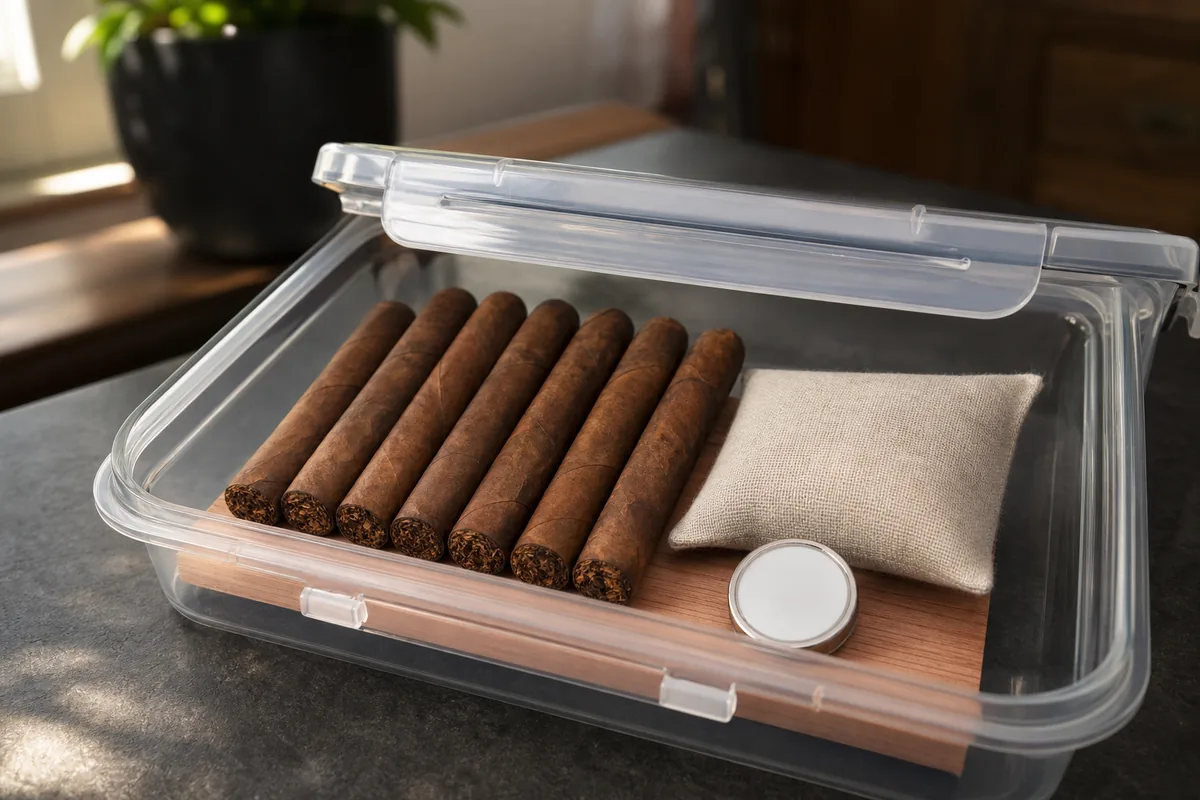
How to Store Cigars Without a Humidor
A sealed Tupperware container with a Boveda 69% pack inside maintains humidity as well as any $100 wooden humidor — often better, because the airtight plastic seal has zero leakage. This is called a "tupperdor" and it's the most popular humidor alternative among serious cigar enthusiasts. Don't let the unromantic appearance fool you: your cigars don't care about aesthetics.
Wooden humidors look great on a desk. They also leak, require seasoning, need seal maintenance, and cost $50-200 for the same job a $10 Tupperware container does. If you're starting out or storing a large collection, non-traditional storage isn't a compromise — it's often an upgrade.
The Tupperdor
What You Need
- An airtight food storage container (Sistema, Lock & Lock, or any brand with a rubber gasket seal)
- Spanish cedar strips or a cedar tray (optional — adds aroma and buffer)
- Boveda 69% humidity packs (one per 25 cigars)
- A small digital hygrometer ($15-20) to verify humidity
Setup
Place cedar strips on the bottom (if using), add your cigars, drop in the Boveda pack(s), close the lid. Check the hygrometer after 24 hours. If it reads 65-70%, you're done. Total cost: $15-30 including Boveda and hygrometer. Time to set up: 5 minutes. No seasoning required because plastic doesn't absorb moisture like wood does.
Why It Works
Humidity control is simple physics: a sealed container + a two-way humidity source = stable environment. The container material doesn't matter for humidity maintenance — only the seal matters. Plastic seals better than wood. Boveda packs regulate better than foam humidifiers. The combination outperforms most traditional humidors under $150.
The Coolerdor
Same principle as a tupperdor, scaled up. A small cooler (28-48 quart Igloo or Coleman) serves as bulk storage for 100-300 cigars. The insulated walls add temperature stability as a bonus — your cigars stay cool even if room temperature fluctuates.
Setup
- Clean the cooler interior with baking soda and water (remove any plastic smell)
- Let it air-dry completely (2-3 days with lid open)
- Line with Spanish cedar sheets or planks (optional but recommended for aroma)
- Add Boveda 69% packs: one 60-gram pack per 25 cigars
- Place hygrometer inside, close lid
Coolerdors are the standard solution for collection growth. When your 50-count humidor fills up, you don't buy a bigger humidor — you buy a $20 cooler and store 200 cigars with better seal integrity than a $500 cabinet humidor.
Ziploc Bag (Emergency Only)
A gallon Ziploc bag with a Boveda pack works for temporary storage — under 2 weeks. It's not airtight (Ziploc seals leak slowly) and offers zero physical protection. But if you just bought cigars and don't have a humidor yet, this keeps them alive until your tupperdor or humidor arrives. Not a long-term solution.
What About the Cigar Box They Came In?
Cigar boxes are designed for retail display and short-term shop storage — not home aging. They're not sealed, they don't maintain humidity, and once you open them, the cigars begin drying out within days. If you buy a box of cigars, transfer them to proper storage immediately. Keep the box for display or organization inside your tupperdor/humidor.
Long-Term Aging in Alternative Storage
Cigars age beautifully in tupperdors and coolerdors — many collectors have aged sticks for 5-10 years in sealed plastic with Boveda packs. The process is identical to wooden humidor aging: stable humidity + stable temperature + time = mellower, more complex flavors. Spanish cedar contact adds the aromatic development that wood humidors provide. The aging quality is indistinguishable.
The key factors for aging:
- Humidity: 65-67% (slightly lower than daily-smoking storage for better aging)
- Temperature: 65-70°F (avoid garages, attics, or anywhere with wild swings)
- Darkness: UV degrades wrappers over time. Opaque containers win over glass-top humidors.
- Patience: Minimum 6 months to notice aging effects. 2-5 years for significant transformation.
The Recommendation
Start with a tupperdor. It costs $15, works in 5 minutes, and outperforms most entry-level wooden humidors. If your collection grows past 50 cigars, add a coolerdor. Reserve wooden humidors for the desk display factor — if seeing your cigars in a beautiful box matters to you, buy one for your daily rotation and store the bulk elsewhere.
If you decide you do want a traditional humidor later, check our humidor buying guide. And don't forget the rest of your essential accessories — storage is step one, but you need a clean cut and proper light to enjoy what you've stored.
The Tupperdor Method
An airtight food-storage container with a Boveda humidity pack creates a functional humidor for under 20 dollars total. Choose a BPA-free container with a rubber gasket seal, Sistema, Lock and Lock, or Rubbermaid Brilliance work well. Drop in a 65% Boveda pack (the 60-gram size serves containers holding up to 25 cigars), place your cigars inside with their cellophane intact, seal the lid, and store in a cool dark location. This setup maintains proper humidity for 2-4 months before the Boveda pack needs replacement, indicated by the pack hardening as its moisture depletes.
For larger collections without a humidor, multiple containers organized by smoking priority work well. A bedside container holds this week's cigars for easy access. A closet container holds your aging reserve. Label containers with contents and date stored. This modular approach scales indefinitely by adding containers as your collection grows, without the single large investment that a quality wooden humidor requires.
Emergency Short-Term Storage
If you receive cigars and have no storage solution ready, several household items provide temporary protection for 24-72 hours. A ziplock bag with a damp (not wet) paper towel placed beside but not touching the cigars maintains adequate moisture for 1-2 days. A cooler with a shallow dish of water creates a humid microclimate lasting 2-3 days. Even wrapping cigars in a slightly damp cloth and placing them in a drawer provides 24-hour protection superior to leaving them exposed to dry room air.
None of these emergency methods work beyond 72 hours. After three days, moisture levels become either too high (risking mold from standing water) or too low (as improvised moisture sources deplete without replenishment). Use emergency storage only as a bridge until you can acquire proper humidity control through Boveda packs and an airtight container. At minimum cost of 12-15 dollars for container plus Boveda, there is no practical reason to rely on emergency methods beyond the time needed to receive an online order of proper supplies.
What Not to Do
Never store cigars in a refrigerator or freezer for humidity purposes. Refrigerators maintain 35-40% humidity which dries cigars rapidly. Freezers destroy cellular structure in tobacco leaves, causing irreversible cracking and flavor loss. Some people freeze cigars briefly to kill tobacco beetle larvae, but this is a specific pest-control measure performed carefully over 72 hours with gradual temperature transitions, not a storage solution.
Avoid placing cigars directly in plastic bags without humidity control. Sealed plastic without a moisture source creates a stagnant environment where any existing moisture condenses and redistributes unevenly, potentially causing mold on one side while the other dries. Always include a calibrated humidity source (Boveda, Heartfelt beads, or at minimum a damp sponge in a perforated container) with any sealed storage solution to prevent these problems.
Long-term storage without a traditional humidor is not only possible but increasingly common among modern cigar smokers. The tupperdor revolution demonstrated that Spanish cedar and expensive wood construction are optional luxuries rather than functional requirements. What cigars actually need is consistent humidity between 62-69 percent, stable temperature between 65-72 degrees, darkness to prevent UV degradation of wrapper oils, and airflow sufficient to prevent stagnant moisture pockets. Any container meeting these four criteria stores cigars effectively regardless of whether it cost 10 dollars at a grocery store or 500 dollars from a cigar accessory retailer with fancy branding.
Step by step
- Get an airtight containerSistema, Lock & Lock, or any food container with a rubber gasket seal. Size: at least 2-3 liters for 20-30 cigars.
- Add cedar (optional)Place Spanish cedar strips or a thin cedar sheet on the bottom. This adds aroma and humidity buffering.
- Add Boveda packsOne 60-gram Boveda 69% pack per 25 cigars. Drop it in — no activation or setup needed.
- Place cigars and hygrometerLay cigars inside, place a small digital hygrometer on top. Close the lid.
- Verify after 24 hoursCheck hygrometer reads 65-70%. If so, you're set. If too low, add another Boveda pack. If too high (unlikely in plastic), crack the lid for 30 minutes.
Frequently asked questions
Will plastic affect cigar taste?
No. Airtight food-grade plastic is inert and doesn't off-gas at room temperature. Your cigars taste only of their own tobacco and any cedar you include. Clean new containers with baking soda to remove factory smell, then air-dry for a day.
How long can cigars last in a tupperdor?
Indefinitely, as long as Boveda packs are replaced when spent (every 2-4 months). Many collectors store cigars in tupperdors for 5-10+ years with no degradation. Check humidity monthly.
Do I need Spanish cedar in a tupperdor?
Not strictly necessary. Cedar adds a pleasant aroma to aging cigars and provides a small humidity buffer. Without it, cigars are still fine — just slightly less aromatic aging character. Cedar strips cost $5-10 and are worth adding.
Can I mix different cigar brands in one tupperdor?
Yes for short-term storage (under 6 months). For long aging, strong-flavored cigars (infused, fire-cured) can influence milder ones in the same container. Separate infused cigars from traditional ones.
Community tasting notes
No community notes yet. Be the first to share how this smoked for you.
Log in to share your tasting notes and photos.