
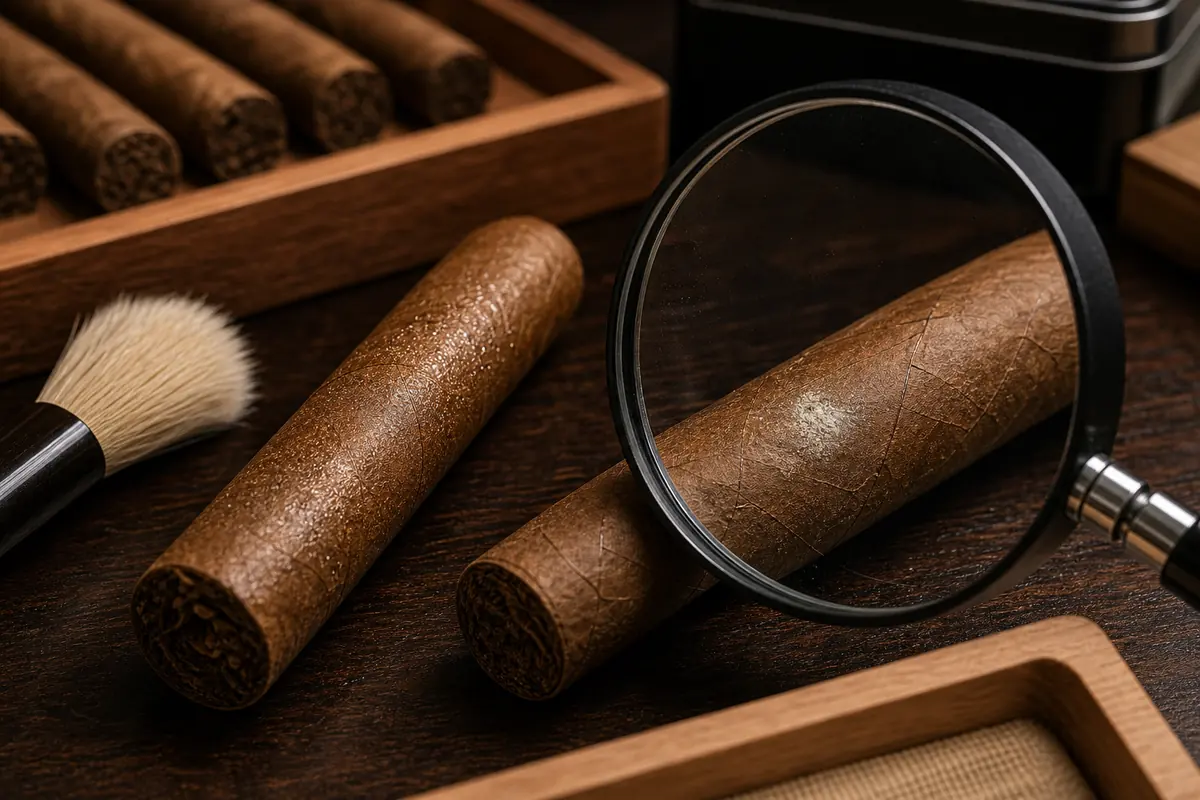
What Is Cigar Plume vs Mold (And How to Tell the Difference)
If you see white spots on your cigars, it's almost certainly mold — not plume. The cigar community spent decades claiming white crystalline deposits were "plume" or "bloom" (a sign of proper aging), but modern analysis shows that most supposed plume is actually mold in early stages. True crystallization of tobacco oils exists but is rare, subtle, and looks nothing like what most people photograph as plume.
The Blunt Truth About Plume
For years, the industry narrative was: white powder on cigars = plume (good), fuzzy white spots = mold (bad). This distinction was largely wishful thinking. Microscopic analysis of "plume" samples has consistently revealed mold structures rather than crystallized oils. The cigar community is slowly accepting this reality, but old information persists everywhere.
Our stance: treat any white deposit on your cigars as mold until proven otherwise. You lose nothing by being cautious. You can lose an entire collection by assuming mold is harmless plume.
What Mold Looks Like
- White fuzzy spots: Three-dimensional, cotton-like texture. Looks like tiny cotton balls or spider webbing when examined closely.
- Blue-green patches: More advanced mold growth. If you see color, it's definitely mold — no ambiguity.
- Concentrated on one area: Often starts at the foot (exposed tobacco) or near the band (moisture collects at band edges).
- Spreads between cigars: If multiple cigars in proximity develop spots, it's mold spreading via spores.
- Smells musty: Heavily molded cigars develop a musty, damp smell distinct from tobacco aroma.
What Actual Crystallization Looks Like (Rare)
- Flat, uniform sheen: Not raised bumps or fuzzy spots. A slight whitish sheen across the wrapper surface — almost like dried mineral water.
- Consistent coverage: If real, appears evenly across the cigar rather than in concentrated spots.
- Does not wipe off easily: Crystallized oils bond to the wrapper. Mold wipes off with a finger.
- No three-dimensional structure: Under magnification, crystals are flat/geometric. Mold has branching filaments (hyphae).
If you have a magnifying glass or phone macro lens, the difference is clear at 10x magnification. Mold shows filament structures; crystals show geometric patterns.
The Simple Test
- Wipe it with your finger. If it brushes off easily, it's mold. Crystallized oils don't brush away cleanly.
- Look at structure. Fuzzy, raised, three-dimensional = mold. Flat, sheen-like = possibly crystallization (but still probably mold).
- Check humidity. If your humidor has been running above 72% RH, it's mold. Period. Crystallization doesn't require excess humidity.
- Check spread pattern. Appearing on multiple cigars near each other = mold spreading via spores. Independent deposits on well-separated cigars are more ambiguous.
What to Do With Molded Cigars
Light Surface Mold (White Spots, Limited Area)
- Isolate immediately. Remove affected cigars from your humidor to prevent spore spread.
- Wipe gently with a dry cloth or paper towel. Remove visible mold from the wrapper surface.
- Inspect the foot. If mold has penetrated the foot and is visible on the filler tobacco, the cigar may be compromised internally.
- Quarantine 2 weeks. Store wiped cigars separately (sealed bag with Boveda) and check for regrowth. If mold returns, the root isn't solved.
- Clean your humidor. Wipe interior surfaces with a lightly dampened cloth (distilled water only — no soap, no chemicals). Allow to dry completely before restocking.
- Lower humidity. Drop to 63-65% RH. Mold grows above 72-75% — your target should be well below that threshold.
Heavy Mold (Blue-Green, Extensive Coverage, Internal Growth)
Discard the cigar. Once mold has penetrated internally (visible at the foot, between wrapper layers, or if the cigar smells musty throughout), no amount of surface cleaning helps. The mycelium network is inside the tobacco. Smoking heavily molded cigars can introduce mold spores to your lungs.
Preventing Mold
- Keep humidity at 65-68% RH. The 70% target that was standard for decades is too high for mold prevention. Modern consensus favors 62-67%.
- Ensure air circulation. Stagnant air promotes mold. Don't pack humidors so tight that air can't circulate between cigars.
- Temperature control. Higher temperatures accelerate mold growth. Keep below 72°F.
- Inspect monthly. Catch mold early before it spreads. A monthly visual check of your collection takes 5 minutes and can save hundreds of dollars in cigars.
- Don't introduce contaminated cigars. New purchases from questionable sources can carry dormant spores. Inspect before adding to your main humidor.
- Spanish cedar helps. Cedar naturally inhibits (doesn't prevent) mold growth. Cedar-lined humidors have lower mold incidence than unlined containers.
Can You Smoke a Cigar That Had Mold?
Light surface mold that was completely wiped off: yes, most smokers do. The mold was on the wrapper surface and didn't penetrate. Monitor flavor — if the first third tastes musty or off, put it down.
Internal mold or extensive coverage: no. Burning mold doesn't neutralize all compounds, and the flavor will be compromised regardless. The $8-15 cost of a cigar isn't worth the risk or the bad experience.
For proper humidity management: managing humidity in different climates. For storage fundamentals: storing cigars without a humidor.
What to Do If You Find Mold
If you discover mold on cigars in your humidor, act immediately. Remove all affected cigars and inspect each one individually under bright light. Surface mold that hasn't penetrated the wrapper can sometimes be wiped off with a slightly damp cloth and the cigar salvaged. If mold has penetrated into the foot or appears inside the wrapper when you inspect the open end, discard the cigar entirely. The mycelium network extends deeper than visible surface growth and will affect taste even if you remove what you can see.
After removing affected cigars, clean your humidor thoroughly. Wipe interior cedar with a cloth dampened in a solution of equal parts distilled water and isopropyl alcohol. Let the humidor air dry completely for 24-48 hours with the lid open before returning any cigars. Inspect your humidity control system: mold indicates excess moisture, so reduce your target RH by 3-5% from whatever level produced the outbreak. Replace your Boveda packs or recalibrate your humidity source to prevent recurrence.
Prevention Strategies
Mold prevention starts with proper humidity management between 62-68% relative humidity. Exceeding 72% creates conditions where mold thrives regardless of other factors. Air circulation within your humidor helps prevent stagnant moisture pockets where mold colonies establish first. If your humidor lacks passive airflow, briefly opening the lid once daily for 30 seconds introduces fresh air and disrupts the still conditions mold requires.
New cigars entering your humidor can introduce mold spores from shop conditions. Inspect any new purchase before adding it to your collection. If buying from unfamiliar retailers or humid climates, quarantine new cigars in a separate container for 2-3 weeks before introducing them to your main humidor. This isolation period reveals any dormant mold issues without risking contamination of your existing collection. Think of it as a quarantine protocol that protects your investment in aged and rare cigars from a single contaminated newcomer.
The Plume Debate in the Community
The existence of plume (crystallized tobacco oils appearing as white bloom on aged wrappers) remains hotly debated among cigar enthusiasts and scientists. Traditional cigar wisdom held that white dusty coating on aged cigars indicated proper long-term storage and desirable chemical changes in the tobacco. Recent microscopic analysis by cigar scientists and hobbyists has challenged this, suggesting that many cases of supposed plume are actually benign mold colonies. The debate continues without definitive resolution, but the practical advice remains the same regardless of which camp is correct.
Whether the white substance on your aged cigar is crystallized oil or harmless mold, the protocol is identical: gently wipe it off with a soft brush or cloth and smoke the cigar normally. If it smells musty or off, discard it. If it smells like tobacco and lights cleanly, enjoy it. Getting caught up in the plume-versus-mold argument matters less than trusting your nose and the cigar's smoking characteristics to tell you whether it remains enjoyable after whatever cosmetic changes time has produced on the wrapper surface.
Frequently asked questions
Is plume real or a myth?
Crystallization of tobacco oils is theoretically possible and may occur on aged cigars, but the vast majority of what smokers have identified as 'plume' has been shown to be mold under microscopic examination. The safe assumption: if you see white deposits, treat as mold.
Will smoking a lightly molded cigar make me sick?
Unlikely from a single cigar with surface mold that was wiped off. The combustion temperature kills most mold organisms. However, heavily molded cigars with internal growth could introduce spores to your respiratory system. Not worth the risk with extensive mold.
My entire humidor has mold — what do I do?
Remove all cigars. Wipe each cigar individually, separating heavily molded from lightly affected. Clean the humidor interior with distilled water cloth and let dry 48 hours. Re-season at lower humidity (63-65%). Reintroduce only clean cigars. Lower your humidity target going forward. Check your seal — if the humidor isn't airtight, ambient humidity may be the cause.
Can I prevent mold with anything besides humidity control?
Spanish cedar naturally inhibits mold. Proper air circulation helps. Some smokers use food-grade silica gel packets as emergency dehumidifiers. But humidity control is 90% of mold prevention — get that right and other measures are supplementary.
Community tasting notes
No community notes yet. Be the first to share how this smoked for you.
Log in to share your tasting notes and photos.