
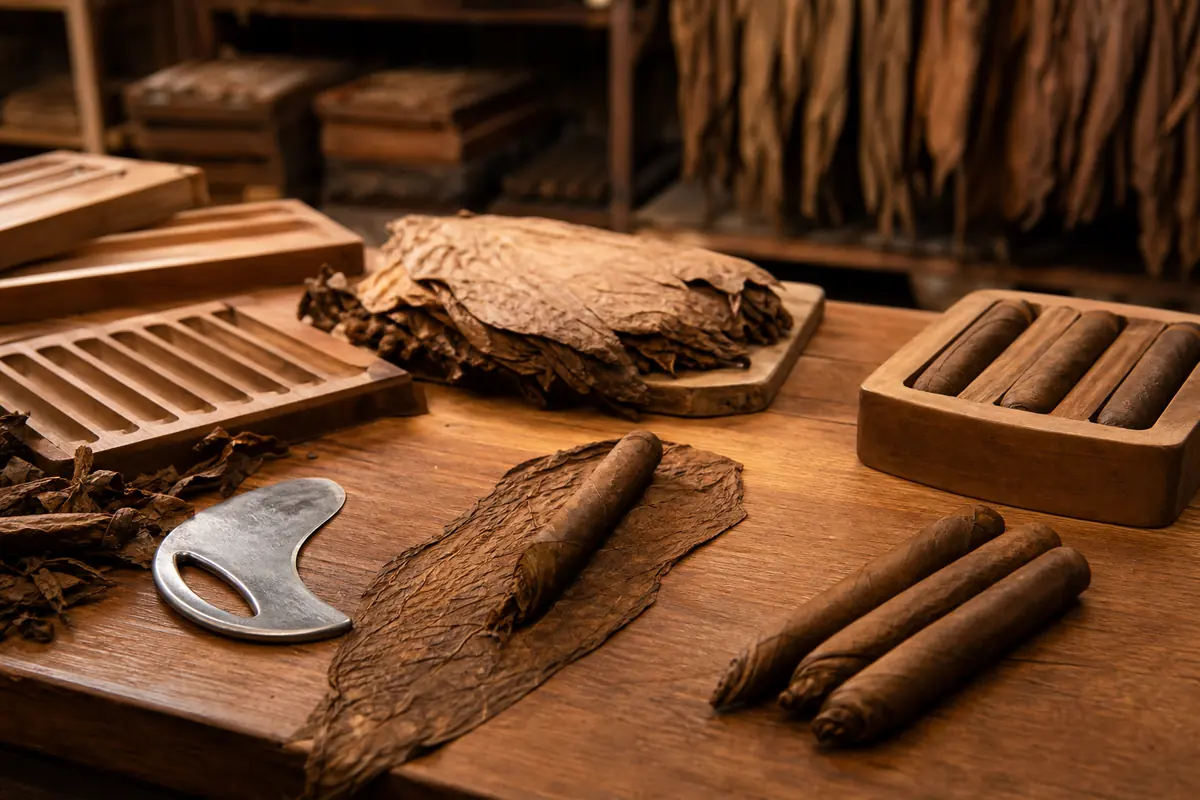
How Cigars Are Made in Factories
A premium handmade cigar takes about 200 manual steps from harvested leaf to finished product — and the process from seed to smoke spans 2-5 years. Factory production is where tobacco becomes a cigar, transforming aged, fermented leaves into a precisely constructed smoking instrument. The answer: inside.
Before the Factory: Preparation
By the time tobacco arrives at a cigar factory, it has already been through months of work:
- Curing (4-8 weeks): Harvested leaves hung in curing barns, changing from green to brown as chlorophyll breaks down and sugars develop.
- First fermentation (30-60 days): Leaves stacked in pilones (large piles) where heat generated by microbial activity transforms harsh compounds into smoother ones. Interior temperatures reach 100-140°F. Workers rotate leaves from center to edge to prevent burning.
- Aging (6 months to 5+ years): Bales of fermented tobacco rest in warehouses. Longer aging means smoother, more refined flavor. Premium brands age wrapper leaves 3-5 years before use.
Only after this extended preparation does tobacco enter the factory for cigar construction.
Stage 1: Leaf Selection and Sorting (Escogida)
Experienced sorters classify tobacco by:
- Color: Wrappers sorted into 60+ shade grades (claro through oscuro). A single cigar line might require one specific shade — every cigar in a box must match visually.
- Size: Leaves matched to the vitola (cigar size) they'll wrap. Larger cigars need larger wrapper leaves.
- Texture and thickness: Affects burn rate and flavor delivery. Thin, elastic wrappers for certain brands; thicker, oilier leaves for others.
- Tobacco type: Filler leaves sorted by priming position (ligero from top, seco from middle, volado from bottom) which determines strength, flavor, and combustion characteristics.
Sorting is done by hand, by experienced workers who've trained their eyes and fingers over years. There's no machine that can match a skilled sorter's ability to grade wrapper color consistency.
Stage 2: Blending (Liga)
The master blender (ligador) creates the recipe: which leaves, from which farms, in which proportions. A single cigar might contain 3-5 different tobacco types:
- Ligero: Top-priming leaves with the most sun exposure. Slow-burning, strongest flavor. Used sparingly for power.
- Seco: Middle leaves. Medium strength, best aroma. The flavor backbone of most blends.
- Volado: Bottom leaves. Mild flavor but excellent combustion. Ensures the cigar burns evenly.
The blender balances these to achieve target flavor, strength, and burn characteristics. Proportions are specific and proprietary — the same leaf types from the same farms produce different cigars depending on the blend ratio.
Stage 3: Rolling (Torcido)
This is the core skill. A torcedor/torcedora (roller) produces 80-200 cigars per day depending on size and complexity.
Bunch Making
- Filler leaves folded accordion-style ("booking") or gathered in a spiral ("entubado") — different methods affect draw
- Binder leaf wrapped around the filler bunch to hold shape
- Bunch placed in a wooden mold for 30-45 minutes to set shape
Wrapper Application
- Wrapper leaf trimmed and stretched by hand
- Applied in a spiral from foot to head with slight tension — too tight restricts draw, too loose causes unraveling
- Cap constructed: flag cap (single piece folded) or triple cap (three layers) depending on tradition
- Vegetable-based pectin or gum adhesive applied sparingly to seal the cap
The entire rolling process takes 2-4 minutes for a skilled roller. But those minutes represent years of muscle memory — consistent tension, even spiral spacing, and invisible seams distinguish master rollers.
Stage 4: Quality Control
Multiple inspection points:
- Draw test: Every cigar tested with a draw machine (measures airflow resistance). Too tight or too loose = rejected. Acceptable range: 1.5-3.5 on standard draw scales.
- Visual inspection: Wrapper veins, color consistency, cap construction, overall shape. Imperfect cigars get pulled.
- Weight/firmness: Hand-squeeze test and scale verification. Underfilled or overfilled cigars rejected.
- Smoke test: Random samples from each roller's daily output are smoked by quality control staff who evaluate burn, draw, ash, and flavor.
Rejection rates at premium factories run 15-30% — a significant portion of production never reaches consumers.
Stage 5: Aging Room (Escaparate)
Finished cigars rest in the factory's aging room for 21 days minimum (Cuban standard) to several months. This "marriage" period allows the different tobaccos to meld flavors and equalize moisture content. Without this rest, individual tobacco components taste disjointed.
Stage 6: Color Grading and Banding
Before boxing, cigars pass through the color grader (escogedor) — a specialist who arranges cigars in each box from darkest (left) to lightest (right) in a subtle gradation. Open any premium cigar box and you'll notice this gradient. It's purely aesthetic but represents the pride factories take in presentation.
Bands are applied by hand, cigar labels placed, and boxes sealed with warranty codes for authentication.
Factory Types
Cuban State Factories (Habanos S.A.)
Highly structured, union-operated, government-owned. Famous factories: Partagás (Havana), El Laguito (Cohiba), H. Upmann. Rollers are trained in national programs and earn government salaries. Production quotas are set centrally.
Nicaraguan/Dominican/Honduran Factories
Privately owned, ranging from boutique (20 rollers) to industrial (500+ rollers). Major operations: Plasencia, AGANORSA, General Cigar, Tabacalera de García. Rollers are typically piece-rate employees — paid per cigar, incentivizing speed alongside quality.
Boutique vs. Mass Production
Boutique factories (Warped, RoMa Craft, Dunbarton Tobacco & Trust) produce under 500,000 cigars annually with hands-on blender oversight. Mass producers (General Cigar, Altadis) produce millions with more standardized processes. Both are handmade — the difference is scale of oversight, not necessarily quality.
For what each part of the finished cigar does: anatomy of a cigar. For how the tobacco itself is grown before reaching the factory: tobacco growing and harvesting.
The Human Element in Premium Production
Despite technological advances, premium cigar production remains fundamentally handcraft. A skilled torcedor (roller) produces 100-150 cigars per day, maintaining consistent draw, shape, and weight across every single stick. These artisans train for 6-12 months before rolling production cigars, learning to assess tobacco's moisture and elasticity by touch, judging filler bunch density by feel, and applying wrapper with even tension that prevents cracking. The best rollers at factories like Padron and Fuente have 20-30 years of experience and are treated as elite craftspeople within the manufacturing culture.
Quality control at premium factories involves multiple checkpoints. After rolling, each cigar passes through draw testing machines that measure airflow resistance. Cigars falling outside acceptable parameters are rejected, with rejection rates of 5-15% at top factories. Color sorting stations group cigars by wrapper shade within a single blend to ensure visual consistency within each box. The most experienced workers handle color sorting since shade differences between acceptable and reject-grade wrappers can be extremely subtle to untrained eyes.
From Factory Floor to Your Humidor
After production, cigars enter aging rooms where they rest for 30-90 days minimum before boxing. This rest period allows the different tobaccos to marry, producing a unified flavor rather than the disjointed character of freshly rolled cigars. Some premium lines like Padron 1926 and 1964 series receive years of additional aging at the factory, with the manufacturer absorbing the carrying cost of warehouse storage to deliver a more refined finished product to the consumer.
Boxing, banding, and cellophaning are the final production steps. Bands are applied by hand with vegetable-based adhesive. Cellophane sleeves, contrary to popular belief, are not plastic but a plant-based product that allows humidity exchange. Cigars are packed into boxes arranged by shade gradient from darkest on the left to lightest on the right, a traditional presentation standard that persists across all premium manufacturers regardless of country of origin.
Frequently asked questions
How long does it take to become a cigar roller?
In Cuba's formal program, 9 months of training followed by years of graduated difficulty — starting with simple vitolas and earning the right to roll premium sizes. In other countries, apprenticeships typically last 6-12 months before independent production. Master-level skill takes 5-10 years.
What's the difference between long filler and short filler cigars?
Long filler uses whole leaves running the length of the cigar — better draw, slower burn, more complex flavor. Short filler (tripa corta) uses chopped leaf fragments, like what's inside cigarettes but larger cut. Short filler is cheaper, burns hotter, and tastes simpler. Premium cigars are always long filler.
How many cigars does one factory produce daily?
Varies enormously. A boutique factory with 20 rollers: 2,000-3,000 cigars/day. A large factory with 400 rollers: 40,000-80,000/day. Cuba's entire industry produces roughly 80-100 million cigars annually across all factories.
Are machine-made cigars still made in factories?
Yes, but different facilities. Machine-made cigars (Swisher Sweets, Dutch Masters, Backwoods) use automated equipment producing thousands per hour. They use homogenized tobacco leaf (HTL) wrappers and short filler. Completely different process from handmade premium production.
Community tasting notes
No community notes yet. Be the first to share how this smoked for you.
Log in to share your tasting notes and photos.