
How to Smoke a Cigar: Complete Beginner's Guide
Don't inhale. Puff every 45-60 seconds. Let the cigar rest between draws. That's the foundation of cigar smoking — the rest is technique that improves your experience but isn't mandatory. If you do nothing else right, those three rules prevent the nausea, overheating, and bitterness that ruin most first cigars.
Cigars aren't cigarettes. You don't inhale the smoke into your lungs — you draw it into your mouth, taste it, and exhale. The pleasure comes from flavor on your palate, not nicotine absorption through your lungs. If you inhale a cigar, you'll cough violently, get extremely dizzy, and probably never try one again. Draw into your mouth only.
Step 1: Choose the Right First Cigar
Start mild. A Connecticut-wrapped Robusto from a reputable brand — Arturo Fuente Hemingway Short Story, Perdomo Champagne 10th Anniversary, or Ashton Classic. These are mild enough that even without perfect technique, you won't be overwhelmed by nicotine or harshness. Save full-bodied cigars for your 30th smoke, not your first.
Eat a meal 30-60 minutes before smoking. Food in your stomach buffers nicotine absorption. Even mild cigars deliver some nicotine through your mouth's mucous membranes — an empty stomach amplifies this effect dramatically.
Step 2: Cut
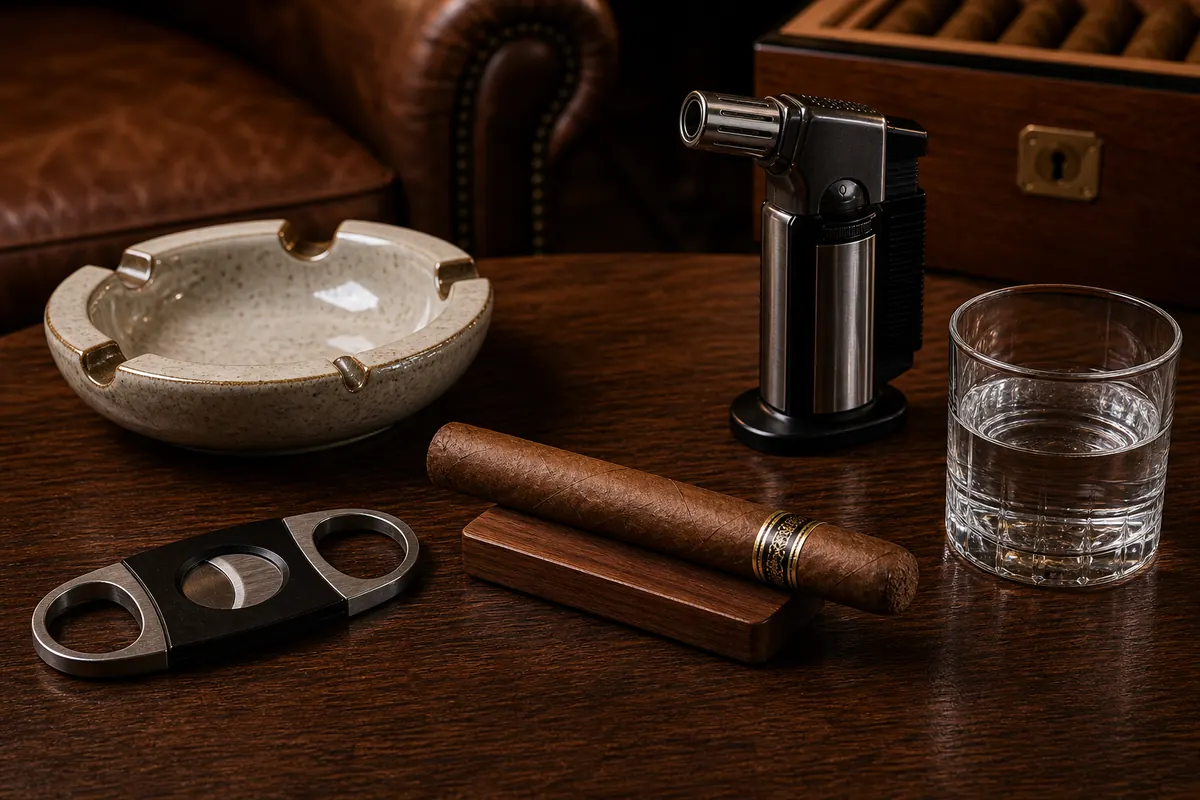
Use a guillotine cutter (any sharp double-blade cutter works). Place the blade just above the shoulder line — that's the visible ridge where the rounded cap meets the straight barrel. Cut in one swift, decisive motion. Don't saw or hesitate — a clean cut prevents wrapper cracking.
If you don't have a cutter: a sharp knife works in an emergency. Press the blade firmly and roll the cigar against it. Don't use your teeth — you'll tear the wrapper and ruin the draw.
Step 3: Light
Hold the cigar at a 45-degree angle. Toast the foot (flat end) with a lighter flame without touching the flame directly to the tobacco. Rotate the cigar while toasting — you want the entire foot surface glowing orange evenly before you start drawing.
Once the foot is toasted (30-45 seconds of rotation), bring the cigar to your mouth and take gentle puffs while continuing to hold the flame near the foot. After 3-4 draws, the cigar should be lit evenly across the entire foot. Check by looking at the lit end — you want a complete ring of glowing ash, not a half-lit side.
Butane torch lighters work best. Matches work too — let the sulfur burn off first (wait 3 seconds after striking). Never use a candle (wax fumes) or Zippo (naphtha taste).
Step 4: Smoke
Puffing Rhythm
One puff every 45-60 seconds. This isn't a suggestion — it's the pace that prevents overheating. Too fast (every 20-30 seconds) overheats the cigar, making it bitter and harsh. Too slow (every 2+ minutes) risks the cigar going out. Find the rhythm between these extremes.
How to Puff
Draw gently — like sipping through a straw, not sucking a milkshake through a thin straw. A gentle pull for 2-3 seconds fills your mouth with smoke. Hold it briefly (1-2 seconds), taste it on your palate, then blow out slowly through your mouth. You're tasting, not consuming.
What to Taste
Pay attention to what you perceive: is it sweet, spicy, earthy, creamy, bitter, nutty? Cigar flavors are subtle compared to food — you won't taste "chocolate" the way you taste chocolate cake. It's an impression, a direction. The more cigars you smoke, the clearer these impressions become.
Holding the Cigar
Hold between thumb and index finger, or between index and middle finger. There's no "correct" way — whatever feels natural and comfortable. Don't clamp it between your teeth for extended periods — saliva saturates the cap and the wrapper unravels.
Ashing
Don't tap ash off constantly like a cigarette. Premium cigar ash insulates the cherry and contributes to an even burn. Let it grow to 1-1.5 inches before gently rolling it off in an ashtray. The ash should fall naturally — if you're forcing it, it wasn't ready.
Step 5: When to Stop
Smoke as far down as you enjoy it. There's no rule that you must finish. Most smokers stop when the cigar gets hot and flavors turn harsh — typically 1-2 inches from the band. If it stops being pleasant, put it down. Set it in the ashtray and let it go out naturally — don't crush it like a cigarette (that creates an acrid smell).
Common First-Timer Mistakes
Inhaling: The most common mistake. If you're coughing or feeling chest discomfort, you're inhaling. Keep smoke in your mouth only.
Smoking too fast: Results in a hot, bitter, harsh cigar. If the cigar tastes bitter, you're puffing too often. Slow down and let it cool.
Choosing too strong a first cigar: Your buddy's Liga Privada is not a first cigar. Start mild. You can always go stronger later — you can't undo the nausea from a first cigar that's too powerful.
Not eating first: Nicotine on an empty stomach causes nausea, lightheadedness, and cold sweats. Eat a full meal. Keep a sugary drink nearby — sugar counteracts nicotine sickness quickly.
Ready to go deeper? Learn retrohaling to unlock more flavor, understand strength vs body vs flavor to buy smarter, and explore our recommended first cigars.
Your First Month: What to Expect
The first 5-10 cigars are a learning phase where technique matters more than cigar selection. Focus on three fundamentals: cut cleanly above the cap line, toast the foot evenly before your first puff, and maintain a puff every 45-60 seconds throughout the smoke. Everything else comes with experience. Do not worry about retrohaling, flavor note identification, or pairing beverages during your first month. Master the mechanics first, then layer sophistication onto a solid foundation of proper smoking habits.
Physical reactions during your first few cigars are normal and not cause for alarm. Mild lightheadedness from nicotine exposure unfamiliar to your system dissipates within 10-15 minutes if you set the cigar down and drink water. Tingling lips from nicotine absorption through oral mucosa is harmless and decreases as mild tolerance develops over your first 5-10 cigars. If you feel genuinely nauseous, eat something sweet immediately, drink water, and stop smoking for the day. These early-stage reactions disappear entirely within your first month as your body calibrates to occasional nicotine exposure.
Common Beginner Mistakes to Avoid
Inhaling cigar smoke into your lungs is the most common and most punishing beginner error. Cigar smoke is designed to be tasted in the mouth and expelled, never pulled into the lungs like cigarette smoke. Inhaling produces violent coughing, extreme nausea, and nicotine overdose symptoms because a single cigar contains 10-20 times more tobacco than a cigarette. Draw smoke into your mouth, taste it, exhale through your mouth. Never draw into your lungs.
Smoking too fast overheats the cigar and produces bitter, acrid flavors that lead beginners to conclude they don't like cigars when they actually don't like overheated cigars. One puff per minute is the target rhythm. Count seconds between puffs if you lack internal timing sense. Smoking too fast also concentrates nicotine delivery beyond comfortable levels for unacclimated beginners. Slow smoking produces cooler, smoother, more flavorful smoke while keeping nicotine delivery gentle enough for new smokers still building tolerance over their first few weeks of the hobby.
Step by step
- Choose a mild cigar and eat firstConnecticut-wrapped Robusto from a reputable brand. Eat a full meal 30-60 minutes before smoking.
- Cut just above the shoulderUse a guillotine cutter. One swift, decisive cut 1-2mm above the cap line.
- Toast and lightHold cigar at 45°, toast foot with flame while rotating (30-45 sec). Then draw gently while holding flame near foot. Ensure entire foot is lit evenly.
- Puff every 45-60 secondsGentle draw into mouth for 2-3 seconds. Hold briefly, taste, exhale through mouth. Don't inhale into lungs.
- Enjoy and stop when readyLet ash grow naturally. Stop when flavors turn harsh (usually 1-2 inches from band). Set in ashtray to go out — don't crush.
Community tasting notes
No community notes yet. Be the first to share how this smoked for you.
Log in to share your tasting notes and photos.