How to Touch Up a Cigar's Burn Line
When your cigar develops a slightly uneven burn — not a full canoe, just a section burning half an inch ahead of the rest — a touch-up is faster and less disruptive than a full relight. Hold your lighter flame briefly to the lagging section of the wrapper until it catches up. No puffing needed. Takes 3-5 seconds and preserves your flavor profile better than relighting the entire foot.
Touch-Up vs. Full Relight vs. Letting It Self-Correct
Three options when burn goes uneven:
Let It Self-Correct (Minor Unevenness)
If the differential is less than 1/4 inch, do nothing. Many cigars correct themselves as the slower-burning section catches up naturally. Rotate the cigar so the slow-burning side faces down (heat rises — bottom burns faster). Wait 2-3 puffs. If it evens out, problem solved without intervention.
Touch-Up (Moderate Unevenness)
If the differential is 1/4 to 1/2 inch and not self-correcting, apply flame directly to the lagging wrapper edge. This is the sweet spot technique — minimal intervention, maximum correction.
Full Relight (Severe Unevenness)
If the burn has gone truly sideways — canoeing, tunneling, or more than 1/2 inch differential — you need a full relight. Purge first (blow gently through the cigar), then toast the entire foot evenly. Our full uneven burn fix guide covers this in detail.
The Touch-Up Technique
Step 1: Identify the Lag
Look at your burn line. The section that's burning ahead isn't the problem — the section lagging behind is. You're going to apply heat to the slow section, not remove the fast section.
Step 2: Position Your Flame
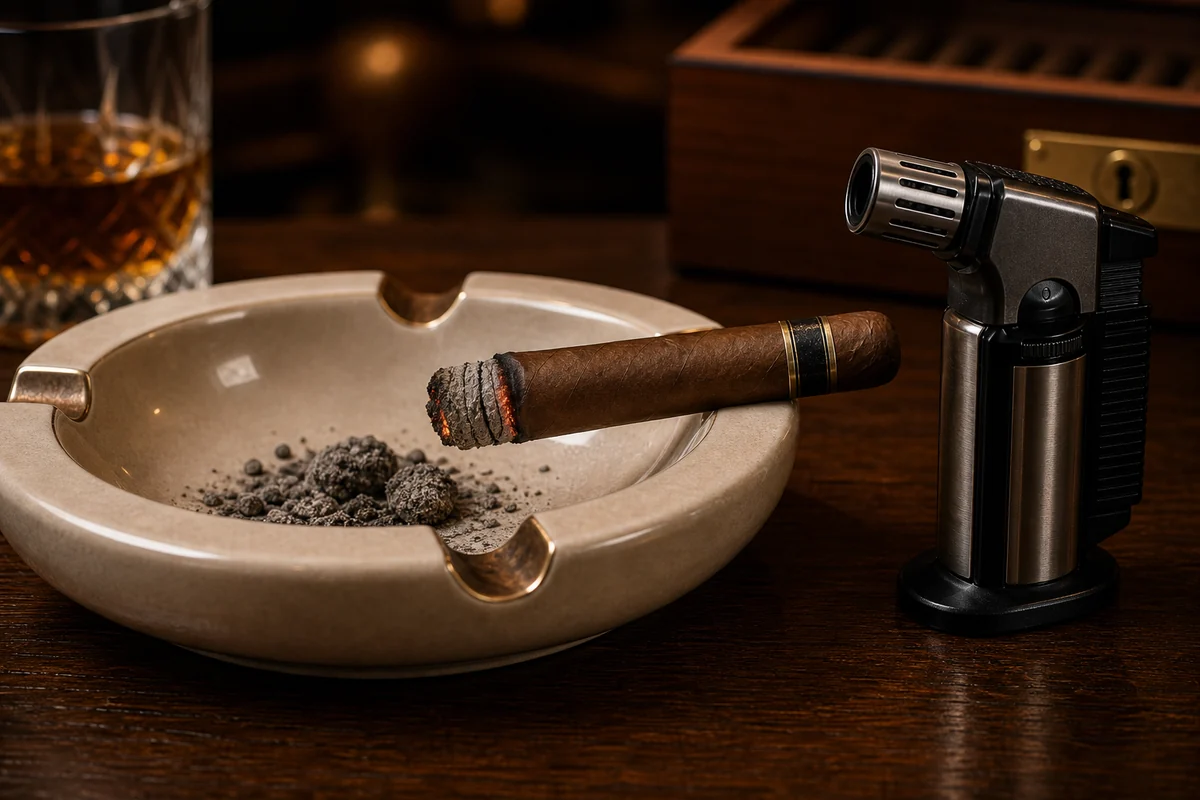
Use a soft flame lighter or cedar spill — torch lighters work but risk scorching the wrapper if you're not careful. Hold the flame 1/2 inch from the unburnt wrapper at the lagging edge. You want the tip of the flame's heat zone, not the blue core.
Step 3: Apply Heat Briefly
3-5 seconds. Watch the wrapper char and catch. You'll see the burn line start to even out. Don't hold the flame so long that you create a new hot spot — you're nudging, not torching.
Step 4: Don't Puff During Touch-Up
Keep the cigar out of your mouth during the touch-up. Drawing air through while applying flame to the side can superheat the filler and create harsh flavors. Let the wrapper catch on its own from external heat.
Step 5: Rotate and Wait
After the touch-up, rotate the cigar so the formerly-lagging side faces down (heat rises, bottom position burns slightly faster). Take 2-3 normal puffs and check. The burn should be tracking evenly now.
Common Touch-Up Mistakes
- Using a torch too close: Torch lighters at point-blank range scorch wrapper tobacco, creating a bitter char taste. Keep distance or use a soft flame for touch-ups.
- Over-correcting: If you apply too much heat to the lagging side, it'll overshoot and now that side is burning ahead. Brief application — 3-5 seconds max.
- Touching up too often: If your cigar needs constant correction, the problem isn't your technique — it's the cigar (construction issue, humidity problem, or wind exposure). Frequent touch-ups compound by creating multiple relit spots with altered flavor.
- Ignoring the cause: Wind hitting one side? Holding the cigar at an angle? The cigar over-humidified on one side? Fix the root cause or the burn will go uneven again after your correction.
When Touch-Ups Won't Help
Some burn issues can't be fixed with surface corrections:
- Tunneling: The center burns faster than the wrapper — you see a crater forming while the outer ring stays unlit. This is a humidity or construction issue. Purge and relight fully.
- Canoeing: A full-length burn differential where one side is half an inch or more ahead for the entire circumference. Too severe for a touch-up — full relight needed.
- Wrapper separation: If the wrapper is delaminating (peeling away from the binder), touch-up won't adhere it. The structural integrity is compromised.
Prevention Is Better
Touch-ups are a tool, not a habit. If you're touching up every cigar:
- Check your humidity — cigars at 70%+ RH burn unevenly more often
- Check your initial light — toast the entire foot evenly before first draw
- Check your environment — wind creates one-sided burns consistently
- Check your puff frequency — smoking too fast overheats one side
For prevention through proper lighting technique: how to properly light a cigar. For the full treatment on burn corrections: how to fix an uneven burn.
Prevention Through Proper Technique
Most burn corrections become unnecessary when initial lighting technique is correct. The most common cause of needing touch-ups: rushing the toasting phase and creating uneven initial combustion. Spending 20-30 full seconds toasting the foot with slow rotation before your first puff establishes even burn that often maintains itself throughout the entire cigar without further intervention. Think of those initial seconds as an investment that pays dividends across the following 45-60 minutes of maintenance-free smoking pleasure.
Puffing rhythm also determines touch-up frequency. Erratic puffing with long pauses followed by rapid chains creates temperature cycling that produces uneven burn. Consistent once-per-minute rhythm maintains steady combustion across the full diameter. If your lifestyle prevents consistent puffing (conversations, phone calls, eating while smoking), accept that occasional touch-ups are the natural consequence and keep your lighter accessible throughout the session rather than putting it away after initial lighting.
When Touch-Ups Indicate a Bigger Problem
Needing more than 2-3 touch-ups in a single cigar suggests an issue beyond technique. The cigar may be over-humidified with moisture preventing even combustion. It may have construction defects with uneven filler density creating variable burn rates. Or the wrapper may be significantly thicker on one side than the other, burning at different speeds around the circumference. Frequent touch-ups on multiple cigars from the same box suggest a storage or manufacturing issue rather than personal technique problems.
If one specific cigar in your rotation consistently requires touch-ups while others from different brands smoke perfectly, the issue is that product rather than your technique. Note the brand, vitola, and approximate date and move on. Life is too short to fight with poorly constructed cigars when thousands of well-made alternatives exist at every price point. A cigar requiring constant maintenance delivers diminished enjoyment regardless of its tobacco quality because frustration replaces relaxation as the dominant experience of the session.
The Quick Touch-Up Technique
For minor unevenness where one side leads by less than a quarter inch: do nothing but rotate the cigar so the slow side faces down. Gravity and natural heat convection often self-correct minor asymmetry within 3-4 puffs. For moderate unevenness exceeding a quarter inch: hold your lighter flame against only the lagging section for 2-3 seconds without puffing, then draw normally. For severe canoeing: rest the cigar for 2 minutes, then apply flame to the lagging side while simultaneously blowing gently outward through the head to push heat toward the correction area. One correction at each severity level is usually sufficient if performed patiently.
Keep perspective on burn perfection expectations. No handmade cigar burns with laser-straight precision throughout its full length. Minor wavering of the burn line by an eighth to a quarter inch is normal and does not require intervention. Touch-ups are warranted only when unevenness exceeds a quarter inch, when canoeing visibly destroys wrapper material on the fast-burning side, or when tunneling causes the interior to burn ahead of the exterior creating a hollow tube that will eventually collapse. Accepting normal imperfection while correcting genuine problems preserves your enjoyment without turning every smoke into a maintenance project that distracts from relaxation and conversation.
Step by step
- Identify the lagging sectionLook at the burn line — the section that hasn't burned as far is your target for heat application.
- Position flame at the lag pointHold a soft flame lighter or cedar spill about 1/2 inch from the unburnt wrapper at the lagging edge.
- Apply heat for 3-5 secondsWatch the wrapper char and catch. Brief application only — you're nudging the burn, not torching it.
- Don't puff during the touch-upKeep the cigar out of your mouth. Let the wrapper catch from external heat alone to avoid superheating filler.
- Rotate and take normal puffsTurn the formerly-lagging side down (heat rises). Take 2-3 normal puffs and verify the burn has evened out.
Frequently asked questions
How many touch-ups are too many for one cigar?
One or two across an hour-long smoke is normal — cigars aren't perfect machines. Three or more suggests a construction or humidity problem. More than that and you're fighting the cigar rather than enjoying it. Consider whether it's worth continuing.
Does a touch-up affect flavor?
Minimally. A brief wrapper touch-up introduces far less relit flavor than a full relight because you're only charring a small section of wrapper, not re-toasting the entire filler. It's the lightest intervention available.
Should I let my cigar go out and relight rather than touching up?
Different problems. If the cigar is burning fine but uneven, a touch-up keeps you smoking continuously. If you're putting the cigar down for 10+ minutes, let it go out and do a clean relight later. Don't touch-up a cold cigar — that requires a full relight.
Can I use a match for a touch-up?
Yes, but matches burn quickly and are awkward to hold sideways against a burn line. Cedar spills (strips of Spanish cedar) work better — they stay lit longer, produce clean flavor, and are easy to position precisely against a specific wrapper section.
Community tasting notes
No community notes yet. Be the first to share how this smoked for you.
Log in to share your tasting notes and photos.