
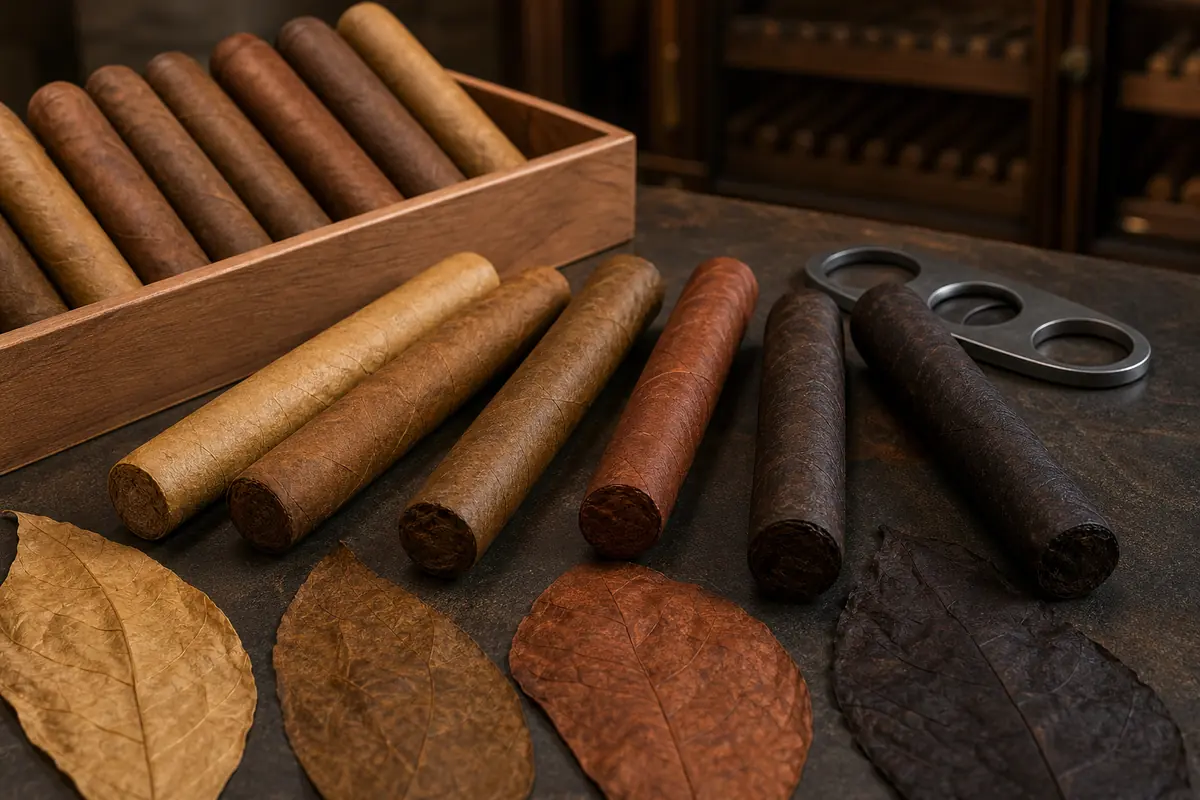
Cigar Wrapper Types Explained
Why does a Connecticut-wrapped cigar taste like cream while a Habano version of the same blend punches you with pepper? The wrapper contributes up to 60% of a cigar's flavor and determines your first impression before you even light up. Connecticut Shade gives you cream and smoothness. Habano delivers pepper and earth. Maduro brings chocolate and sweetness. Knowing wrapper types lets you predict what a cigar will taste like before buying - no guesswork, no wasted money on sticks that do not match your palate.
Wrappers are categorized by growing region, curing method, and color. The same seed planted in different soil produces different flavors — that's why "Connecticut Shade" grown in Ecuador tastes different from Connecticut Shade grown in actual Connecticut. Location matters as much as the leaf itself.
Connecticut Shade
The mildest common wrapper. Grown under shade cloth (cheese cloth or tapado) that filters sunlight, producing thin, light-colored leaves with minimal oils. Flavor: cream, light cedar, vanilla, sometimes a faint sweetness. Zero pepper on most examples.
Originally from the Connecticut River Valley (hence the name), but now grown extensively in Ecuador where similar conditions produce leaves at lower cost. Ecuadorian Connecticut tends slightly thicker and more flavorful than American-grown; both are mild but the Ecuadorian version has a bit more character.
Choose Connecticut Shade when: you want a no-challenge, smooth smoke. Morning cigars. Beginners. Pairing with light drinks.
Connecticut Broadleaf
Don't confuse this with Connecticut Shade — they're opposite ends of the spectrum. Broadleaf is grown in full sun, producing thick, oily, dark leaves with intense flavor. After maduro processing (extended fermentation), it delivers tar, sweetness, leather, and dark chocolate. Liga Privada No. 9 and T52 use Connecticut Broadleaf — that should tell you everything about its intensity.
Choose Broadleaf when: you want full-bodied richness and don't mind intensity.
Habano (Havana Seed)
Cuban-seed tobacco grown in non-Cuban countries — primarily Ecuador, Nicaragua, and Honduras. Habano wrappers are the backbone of medium-to-full cigars. Flavor: earth, red pepper, leather, sometimes a coffee note depending on origin. More textured and oily than Connecticut, with visible veins and a warm brown color.
Ecuadorian Habano is the most common — grown at altitude in Ecuador's cloud forests. It's slightly less aggressive than Nicaraguan Habano but still solidly medium-plus. Brands like My Father, Oliva, and Padron use various Habano wrappers extensively.
Choose Habano when: you want complexity and spice without going full-bodied. The "default" wrapper for experienced smokers.
Maduro
Maduro isn't a leaf variety — it's a process. Any wrapper leaf can be maduro'd through extended fermentation and/or additional primings (top leaves that get more sun). The extra fermentation converts starches to sugars, darkening the leaf from brown to near-black and adding sweetness.
Flavor: dark chocolate, espresso, dried fruit, caramel sweetness. Maduro wrappers are almost always fuller in body than their non-maduro counterparts from the same brand. A Padron 3000 Natural (medium) versus Padron 3000 Maduro (medium-full) — same filler, different wrapper, noticeably different experience.
Choose Maduro when: you want sweetness, richness, and depth. Evening cigars. Pairing with bourbon, port, or dark beer.
Cameroon
African-grown wrapper (originally Cameroon, now also Central African Republic) with a distinctive toothy texture — small bumps across the leaf surface. Thin, delicate, and difficult to work with, which is why fewer brands use it. Flavor: sweetness, nuts, light spice, and a unique aromatic quality that nothing else replicates.
Arturo Fuente uses Cameroon wrappers on their core lines and the legendary Hemingway series. The wrapper's natural sweetness complements Dominican filler beautifully.
Choose Cameroon when: you want something distinctive that sits in the mild-to-medium range with unique flavor. The connoisseur's "mild" wrapper.
Sun Grown
Any wrapper grown without shade cloth, exposed to full sunlight. Sun exposure causes the plant to produce more oils (natural sunscreen) and thicker leaves with more flavor. Sun Grown wrappers are almost always more flavorful and fuller-bodied than their shade-grown counterparts.
Flavor varies by region but generally: more pronounced spice, more body, more oils visible on the surface. Perdomo's Sun Grown lines and Oliva Serie O Sun Grown are accessible examples.
Choose Sun Grown when: you want more flavor than Shade without jumping to Maduro intensity.
Oscuro and Double Maduro
The darkest wrappers available — nearly black. Extended fermentation beyond standard maduro, producing an intensely sweet, almost syrupy quality. Rare because the process loses significant leaf material (many leaves don't survive the extended fermentation). When done well: dark fruit, molasses, espresso. When overdone: harsh, burnt, one-dimensional.
Sumatra
Originally from the Indonesian island of Sumatra but now grown extensively in Ecuador. Ecuadorian Sumatra wrappers are medium-brown, slightly oily, with refined flavor: cedar, mild spice, natural sweetness. The Oliva Serie V Melanio uses Ecuadorian Sumatra — it's an approachable wrapper that adds complexity without aggression.
Wrapper Color and Strength: The General Rule
- Claro (light tan): Mild — Connecticut Shade, some Cameroon
- Colorado Claro (medium brown): Mild-medium — Sumatra, light Habano
- Colorado (reddish brown): Medium — Habano, Sun Grown, Cameroon
- Colorado Maduro (dark brown): Medium-full — dark Habano, light Maduro
- Maduro (very dark brown/black): Full — Broadleaf, processed Maduro
- Oscuro (near-black): Full-plus — Double Maduro, extended fermentation
This is a guideline, not a rule — filler composition affects overall strength more than wrapper alone. But wrapper color gives you a reliable first guess about what to expect.
Ready to put this knowledge to use? Check our beginner picks (mostly Connecticut) or step up to medium-bodied cigars (Habano and Sumatra territory).
Emerging Wrapper Varieties
Beyond the established wrapper types, newer varieties are gaining market share among premium manufacturers. San Andres Mexican wrapper has exploded in popularity over the past decade, used by Drew Estate, AJ Fernandez, and Rocky Patel for its dark color, natural sweetness, and chocolate-forward character at lower cost than Connecticut Broadleaf. Arapiraca Brazilian wrapper appears in cigars from CAO, Villiger, and Rocky Patel, delivering cocoa and nut flavors with a distinctive mineral finish that sets it apart from Central American-grown alternatives.
Pennsylvania Broadleaf, once used primarily for chewing tobacco and machine-made cigars, has been rehabilitated by craft-focused brands like Foundation Cigar Company for premium wrappers with rustic character and bold earth flavors. Indonesian Besuki wrapper provides an affordable alternative to Cameroon with similar tooth texture and natural sweetness, appearing in many value-priced premium cigars where Cameroon's cost would push retail pricing beyond target margins.
How Wrapper Selection Affects Pricing
Wrapper leaf is the single most expensive component in cigar manufacturing because quality requirements are extreme. Only the top 10-15% of harvested leaves meet wrapper-grade standards for color uniformity, vein size, elasticity, and freedom from tears or spots. This rejection rate means wrapper tobacco costs 4-10 times more per pound than filler-grade tobacco from the same farm. Connecticut Shade from the Connecticut River Valley commands the highest prices at 25-40 dollars per pound wholesale due to shade-growing infrastructure costs and extremely low yield rates per acre.
Price sensitivity in the wrapper market directly affects what you pay at retail. When a manufacturer switches from domestic Connecticut Shade to Ecuadorian Connecticut, the cost savings of 5-8 dollars per pound at wholesale translates into a 1-2 dollar per cigar reduction at retail. This is why many brands that formerly used Connecticut Valley tobacco now source from Ecuador: the flavor profile is nearly identical but the economics are dramatically more favorable for both manufacturer and consumer at every price point in the supply chain.
Wrapper Care and Handling
Different wrapper types require different humidity levels for optimal storage. Thin wrappers like Connecticut Shade store best at 62-65% where they remain pliable without becoming soggy. Thick wrappers like Broadleaf and San Andres tolerate 65-69% without issues due to their density and oil content preventing excess moisture absorption. If you store multiple wrapper types in one humidor, target 64-65% as a compromise that keeps thin wrappers from cracking and thick wrappers from over-humidifying.
Frequently asked questions
Does wrapper really affect flavor that much?
Yes — up to 60% of perceived flavor comes from the wrapper because it's the outermost leaf burning directly against your palate. Filler determines overall strength and complexity, but wrapper sets the dominant flavor tone.
Why is the same wrapper grown in different countries?
Seed, soil, and climate interact to produce different results. Connecticut-seed grown in Ecuador produces a slightly different leaf than the same seed in actual Connecticut — different terroir means different flavor, even from identical genetics.
What wrapper should a beginner start with?
Connecticut Shade or Cameroon. Both are mild, smooth, and forgiving. Once comfortable, move to Habano for medium complexity. Maduro and Broadleaf come later when your palate can handle full-bodied flavors.
Can I tell cigar strength just by looking at the wrapper?
You can estimate. Darker wrappers generally indicate fuller body and more strength. But filler composition matters too — a dark wrapper on mild filler won't be as strong as expected. Wrapper color is a useful first guess, not a guarantee.
Community tasting notes
No community notes yet. Be the first to share how this smoked for you.
Log in to share your tasting notes and photos.