
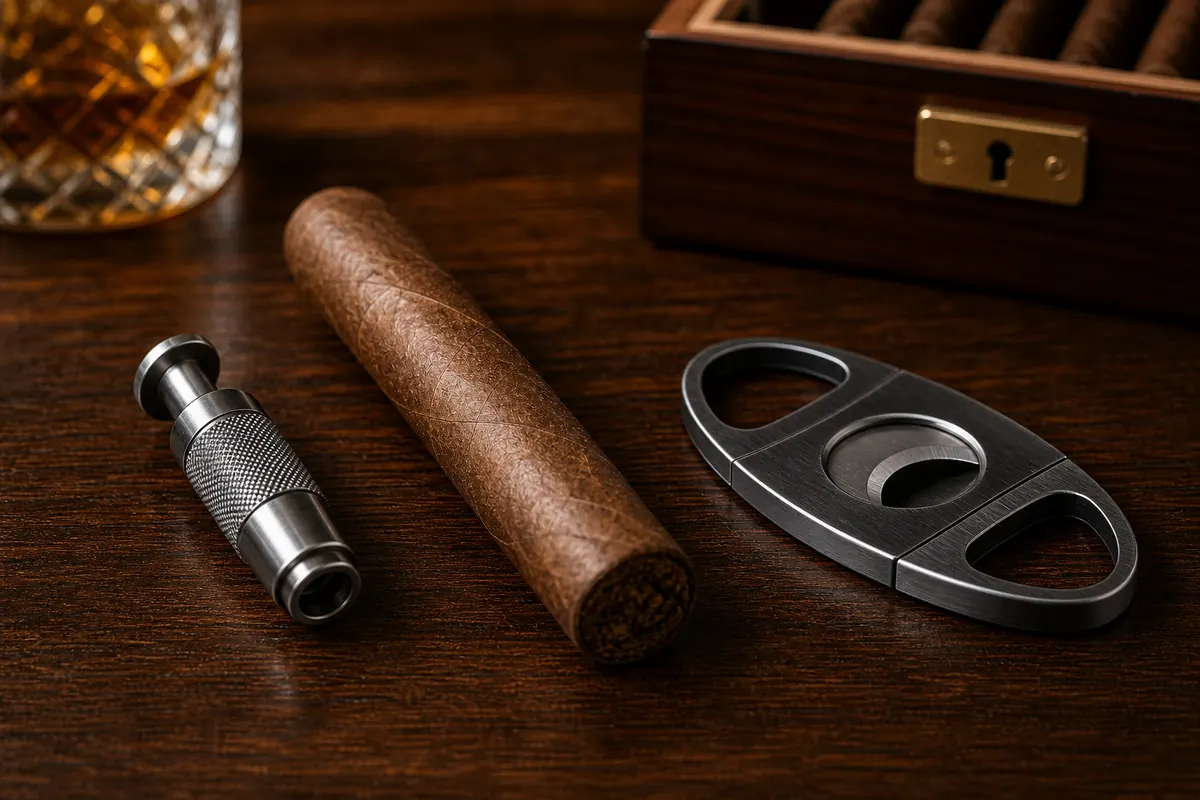
Cigar Punch vs Guillotine Cutter: Which to Use
A punch gives you a tighter, more concentrated draw with less tobacco on your lips. A guillotine opens the entire cap for full airflow. The right choice depends on the cigar's ring gauge and how you like your smoke to feel in your mouth.
Most smokers eventually carry both — but if you're picking one to start, here's how to decide.
How Each Cut Works
The Punch Cut
A punch cutter uses a circular blade to bore a small hole in the cap. You press it into the head, twist slightly, and pull away a plug of tobacco. The result is a clean, round opening — typically 7mm to 9mm in diameter — that concentrates smoke through a narrow channel.
Because the cap stays mostly intact, the wrapper is less likely to unravel during your smoke. The trade-off: tar and oils can accumulate around that small opening, especially in the final third.
The Guillotine Cut
A guillotine (straight cut) slices the entire cap off in one motion. Single-blade or double-blade, the goal is the same: remove enough cap to expose the filler while leaving the shoulder intact. You get maximum airflow and an even burn from the start.
The risk with a guillotine is cutting too deep. Take off more than 2–3mm and the wrapper can unravel. A sharp blade makes this a non-issue — a dull one tears the leaf and ruins the first impression.
Draw and Flavor Differences
The punch delivers a more concentrated flavor profile. Smoke passes through a restricted opening, which creates a slight back-pressure. You taste more intensity per puff, and the smoke feels denser on the palate. For medium to full-bodied cigars, this can amplify complexity.
A straight cut gives you volume. The draw is open, effortless, and cooler. Subtle flavors come through more clearly because you're not fighting any resistance. If a cigar is already tight from construction, a straight cut helps compensate.
Here's the practical difference: if you tend to puff aggressively, a punch slows you down (which keeps the cigar cooler). If you're a gentle smoker, a guillotine lets you enjoy full flavor at low effort.
Ring Gauge Matters
Punch cutters work best on cigars with a 46 ring gauge or larger. On thinner cigars (lanceros, coronas under 42 gauge), the punch hole is proportionally too large relative to the cap, and you lose the structural advantage.
Guillotines handle any ring gauge. From a slim panatela to a 60-ring gordo, a straight cut adapts. This versatility is why many smokers default to a guillotine for their everyday carry.
One scenario where a punch fails entirely: torpedos and figurados. The tapered head doesn't have a flat surface for the punch blade to grip. You need a straight cut (or a V-cut) for pointed caps.
Durability and Maintenance
Punch cutters are nearly indestructible. The blade is recessed, protected from drops and pocket debris. Many lighters come with a built-in punch — it's that simple a mechanism. The downside: once the blade dulls, most punches aren't designed to be sharpened. You replace the tool.
Guillotine cutters need sharper blades and more precise engineering. A good double-blade cutter (Xikar, Palio) stays sharp for years with normal use. A cheap single-blade gas station cutter? It's dull in a month. Invest once — a $30–40 cutter outperforms anything under $15 for the life of the tool.
Common Mistakes
- Using a punch on a torpedo: It won't seat properly. You'll crush the cap instead of cutting it.
- Punching too shallow: If you don't push past the cap into the binder, the draw stays plugged. Commit to the full depth of the punch blade.
- Guillotine too deep: Cut just above where the cap meets the shoulder — about 2mm. Look for the visible line where the cap was glued.
- Using a dull guillotine: If you see wrapper fibers instead of a clean edge, your blade is done. A torn cut causes uneven burn and flaking.
When to Choose the Punch
Go with a punch when you're smoking a large ring gauge robusto or toro with a flat cap. When you want concentrated flavor and a cooler smoke. When you're outdoors and don't want tobacco flakes blowing around. When the cigar has a delicate wrapper you don't want to risk cracking — Connecticut Shade, Cameroon, and Candela wrappers all benefit from the minimal disruption of a punch.
When to Choose the Guillotine
Reach for the guillotine when you're smoking anything with a pointed or uneven cap. When the cigar has a tight draw and needs all the airflow it can get. When you prefer volume over concentration. For figurados, lanceros, and any cigar under 44 ring gauge — straight cut is your only practical option.
The Case for Carrying Both
A keychain punch weighs nothing. A compact double-blade guillotine fits in any pocket. Together they cost under $50 and cover every cigar shape you'll encounter. Most experienced smokers settle into a preference but keep the other as backup.
If you smoke primarily robustos and toros (the most popular formats), you'll use the punch 70% of the time and reach for the guillotine when variety calls. If your humidor leans toward coronas and lanceros, reverse those numbers.
Your Next Step
Already own both? Make sure your guillotine is still cutting clean — learn how to maintain and sharpen your cutter. And if you haven't explored V-cuts yet, check our full breakdown of every cigar cutter type to see where the V-cut fits between these two.
Ring Gauge Compatibility
Punch cutters work best on cigars with ring gauges between 46 and 56. Below 46, the punch creates a proportionally large hole relative to the cap area, weakening wrapper integrity and increasing the risk of cracking. Above 56, a standard 8-9mm punch creates too small an opening relative to the massive filler volume, producing restricted draw that frustrates smokers expecting full airflow from a wide-gauge cigar. For large ring gauges, either use a larger punch diameter or default to guillotine for unrestricted draw.
Guillotine cutters accommodate virtually any ring gauge up to their maximum capacity. Most standard guillotines accept up to 54-56 ring gauge. For 60-plus gauge cigars like many Asylum or Oliva Serie O Grande formats, you need a large-bore guillotine specifically designed for wide diameters. Xikar and Colibri both produce 70-ring-gauge-capacity guillotines for the growing market of thick cigars that standard cutters cannot physically accommodate.
Draw Differences and Smoking Experience
The opening style affects your entire smoking session. A guillotine's full cap removal creates maximum airflow with minimal draw resistance. This produces cooler smoke temperature and more volume per puff but can make a loosely-rolled cigar smoke too fast and hot. A punch's restricted circular opening creates back-pressure that slows your draw naturally, producing warmer, more concentrated smoke with intense flavor delivery but potentially requiring harder puffing effort on tightly-constructed cigars.
For experimentation, try the same cigar with both cut styles on different occasions. Many enthusiasts find that certain blends perform better with one cut over another depending on construction tightness and wrapper thickness. A tightly rolled Padron benefits from guillotine cut that opens the draw, while a loosely rolled budget cigar benefits from punch restriction that prevents it from smoking too quickly and hot. Understanding this relationship lets you adjust your cut to compensate for individual cigar construction rather than accepting whatever draw fate provides.
For smokers unable to choose between punch and guillotine, multi-tool options exist combining both in one device. Several manufacturers produce combination cutters with a guillotine blade on one end and a retractable punch on the other. Xikar, Colibri, and Vertigo all offer these dual-purpose tools in the 40-60 dollar range. This lets you match your cut to each specific cigar's construction and ring gauge without carrying two separate tools, and gives you the flexibility to experiment with different cuts on the same blend across multiple sessions to discover which opening style maximizes that particular cigar's performance.
Community tasting notes
No community notes yet. Be the first to share how this smoked for you.
Log in to share your tasting notes and photos.