
Cigar Ash: What It Tells You About Your Smoke
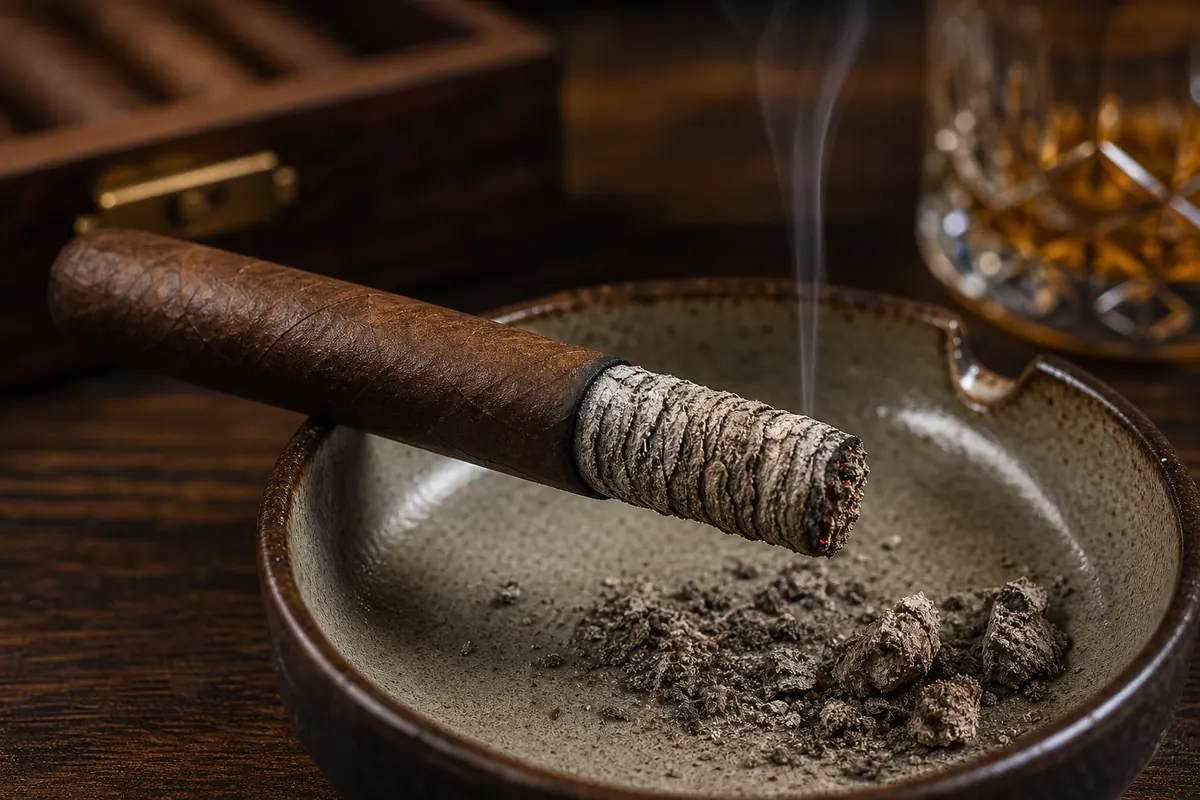
Cigar ash is a live diagnostic tool — its color, firmness, and length tell you about tobacco quality, construction, humidity, and your smoking pace. White, firm ash that holds an inch or more generally indicates well-fermented tobacco, proper rolling, and correct humidity. Dark, flaky ash that falls at half an inch suggests issues worth understanding.
Ash Color
White to Light Gray (Good)
Indicates: well-fermented tobacco with low mineral content, proper soil conditions, and complete combustion. Cuban and Nicaraguan volcanic-soil tobaccos often produce very white ash because volcanic soil is mineral-rich and promotes clean burn. White ash is generally a positive indicator but not an absolute quality guarantee — some excellent tobaccos produce gray ash.
Medium Gray (Normal)
Most cigars fall here. Perfectly acceptable — indicates adequate fermentation and reasonable tobacco quality. Gray is the normal baseline, not a deficiency.
Dark Gray to Black (Potential Issues)
Indicates one or more of:
- Under-fermented tobacco (incomplete chemical transformation)
- High tar content remaining in the leaf
- Over-humidified cigar (incomplete combustion from excess moisture)
- Smoking too fast (hot burn creates darker ash from rapid combustion)
Not necessarily a bad cigar — but dark ash with harsh flavors together suggest quality or storage issues.
Ash Firmness and Hold Length
Firm, Holds 1-2+ Inches
Signs of excellent construction and properly fermented long-filler tobacco. When whole leaves run the length of the cigar (long filler) and the roller packed them with consistent density, the ash structure holds together through internal leaf architecture. a skeleton — the leaf veins and stems create a scaffolding that keeps ash intact.
Flaky, Falls Under 1 Inch
Could indicate:
- Short filler: Chopped tobacco has no structural continuity — ash falls in chunks because there's no leaf skeleton holding it.
- Loose pack: Under-filled cigar means more air space, less structural integrity in the ash column.
- Low humidity: Dry cigars burn faster and the ash is more brittle due to rapid combustion.
- Wind: Outdoor smoking with wind literally blows ash off before it can build length.
The Long-Ash Contest Myth
Cigar events sometimes hold "longest ash" competitions. While fun, long ash isn't a smoking goal — an inch of ash actually insulates the cherry (burning end), keeping temperature lower and potentially making the cigar taste slightly milder. But past 1.5 inches, you risk ash falling on yourself, and the insulation effect can make the burn go uneven. Let ash fall naturally at 1-1.5 inches.
What Ash Tells You in Real Time
Ash as Temperature Gauge
Longer ash = cooler burn (insulation effect). If your cigar is tasting harsh or hot, let the ash build slightly longer before ashing. The extra ash acts as a heat buffer. Conversely, if flavors seem muted or the cigar keeps going out, ash might be too long — tap off some to expose more of the cherry to air.
Ash Cone Shape
- Flat/even: Burn is tracking straight across. Good.
- Conical/pointed: Center is burning faster than wrapper (minor tunneling). Slow your pace — you're drawing too much air through the center.
- Crater-shaped: Wrapper burning ahead of filler. This is unusual and often means the wrapper is too dry relative to filler. A humidity equalization issue.
Ash Smell
Hold your ash tray close and smell the ash directly. Good cigar ash smells like campfire — clean, woodsy, slightly sweet. Acrid or chemical-smelling ash indicates poorly fermented tobacco, excessive fertilizer residue, or pesticide contamination. This is a quality red flag.
When and How to Ash
- When: Let ash build to 3/4 to 1.5 inches, then gently tap or roll off. Don't flick aggressively — you risk cracking the cherry or dislodging the burn.
- How: Gently rest the cigar on the edge of your ashtray and roll slightly. The ash should break cleanly at the weakest point. Don't tap it like a cigarette — cigars are thicker and aggressive tapping can crack the wrapper near the burn line.
- Where: Use an ashtray with a wide bowl or cradle. Deep ashtrays prevent ash from scattering. Outdoor wind means ashing more frequently (every 1/2 inch) to prevent embarrassing ash avalanches.
Ash Variations by Origin
- Cuban (Vuelta Abajo): Typically very white ash due to mineral-rich red soil. Long hold due to quality long-filler and strict construction standards.
- Nicaraguan (Estelí/Jalapa): White to light gray. Volcanic soil produces mineral-rich tobacco with clean ash. Often very firm structure from dense Nicaraguan leaf.
- Dominican: Medium gray is typical. Lighter soils produce slightly different mineral composition. Still firm with quality brands.
- Honduran: Variable — ranges from white (Copán valley) to gray. Depends heavily on specific growing region.
- Connecticut Shade: Often lighter, more delicate ash structure due to thin wrapper leaf. May not hold as long as maduro-wrapped cigars.
For more on what's physically happening inside your cigar: anatomy of a cigar explained. For technique fixes when ash reveals problems: fixing uneven burn.
Reading Ash Color Patterns
Ash color provides information about soil composition where the tobacco grew. White or near-white ash indicates calcium-rich soil, common in the Vuelta Abajo region of Cuba, parts of Ecuador, and certain Nicaraguan valleys. Gray ash suggests lower calcium content typical of Dominican and Honduran growing regions. Dark or black ash can indicate excess potassium or improper fermentation. None of these colors reliably indicate quality, only origin and processing differences between the leaves used in the blend.
Mottled ash showing different shades in layers tells you the blend uses tobaccos from different soil types. You might see a white layer from a Nicaraguan ligero followed by a gray layer from a Dominican seco as different filler leaves become the primary burn source. This banding effect is common in multi-origin blends and simply reflects the blender's choice to combine tobaccos from different regions rather than indicating any quality issue with the cigar.
Ash Firmness and Construction Quality
Firm ash that holds for an inch or more before naturally falling indicates good construction: the roller applied proper pressure, the filler is evenly distributed, and the binder holds everything together tightly. Loose ash that crumbles after a quarter-inch suggests under-filled sections, uneven filler distribution, or a binder leaf that lacks sufficient adhesion. While you shouldn't obsess over ash length as a quality metric, consistently short ash across multiple cigars from the same box suggests a construction issue from the factory.
Environmental factors affect ash behavior independently of cigar quality. Wind obviously dislodges ash prematurely. Low humidity environments dry the ash and make it more fragile. The angle at which you hold the cigar matters: upward angles help ash stay attached while downward angles accelerate falling. Judge ash firmness only in calm, indoor conditions if you want meaningful information about the cigar's actual construction quality rather than environmental interference.
Practical Ashing Technique
Resist the urge to tap your cigar like a cigarette. Premium cigars are designed to hold their ash, and that ash serves a purpose: it insulates the cherry, keeping burn temperature consistent and preventing the cigar from burning too hot. Let ash grow to at least half an inch before gently rolling it off in an ashtray. Some smokers let ash reach an inch or more, finding that longer ash produces cooler, smoother smoke by creating distance between the burning cherry and the incoming air.
When ash finally falls, look at the shape of the remaining coal. A flat, even coal indicates proper burn. A cone-shaped or pointed coal suggests canoeing or tunneling that may need correction. A crater in the center means the cigar is tunneling, burning filler ahead of wrapper, which requires a touch-up with your lighter to even the burn line. Reading these signs takes practice but becomes instinctive after several dozen cigars, giving you early warning of burn issues before they affect flavor.
Frequently asked questions
Does white ash mean a cigar is good?
It's a positive indicator but not a guarantee. White ash shows good fermentation and mineral-rich soil. But a technically well-made cigar with poor tobacco can have white ash and still taste boring. Ash color is one data point — combine it with flavor, burn, and draw for the full picture.
Why does my cigar ash keep falling off immediately?
Most likely causes: short-filler cigar (no leaf skeleton), cigar is too dry (brittle ash from rapid combustion), you're in wind (physical disruption), or the cigar is loosely constructed (under-filled). If it's a premium long-filler in proper humidity indoors, construction quality might be the issue.
Should I try to keep the ash as long as possible?
Not really. Past 1-1.5 inches, long ash risks falling on you and can cause the burn to go uneven (ash insulates unevenly at that length). Let it fall naturally or gently tap off at about an inch. Long-ash contests are fun party tricks, not smoking goals.
Can ash color change during a single cigar?
Yes — as you smoke through different filler leaves (ligero, seco, volado from different primings), ash color can shift slightly. The first third often has lighter ash than the final third because bottom-priming leaves (smoked first) are thinner and lighter than top-priming ligero (reached in the final third).
Community tasting notes
No community notes yet. Be the first to share how this smoked for you.
Log in to share your tasting notes and photos.