
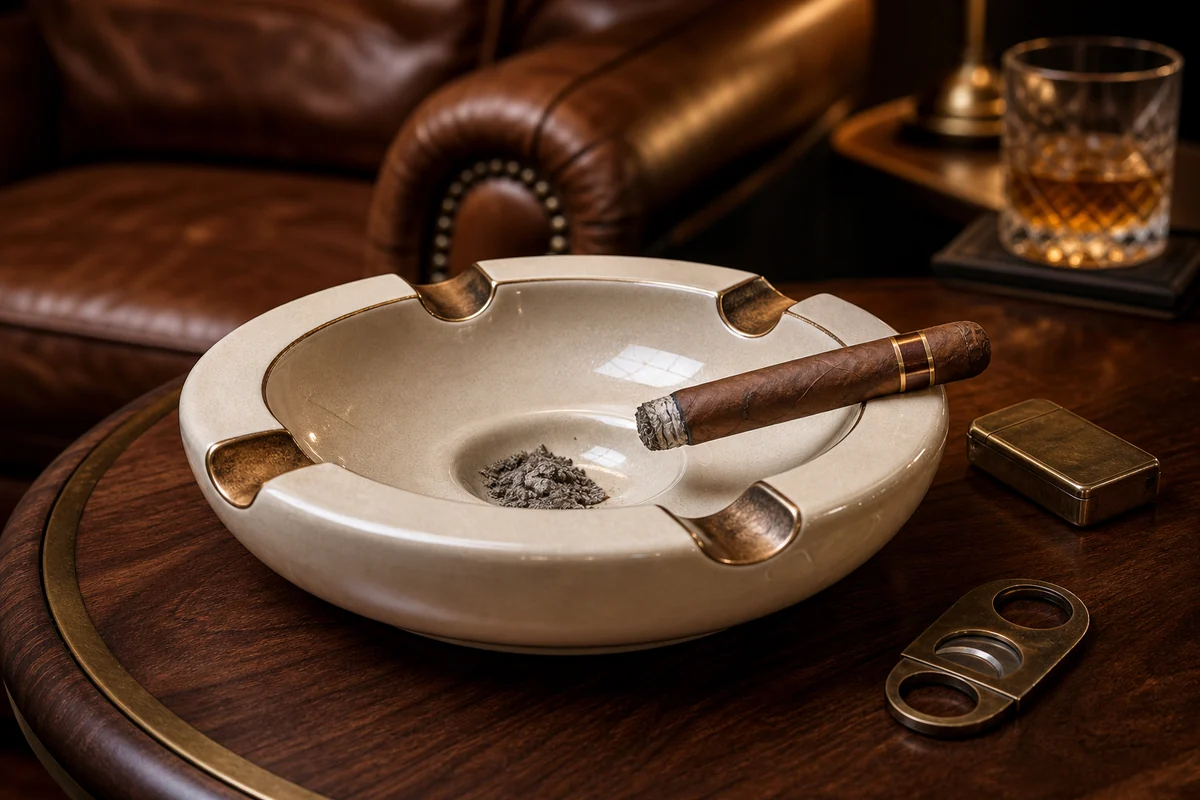
Best Cigar Ashtrays for Indoor Use
A deep, wide ashtray with proper cigar rests changes your indoor smoking experience more than any other single accessory upgrade. The wrong ashtray lets ash scatter, tips your cigar onto the table, and fills the room with stale smell faster than necessary.
For most smokers, the Stinky Cigar Ashtray in stainless steel is the best indoor ashtray you can buy — deep bowl, four stirrup-style rests that hold any ring gauge securely, and a lifetime of use without chipping or cracking. If you prefer the classic look of ceramic, the Craftsman's Bench line delivers at half the price.
What Makes a Good Indoor Cigar Ashtray
Indoor ashtrays serve a different purpose than outdoor ones. You need depth to contain ash and reduce smell dispersion, weight to prevent tipping, and rest grooves sized for cigars — not cigarettes. A shallow ashtray designed for cigarettes forces you to tap constantly and sends fine ash particles into the air every time you do.
Three things separate a proper cigar ashtray from a decorative bowl with notches:
- Bowl depth of at least 1.5 inches — holds an entire session's ash without overflow
- Rest width of 18-22mm — accommodates ring gauges from 42 to 60 without the cigar rolling
- Base weight over 1 pound — a resting cigar shouldn't be able to tip the tray
Stainless Steel: The Stinky Cigar Ashtray
The Stinky earned its cult following for a reason. The bowl is roughly 3 inches deep — deeper than any ceramic competitor at this price — which means ash stays put and smoke doesn't waft up from smoldering remnants. Four stirrup-style rests hold cigars at a slight downward angle, so any loose ash falls into the bowl rather than onto your table.
Stainless steel cleans with soap and water in seconds. No staining, no ghost smells after washing, no risk of cracking if you knock it off a side table. At around $40–60 depending on finish, it costs more than entry-level ceramic but less than crystal — and it will outlast both.
The only downside: it looks industrial. If your smoking room has leather chairs and mahogany, the Stinky's utilitarian aesthetic might clash. But function wins over form here.
Ceramic: Craftsman's Bench and Xikar
Ceramic ashtrays dominate the market because they look the part. The Craftsman's Bench line ($25–35) offers four-finger models in solid colors that fit any decor. Glazed ceramic doesn't absorb odors the way unfinished pottery does, and the weight keeps things stable on a coffee table.
The Xikar Ceramic series costs more ($45–70) but comes with Xikar's lifetime warranty — a genuine one that covers manufacturing defects, not just lip service. The rest grooves are precision-cut to hold cigars without the wobble you get from hand-molded cheaper options.
Ceramic's weakness: it chips. One drop from table height onto a hardwood floor and you've got a permanent scar or a shattered tray. Keep this in mind if you have kids, pets, or a habit of moving furniture around.
Crystal and Glass: Prestige Pieces
Crystal ashtrays from brands like Prestige Import Group and Davidoff are statement pieces first, functional ashtrays second. A well-cut crystal tray catches light beautifully and signals that your smoking space is intentional, not an afterthought.
Functionally, crystal works fine — it's heavy, non-porous, and cleans easily. But at $80–300+, you're paying for aesthetics and brand heritage. The Prestige Import Group crystal ($80–120) gives you 90% of the look at a third of Davidoff's price. Unless you're furnishing a space where brand names on accessories matter to your guests, save the difference.
Wood: Traditional but Limited
Wooden ashtrays — cherry, walnut, or ash — look warm and traditional. Some smokers love the contrast of a dark wood tray against a lighter desk. But wood has functional problems indoors: it absorbs tar and smell over time, scorches if a cigar is left resting too long, and requires periodic refinishing to maintain appearance.
If you choose wood, get one with a removable metal or ceramic insert for the bowl portion. The wood frame provides the aesthetic while the insert handles the heat and mess. Without that insert, expect visible burn marks within six months of regular use.
Placement and Ventilation Considerations
Where you position your ashtray matters as much as what you buy. Place it at elbow height or below — reaching up to tap ash means you'll drip ash along the path. A side table, desk edge, or dedicated ashtray stand at seated arm height is ideal. Avoid placing ashtrays directly on fabric surfaces; even heavy trays can shift on a tablecloth, and ash particles settle into fabric grain within minutes.
Pair your ashtray placement with airflow awareness. Position it between yourself and the room's air outlet if possible — this draws ash smoke away from your seating area rather than letting it pool at face level. Some smokers place a small desktop fan behind their ashtray pointing toward an open window. This simple airflow trick reduces lingering room smell by 30-40% compared to still-air smoking.
How Many Rests Do You Need?
For solo smoking: a single-rest or two-rest ashtray keeps the footprint small. For hosting: four rests minimum. The mistake most buyers make is getting a four-rest tray when they only ever smoke alone — it takes up desk space for no reason. If you host cigar nights monthly or more, a four-rest model earns its size. Otherwise, a two-rest model gives you one slot for your cigar and one for a friend who drops by.
Cleaning and Maintenance
Empty ash after every session — letting it sit overnight makes the smell permeate whatever surface the tray sits on. For stainless steel and ceramic, warm water and dish soap does the job. For crystal, avoid abrasive sponges that can dull the surface over time. A microfiber cloth keeps the clarity.
One habit that extends any ashtray's life: line the bottom with a thin layer of fine sand or baking soda. It absorbs moisture from the ash, prevents tar from bonding to the bowl surface, and makes dump-and-clean a 10-second job instead of a scrubbing session. This works for every material except wood.
For deep cleaning after heavy use — say a poker night where four cigars burned simultaneously — soak stainless steel or ceramic in warm water with a tablespoon of baking soda for 15 minutes. The alkaline solution lifts tar residue without scrubbing. Crystal can be soaked similarly but dry it immediately with a lint-free cloth to avoid water spots that dull the polish.
Budget Options Worth Mentioning
If you're spending under $20, the Cigar Manor Melamine Ashtray at $12-15 is surprisingly functional. Melamine is shatter-resistant (unlike ceramic), lightweight but stable, and cleans easily. It won't impress guests at a formal gathering, but for a garage setup or back porch it performs well above its price. The Cuban Crafters resin ashtray ($15-18) offers similar durability with slightly better aesthetics — molded to look like stone or marble from a distance.
The Pick for Most Indoor Smokers
Get the Stinky Cigar Ashtray if function is your priority — nothing else matches its depth-to-price ratio and durability. Get the Craftsman's Bench ceramic if your space demands something more refined and you can live with the fragility trade-off. Skip crystal unless your smoking room is already furnished to that standard.
Pair any of these with a proper accessory setup — a good ashtray means nothing if you're fighting a dull cutter or a sputtering lighter every session.
Frequently asked questions
Can I use a cigarette ashtray for cigars?
Technically yes, but cigarette ashtrays are too shallow and their rests are too narrow. Cigar ash accumulates faster and cigars roll out of narrow grooves. You'll spend more time managing ash than enjoying the smoke.
How often should I clean my cigar ashtray?
After every session. Letting ash sit overnight causes the smell to permeate your furniture and makes tar bond to the bowl surface, requiring harder scrubbing later.
Does ashtray material affect cigar taste?
No. The ashtray doesn't contact the burning end or the smoke you draw. Material choice is about durability, aesthetics, and cleaning ease — not flavor.
How many cigar rests do I need?
Two for solo smokers (one active, one spare). Four if you host cigar nights regularly. A four-rest tray for solo use just wastes desk space.
Community tasting notes
No community notes yet. Be the first to share how this smoked for you.
Log in to share your tasting notes and photos.