
How to Tell a Quality Cigar from a Bad One
A quality cigar tells you what it is before you light it — through the wrapper's sheen, the firmness in your fingers, the cold draw resistance, and the pre-light aroma. You don't need years of experience to spot the difference. You need to know what to check and what each check tells you.
The Wrapper: Your First and Best Indicator
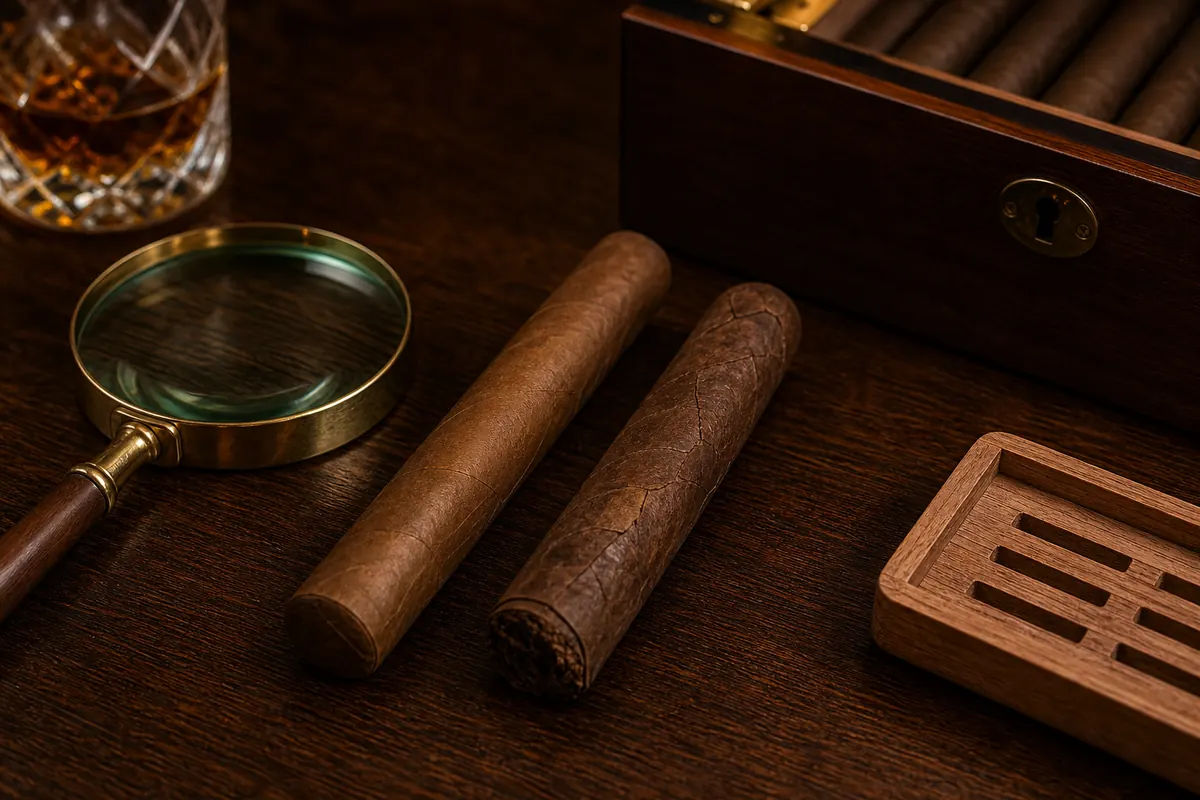
The wrapper leaf accounts for most of what you see and a significant portion of what you taste. On a quality cigar, the wrapper is smooth, consistent in color, and has a slight oily sheen. That oil isn't cosmetic — it indicates proper fermentation, aging, and humidity maintenance throughout the supply chain.
Red flags on the wrapper:
- Green spots or extreme color variation — The leaf was harvested too early or fermented unevenly. Expect grassy, harsh flavor.
- Cracks or dry flaking — The cigar has been stored below proper humidity for too long. The structural integrity is compromised, and it'll burn unevenly.
- Raised veins that feel bumpy — Some veining is natural, but thick protruding veins suggest lower-priming leaves with less refined flavor, or poor selection by the roller.
- Patches of mold vs. plume — Fuzzy, colored spots (especially blue-green) are mold. White crystalline dust that wipes off cleanly could be plume — crystallized oils from aging. If in doubt, treat it as mold.
A quality wrapper looks alive. It has depth in color, responds slightly to touch, and wraps the bunch with no visible seams except at the cap.
The Squeeze Test: Construction
Roll the cigar gently between your thumb and forefinger, pressing lightly along its length. You're checking two things: consistency and resistance.
A well-constructed cigar feels uniformly firm from head to foot — no soft spots and no hard lumps. Soft spots mean gaps in the bunch where the filler leaves weren't distributed evenly. Those gaps create hot spots during combustion and cause burn issues. Hard lumps mean over-packed sections that restrict airflow and create plugs.
The ideal firmness has slight give under gentle pressure — like pressing a ripe avocado. If the cigar feels rock-hard with zero give, it's likely over-humidified or over-packed. If it feels spongy and compresses easily, it's under-filled or dried out.
What About Box Press?
Box-pressed cigars feel different by design — their flat sides are intentional from box aging. Judge them by internal consistency along the length rather than overall roundness. The same rule applies: no soft spots, no hard lumps.
The Cold Draw: Airflow Check
Before lighting, cut the cap and take a draw without any flame. The cold draw tells you about construction quality from the inside.
Ideal resistance: moderate. You should feel some resistance — similar to drinking through a standard straw. Air moves, but it's not effortless. This resistance indicates proper bunch density that will produce good smoke volume and even combustion.
- Too tight (hard to pull any air) — Over-packed or plugged. The cigar may go out repeatedly or require constant re-lighting. Some loosen up slightly once combustion begins, but a genuinely plugged cigar rarely recovers.
- Too loose (air flows like an empty tube) — Under-filled. Expect hot, fast burning with thin smoke and harsh flavor because there's not enough leaf mass to slow combustion properly.
The cold draw also gives you pre-light flavor notes. Quality long-filler cigars show hay, cedar, leather, or cocoa on the cold draw. Short-filler or poor-quality cigars often taste papery, dusty, or like nothing at all.
Pre-Light Aroma
Smell the foot of the cigar — the unlit end where you can see the exposed filler. Quality tobacco smells rich: earth, barnyard sweetness, dried fruit, cocoa, cedar. The smell should make you want to smoke it.
Bad signs: ammonia sharpness (under-fermented tobacco still off-gassing), mustiness (mold or improper storage), cardboard smell (low-grade or stale tobacco), or simply nothing — which indicates the cigar has been sitting too long and the oils have dissipated.
Also smell the wrapper by holding the cigar under your nose along its length. The wrapper contributes aroma distinct from the filler — a quality wrapper adds sweetness, spice, or leather notes on top of the foot aroma.
Cap Construction
The cap is the small piece of tobacco applied to the head to seal the cigar. On a quality cigar, the cap is applied neatly — you can barely see the seam where it meets the wrapper. It should be smooth under your finger.
A sloppy cap — visible glue, uneven edges, loose ends — suggests rushed production. It also means the cap is more likely to unravel after cutting, which creates flaking tobacco in your mouth and a deteriorating draw as you smoke.
Cuban-style triple caps show three distinct layers visible at the shoulder of the cigar. Non-Cuban cigars typically use a single flag leaf or a tab cap. Both can be done well or poorly — judge by neatness and adhesion, not style.
The Burn Test (After Lighting)
Once lit, a quality cigar confirms what the physical inspection promised:
- Even burn line — The cherry advances uniformly around the circumference. Minor waviness is normal; a sharp canoe or tunnel within the first inch indicates construction problems.
- Firm, light-gray ash — Good ash holds for half an inch to an inch before falling. It's light gray to white. Dark, flaky ash that falls in crumbles suggests low-quality or improperly cured filler.
- Consistent smoke output — Each draw produces similar volume. Thinning smoke with unchanged draw effort means the cigar is going out — possible humidity or construction issue.
- Flavor stability — Quality cigars transition flavors gradually across thirds. They don't swing wildly between sweet and harsh within a single inch.
Long Filler vs. Short Filler
Premium handmade cigars use long-filler — whole leaves running the length of the cigar. This creates consistent combustion, complex flavor, and structural integrity. Short-filler uses chopped tobacco scraps, which burn hotter, less evenly, and produce simpler, often harsher flavor.
You can sometimes tell the difference by looking at the foot: long-filler shows identifiable leaf sections with visible structure. Short-filler looks like rough-chopped material without clear leaf definition. Machine-made cigars are almost always short-filler. Handmade doesn't guarantee long-filler, but most premium handmades above the five-dollar range use it exclusively.
Price as a Signal (With Caveats)
Price correlates with quality in the middle of the market. Below three dollars, you're nearly always getting machine-made short-filler. Between five and fifteen dollars, there's an enormous range of handmade long-filler options where construction and leaf quality vary widely — this is where your inspection skills matter most. Above fifteen dollars, you're mostly paying for aged tobacco, rare leaf, or brand prestige. Quality is generally high, but you're not always getting proportionally better tobacco for the price jump.
The sweet spot for learning quality assessment is the five-to-twelve-dollar range. Here you'll encounter both excellent and mediocre cigars, and your physical inspection skills will save you from plenty of bad purchases.
What to Do Next
Now you know what to look for. If you're building a collection, proper storage preserves everything that makes a quality cigar worth smoking. And if you're still figuring out what flavor profiles you prefer, the beginner's guide helps narrow that down without expensive trial and error.
Step by step
- Inspect the wrapperLook for consistent color, oily sheen, and smooth texture. Reject cigars with cracks, green spots, or fuzzy mold patches.
- Perform the squeeze testGently press along the cigar's length checking for uniform firmness with slight give. Flag soft spots or hard lumps.
- Check cap constructionRun your finger over the cap — it should feel smooth with barely visible seams and no loose edges.
- Test the cold drawCut the cap and draw without lighting. Ideal resistance feels like drinking through a straw. Note any pre-light flavors.
- Smell the foot and wrapperRich aromas like earth, cocoa, or cedar indicate quality tobacco. Ammonia, mustiness, or no smell at all are warning signs.
Frequently asked questions
Can you tell cigar quality without smoking it?
Yes. Wrapper appearance, squeeze consistency, cold draw resistance, and pre-light aroma give you strong indicators of construction quality and tobacco condition before lighting.
Does a higher price always mean better quality?
Not always. Above fifteen dollars, you're often paying for aged tobacco or brand prestige. The five-to-twelve-dollar range has the widest quality variance, making inspection skills most valuable there.
What does a tight draw on cold draw mean?
The cigar is over-packed or has a plug in the bunch. It may go out repeatedly during smoking. Some loosen slightly once lit, but a genuinely tight cigar rarely improves enough to smoke well.
Is white powder on a cigar mold or plume?
White crystalline dust that wipes off cleanly may be plume — crystallized oils from aging. Fuzzy or colored spots (blue-green) are mold. When in doubt, treat it as mold and don't smoke it.
Community tasting notes
No community notes yet. Be the first to share how this smoked for you.
Log in to share your tasting notes and photos.