
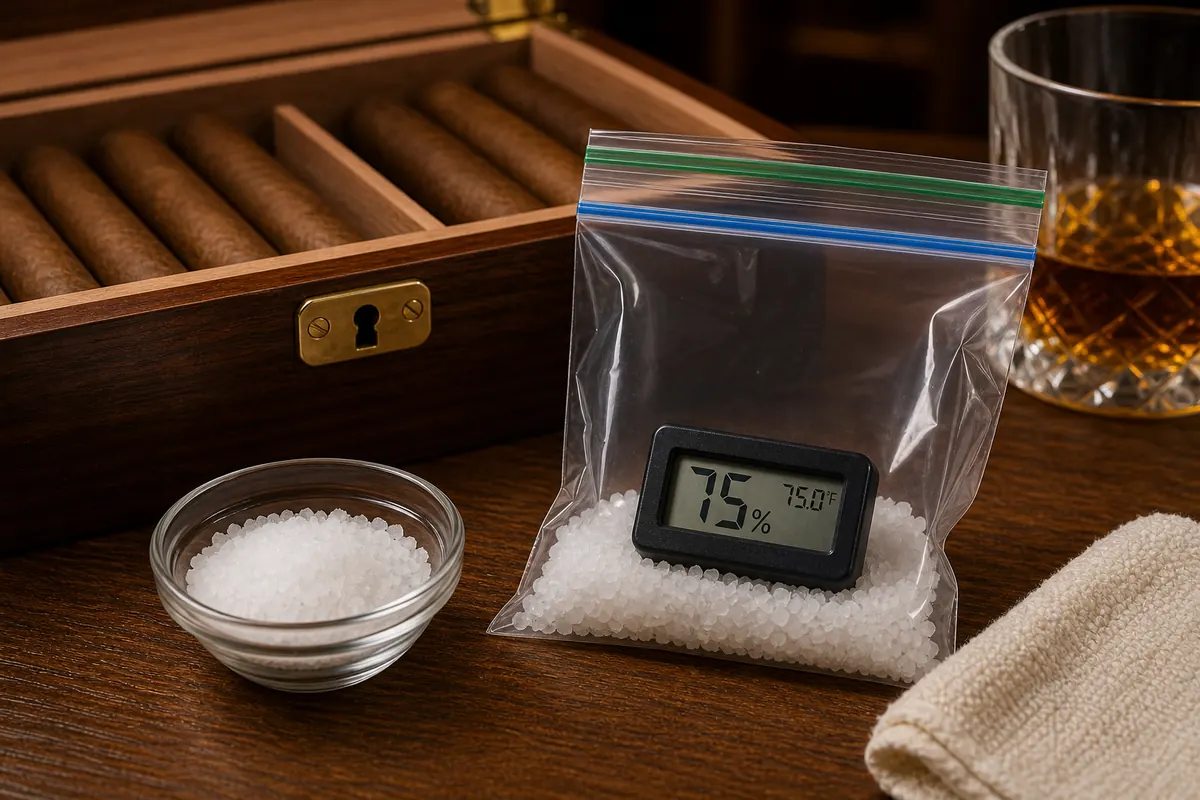
How to Calibrate a Hygrometer
The salt test is the gold standard for hygrometer calibration: seal your hygrometer in a bag with a saturated salt solution, wait 24 hours, and adjust to 75%. It takes five minutes of hands-on work and tells you exactly how far off your readings are — which is often more than you'd expect.
An uncalibrated hygrometer is worse than no hygrometer. It gives you false confidence while your cigars dry out or grow mold. Calibrate before you trust any reading.
What You Need
- Your hygrometer (digital or analog)
- A small cup or bottle cap
- Regular table salt (NaCl)
- A few drops of water
- A ziplock bag or small airtight container
- 24 hours of patience
Alternatively, you can use a Boveda One-Step Calibration Kit (a pre-made 75.5% salt packet). Same principle, less mess. About $5–8 at any cigar shop.
The Salt Test Method (DIY)
Step 1: Create the Saturated Solution
Fill a bottle cap with table salt. Add just enough water to dampen it — you want wet sand consistency, not a pool. The salt should be moist but not dissolved into liquid. If you added too much water, add more salt until it looks like damp beach sand.
The science: a saturated sodium chloride solution in a sealed environment produces exactly 75.5% relative humidity at room temperature. This is a known constant in physics — it doesn't vary with altitude, barometric pressure, or the brand of salt you use.
Step 2: Seal Everything Together
Place the bottle cap of damp salt and your hygrometer inside a ziplock bag. Squeeze out most of the air (leave a small air pocket — the hygrometer needs air to measure). Seal the bag completely. No gaps, no openings.
If using a rigid container (tupperware), same thing: cap of salt inside, hygrometer inside, lid sealed tight.
Step 3: Wait 24 Hours
Set it somewhere with stable temperature — not in sunlight, not near a vent, not in a garage with temperature swings. Room temperature (68–74°F) is ideal. The system needs time to reach equilibrium.
Don't open the bag to check. Every time you break the seal, you reset the clock. Trust the physics. Come back tomorrow.
Step 4: Read Without Opening
After 24 hours, read the hygrometer through the bag (digital) or note the needle position (analog) before breaking the seal. The moment you open the bag, ambient humidity rushes in and the reading changes. Your calibration reference is the number you see while it's still sealed.
The reading should say 75%. If it does — congratulations, your hygrometer is accurate. If not, proceed to calibration.
Step 5: Calibrate
Digital models: Most have a calibration button or adjustment mode. While still in the bag (or immediately after removing), press and hold the calibration button and set it to 75%. Consult your specific model's manual — some use a rear button, others a front press-and-hold. SensorPush and Govee let you enter the offset in their app.
Analog models: Remove from the bag. Immediately use the adjustment screw on the back to move the needle to 75%. Work quickly — you have about 30 seconds before ambient air changes the reading meaningfully. A small flathead screwdriver or the included tool fits the rear screw.
Using a Boveda Calibration Kit
If you'd rather skip the DIY approach, Boveda's One-Step Calibration Kit is a sealed salt packet that produces the same 75.5% environment. Place it in the bag with your hygrometer, seal, and wait 24 hours. Same result, no mess.
The kit is reusable — it lasts for several calibrations before the salt packet dries out. Store it in a sealed bag between uses and it'll last a year or more.
How Often to Calibrate
- Digital hygrometers: Once when new, then annually. If readings seem suspicious (sudden 5%+ change without cause), recalibrate immediately.
- Analog hygrometers: Once when new, then every 2–4 weeks. Mechanical drift is constant and unavoidable.
- After any impact or drop: Both types can shift from physical shock. Recalibrate after any accident.
- After battery replacement (digital): Some models reset their offset when batteries are changed. Re-verify after any power interruption.
Common Mistakes
- Using too much water: The salt should be damp, not swimming. Excess water throws off the 75.5% reference point — you'll end up calibrating to the wrong number.
- Opening the bag to check: Every peek resets the equilibrium. 24 hours sealed, no exceptions.
- Calibrating in extreme temperatures: The 75.5% constant assumes room temperature (68–77°F). In a cold garage or hot attic, the reference value shifts slightly. Calibrate indoors at normal temperatures.
- Forgetting the offset direction: If your hygrometer reads 72% in the bag, it's reading 3% low. Adjust UP by 3%. Sounds obvious, but people reverse this all the time.
- Skipping calibration entirely: "It's new, it must be accurate" is wrong for both digital and analog. Factory calibration on budget models is approximate at best.
What If Your Hygrometer Can't Be Calibrated?
Some cheap digital models have no adjustment function. In that case, note the offset mentally. If it reads 72% in the salt test, you know it's always 3% low. When it says 65% in your humidor, actual humidity is 68%. Write the offset on a small sticker and attach it to the unit.
This works, but it's error-prone over time (especially if someone else checks your humidor). A better solution: spend $15–20 on a model with calibration capability. Caliber IV, Govee, and HygroSet are all adjustable and affordable.
Verifying Your Humidor After Calibration
Once calibrated, place the hygrometer back in your humidor and close the lid. Give it 2 hours to stabilize. Now you have a trustworthy reading of what your cigars are actually experiencing.
If the number surprises you (too high, too low), the issue isn't the hygrometer anymore — it's your humidification system or humidor seal. That's a different problem with different solutions.
What's Next
With a calibrated hygrometer, you're ready to manage humidity with confidence. If you're choosing between digital and analog, our digital vs analog hygrometer comparison breaks down the pros and cons. Building a new setup? See how to season a new humidor — your freshly calibrated hygrometer is essential for knowing when seasoning is complete.
When Calibration Goes Wrong
If your hygrometer consistently reads incorrectly even after calibration, the sensor may be permanently degraded. Analog hygrometers use mechanical bimetallic coils that fatigue over years, eventually losing the ability to respond accurately to humidity changes regardless of calibration attempts. Digital sensors using capacitive polymer elements degrade when exposed to extremes: sustained 80-plus percent humidity saturates the polymer permanently, while exposure to very dry conditions below 30% can crack the sensing element. If calibration fails repeatedly, replace the unit rather than trusting suspect readings that could damage your cigar collection through false confidence in incorrect measurements.
Multi-point calibration verifies accuracy across the humidity range rather than at a single point. The salt test confirms accuracy at 75%, but your humidor operates at 62-69% typically. Some digital hygrometers also allow calibration at a second point using different saturated salt solutions. Magnesium chloride produces 33% and sodium chloride produces 75%, giving you two reference points that verify linearity across the range your humidor actually uses daily. This dual-point approach catches sensors that read correctly at one level but drift at another, a common failure mode that single-point calibration misses entirely.
After successful calibration, verify your hygrometer's accuracy monthly using a quick spot-check method. Place it inside a sealed plastic bag with a small Boveda 75% calibration pack for one hour. If it reads within 2% of 75%, your calibration holds. If it has drifted more than 3%, recalibrate using the full salt test procedure. This monthly verification takes minimal effort but catches drift before it causes your humidor to operate outside safe parameters for extended periods that could damage your cigar collection through undetected over or under-humidification that compounds daily until discovered.
Step by step
- Prepare the salt solutionFill a bottle cap with table salt. Add drops of water until the salt is damp like wet sand — not dissolved or swimming. This creates the saturated solution that produces exactly 75.5% RH.
- Seal in a ziplock bagPlace the bottle cap and your hygrometer inside a ziplock bag. Squeeze out excess air but leave a small pocket. Seal completely with no gaps.
- Wait 24 hours undisturbedLeave the sealed bag at stable room temperature (68-77°F) for a full 24 hours. Do not open to check progress.
- Read through the sealed bagAfter 24 hours, read the display through the bag without opening. Note the exact number — this is your calibration reference against the known 75.5% value.
- Adjust the offsetDigital: use the calibration button to set reading to 75%. Analog: immediately use the rear adjustment screw to move the needle to 75%. Work quickly once the bag is open.
- Verify in your humidorPlace the calibrated hygrometer in your humidor. Wait 2 hours for stabilization. You now have a trustworthy reading of actual conditions.
Community tasting notes
No community notes yet. Be the first to share how this smoked for you.
Log in to share your tasting notes and photos.