
How to Bleed a Cigar Lighter (Fix Sputtering)
A sputtering lighter almost always means trapped air in the fuel tank — not a mechanical failure. Bleeding (purging all gas and air from the tank before refilling) fixes this in under a minute. If your lighter flickers, pops, or gives you an inconsistent flame after refilling, bleed it and start fresh.
Why Lighters Sputter
Every time you refill a butane lighter without fully emptying it first, you push fresh butane into a tank that still contains a mix of residual gas and air. That air came in through the refill valve during the filling process — when butane goes in, air sneaks in around the imperfect seal.
Butane is heavier than air. In a settled tank, air rises to the top and forms a pocket. When the lighter draws fuel, it sometimes pulls from that air pocket instead of pure butane. The result: momentary fuel starvation at the burner, which you experience as sputtering, popping, or a flame that dies seconds after ignition.
The more times you refill without bleeding, the more air accumulates. Eventually the lighter behaves as if it's empty even when the tank is clearly full.
What You Need
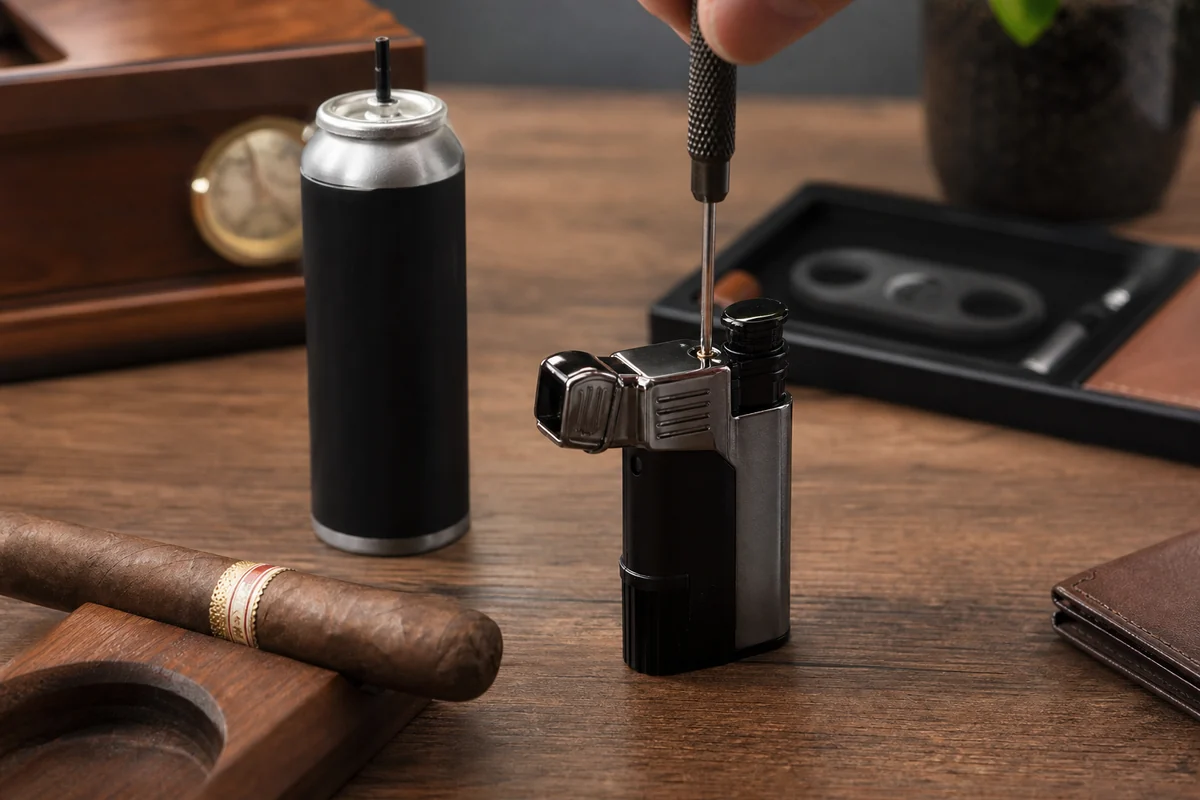
- A small pointed tool: precision screwdriver, ballpoint pen tip, paperclip, or a bleed tool (some lighters include one)
- Well-ventilated area
- A can of quality butane for refilling afterward
That's it. No special equipment, no skills beyond pushing a pin into a hole.
How to Bleed Your Lighter
Step 1: Turn Flame to Minimum
Rotate the flame adjustment to its lowest setting. This closes the fuel valve and ensures all gas exits only through the bleed valve, not the burner assembly.
Step 2: Hold Upright, Valve Facing Up
Flip the lighter so the bottom (where the refill valve lives) faces the ceiling. You want any liquid butane in the tank to pool away from the valve, so you're pushing gas and air out — not spraying liquid fuel everywhere.
Step 3: Depress the Refill Valve
Insert your tool into the refill valve — it's the small brass or silver nipple on the bottom of the lighter. Push down firmly. You'll immediately hear hissing as pressurized gas escapes.
Keep pressing. The hissing will continue for 5–20 seconds depending on how much fuel remains. Hold until the hissing stops completely. Silence means the tank is depressurized and empty of both butane and air.
Step 4: Repeat
Release the valve, wait 2–3 seconds, then press again. If you hear any additional hissing, there was residual gas that needed a second pass. Press until it's truly silent. On most lighters, two presses are enough. On large-tank models, you might need three.
Step 5: Refill Immediately
Don't leave the lighter empty — an open, depressurized tank can draw in ambient air through the burner assembly. Refill promptly after bleeding. Keep the lighter inverted, insert butane nozzle into the refill valve, and press for 5–8 seconds. See our full butane refill guide for the complete process.
When to Bleed Your Lighter
- Before every refill: This is best practice. Bleed → refill is a 20-second habit that prevents air accumulation entirely.
- When the flame sputters or pops: Immediate signal that air is in the system.
- When flame height is inconsistent: Full flame one second, half-height the next — air pocket interference.
- When the lighter won't ignite despite having fuel: Air blocking fuel delivery to the burner.
- After the lighter has sat unused for weeks: Seals allow microscopic air ingress over time. Bleed before reusing a lighter that's been sitting.
Why This Gets Skipped
Most lighter instructions say "refill when empty." They don't explain what happens when you refill a not-quite-empty tank. Smokers top off their lighter at half-tank, air gets introduced, performance degrades gradually, and they blame the lighter rather than the refill technique.
It's also not obvious that the fix is this simple. When a $60 Xikar lighter starts sputtering, the instinct is to send it for warranty repair. Nine times out of ten, bleeding and refilling with quality butane solves it in one minute for free.
Common Mistakes
- Not pressing the valve firmly enough: The valve requires real pressure to fully open. A light touch releases some gas but leaves a pressurized pocket. Push until you feel the valve bottom out.
- Bleeding with the lighter upside down (valve facing floor): Liquid butane will spray out instead of gas. Messy, wasteful, and it doesn't clear the air pocket effectively. Valve faces up.
- Bleeding in a closed space: Butane gas in concentration is hazardous. Work near an open window or outdoors. The volume is small, but good habits prevent stupid accidents.
- Not refilling promptly after bleeding: An empty, depressurized tank is at negative or neutral pressure relative to the atmosphere. Air seeps in through the burner jet. Refill within a minute of bleeding.
- Assuming one bleed fixes everything: If sputtering returns after one refill cycle, the butane source might be impure (introducing contaminants) or the lighter's internal seals might be worn. Try different fuel first.
When Bleeding Doesn't Fix It
If you've bled properly, refilled with quality butane, waited five minutes, and the lighter still sputters — the problem is likely mechanical:
- Clogged jet nozzles: Impurities from low-quality butane accumulate in the tiny burner orifices. Blast compressed air through the nozzle. If that doesn't clear it, a single strand of fine wire (like a twist-tie) can dislodge debris — but be careful not to widen the orifice.
- Worn ignition mechanism: Piezo-electric igniters degrade over time. If you hear the click but see no spark, the piezo crystal is dying. Some lighters allow piezo replacement; others are end-of-life.
- Damaged refill valve: If the valve doesn't seal properly after refilling, fuel leaks continuously and the tank empties. You'll smell butane near the lighter base. Valve replacement on some premium lighters is possible; budget models are cheaper to replace.
- Seal deterioration: Internal O-rings dry out, especially in lighters stored without fuel for extended periods. This causes slow leaks that aren't visible but prevent proper pressurization.
Maintenance Routine
The healthiest habit for any butane lighter:
- Bleed before every refill (20 seconds)
- Use triple-refined or higher butane only
- Store with fuel in the tank (prevents seal dry-out)
- Wipe the burner area monthly to remove carbon buildup
- Test the flame adjustment wheel — if it's stiff, a drop of silicone-free lubricant on the mechanism helps
A quality lighter maintained this way lasts 5–10 years. Neglected, the same lighter might frustrate you into replacing it in 6 months.
What's Next
Now that your lighter is breathing clean fuel, make sure your refill technique is solid — our complete butane refill guide covers fuel selection and the full process. And for choosing between lighter types for different scenarios, see cigar lighter types explained.
Step by step
- Set flame to minimumTurn the flame adjustment wheel to its lowest setting. This closes the fuel jet and ensures gas exits only through the bleed valve.
- Hold lighter upright with valve facing upInvert the lighter so the refill valve on the bottom faces the ceiling. This allows gas and air to escape without spraying liquid butane.
- Press the refill valve firmlyInsert a small screwdriver, pen tip, or bleed tool into the refill valve and push down firmly. Hold until all hissing stops completely — 5 to 20 seconds.
- Repeat until silentRelease, wait 2-3 seconds, press again. If any additional hissing occurs, there's residual gas. Repeat until pressing produces no sound at all.
- Refill immediatelyDon't leave the tank empty. Keep the lighter inverted, insert your butane canister nozzle into the refill valve, and fill for 5-8 seconds. Wait 3-5 minutes before testing ignition.
Community tasting notes
No community notes yet. Be the first to share how this smoked for you.
Log in to share your tasting notes and photos.