
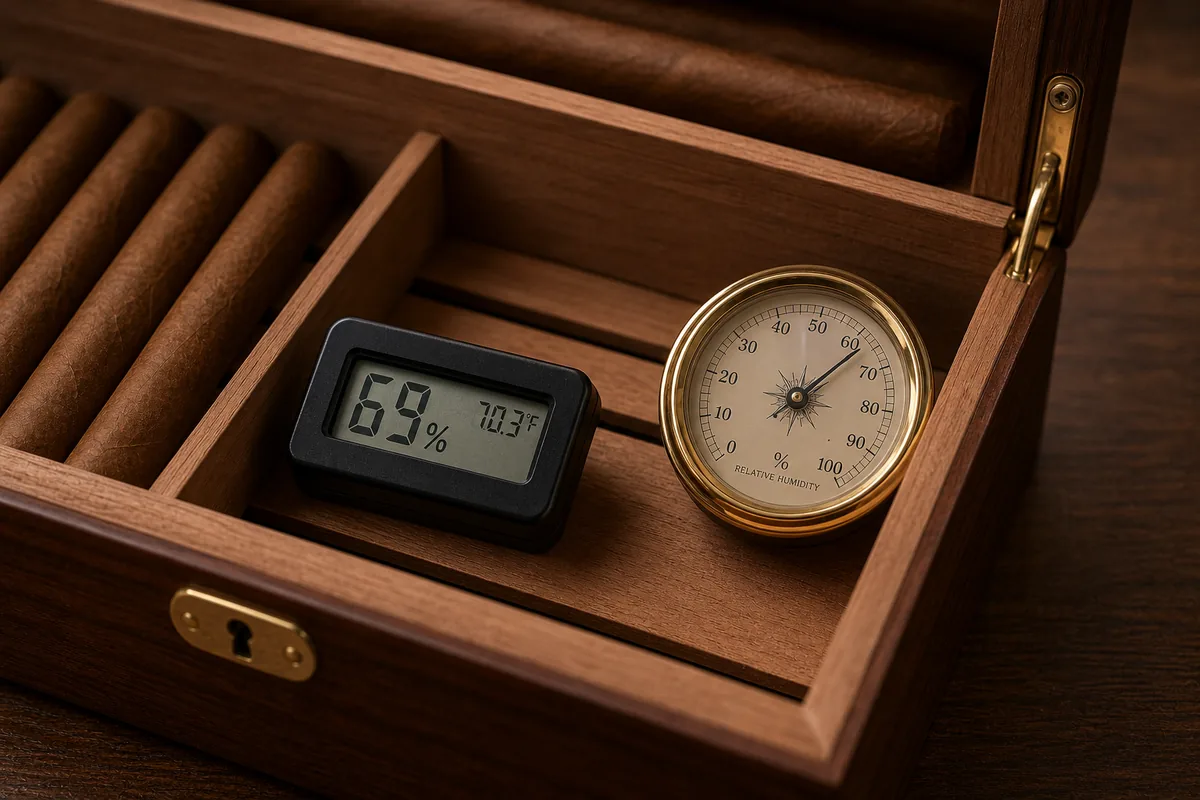
Digital vs Analog Hygrometers for Cigars
For humidor use, go digital. A quality digital hygrometer reads within ±1-2% accuracy out of the box, requires no mechanical calibration, and gives you a clear number instead of guessing where a needle points. Analog hygrometers look classic but drift constantly and need recalibration every few weeks to stay honest.
That said, analog models have their place — and understanding both helps you maintain the humidity your cigars need.
How Each Type Works
Digital Hygrometers
Digital models use a capacitive sensor — a thin polymer film that absorbs and releases moisture. As humidity changes, the film's electrical capacitance shifts, and a circuit converts that reading to a percentage displayed on an LCD screen.
Response time is fast (updates every few seconds), and the sensor doesn't fatigue the way mechanical parts do. The best digital hygrometers (Caliber IV, Govee, SensorPush) maintain accuracy for years without recalibration, though an annual check is good practice.
Analog Hygrometers
Analog (mechanical) hygrometers use either a metal coil or a natural/synthetic hair element that physically expands and contracts with moisture. That movement drives a needle across a dial face. The principle is sound — it's the execution that causes problems.
Metal coils lose elasticity over time. Hair elements stretch. The spring mechanism develops slack. All of this means the needle drifts away from true readings gradually, and you won't know it's lying until your cigars tell you something is wrong.
Accuracy Comparison
Here's where the gap becomes impossible to ignore:
- Digital (quality brands): ±1-2% RH accuracy. Consistent across the 40-80% range relevant to cigar storage.
- Analog (freshly calibrated): ±3-5% RH at best. Accuracy degrades within 2-4 weeks as the mechanism drifts.
- Analog (uncalibrated or old): Can be off by 10-15%. Many smokers discover their analog gauge was reading 70% when actual humidity was 58%.
For cigars, that accuracy gap matters. The sweet spot is 62-70% RH (depending on your preference). An analog reading of 70% could actually be 65% or 75% — and 75% means mold risk. You're essentially guessing.
Calibration Differences
Digital Calibration
Most digital hygrometers have a calibration button or menu. The process: seal the unit in a bag with a Boveda calibration kit (a 75.5% salt packet) for 24 hours. If the display reads anything other than 75%, adjust using the offset button. Done for the year.
Some models (SensorPush, Govee) let you set the offset in a phone app. Others have a physical reset button. Either way, it's a one-minute correction after the 24-hour test.
Analog Calibration
Same salt test, but the adjustment is mechanical. You pull the unit from the bag, then use a small screwdriver or the built-in adjustment screw on the back to move the needle to 75%. The problem: the act of adjusting introduces its own error. And since the mechanism drifts, you'll repeat this every 2-4 weeks if you want meaningful readings.
Many cigar smokers buy an analog hygrometer, calibrate it once, and never touch it again. Two months later, it's reading 5-8% off and they're wondering why their cigars are dry.
Features Only Digital Offers
- High/low memory: Records the highest and lowest readings since last reset. Shows you humidity swings you'd otherwise miss.
- Temperature display: Most digital models show temp alongside RH — useful because temperature affects perceived humidity.
- Bluetooth/WiFi connectivity: Smart models (SensorPush, Govee) send readings to your phone and alert you if humidity drops or spikes past your set thresholds.
- Multiple sensors: You can place several digital units across a large humidor or wineador and monitor each zone independently.
Analog gives you a needle and a number. That's it.
The Case for Analog
So why do analog hygrometers still exist in cigar culture? A few legitimate reasons:
- Aesthetics: A brass-bezel analog gauge looks right in a traditional wooden humidor. It's part of the visual language of cigar culture, like the cedar lining and brass hinges.
- No batteries: Analog units never die at 2 AM. No battery door to pop open, no LCD to fade. They just... sit there, working (or not working, but at least present).
- Glass-top humidors: If your humidor has a display window, an analog gauge behind glass looks intentional. A digital unit with blinking numbers looks like a bedside clock someone dropped inside.
These are valid reasons — as long as you back up the analog with a digital unit you actually trust. Use the analog for looks and the digital for decisions.
Recommended Approach
Run both. Put the analog gauge where you can see it through the humidor glass. Place a small digital unit (Caliber IV is the classic recommendation, roughly $20) inside the humidor where readings are accurate but visibility doesn't matter. Trust the digital. Enjoy the analog.
If you can only have one: digital, no question. Your cigars don't care what the gauge looks like. They care about the actual humidity they're sitting in.
Common Mistakes
- Trusting an analog gauge that's never been calibrated: Many ship from the factory reading 10%+ off. Always calibrate before trusting any reading — analog or digital.
- Placing the hygrometer in a dead zone: Humidity varies inside a humidor. Near the humidification device reads high; far corner reads low. Place your meter in the middle, at cigar level.
- Ignoring temperature: 70% RH at 65°F feels different to cigars than 70% RH at 80°F. Digital models that show temperature help you understand the full picture.
- Buying the cheapest digital option: Dollar-store digital hygrometers use low-quality sensors that are barely better than analog. Spend $15–25 on a known brand.
Our Picks by Use Case
- Best overall: Caliber IV by Western Humidor — accurate, compact, cigar-industry standard at ~$20.
- Smart monitoring: SensorPush HT1 — Bluetooth, phone alerts, unlimited data logging. Around $50.
- Budget digital: Govee H5075 — WiFi, temp/RH, $15. Surprisingly accurate for the price.
- Best analog (if you must): Adorini hair hygrometer — uses genuine hair element, more stable than metal coil. Still needs monthly calibration.
What's Next
Whichever type you choose, calibration is the first step after unboxing. Our guide on how to calibrate a hygrometer walks you through the salt test method and digital offset adjustments. And if you're setting up a new humidor, see how to season a new humidor — your hygrometer is your guide through that process.
Placement Strategy for Accurate Readings
Where you place your hygrometer within the humidor significantly affects its readings and your resulting humidity management decisions. Place it at cigar level rather than on the lid interior where rising warm air creates artificially high readings. If your humidor has multiple levels, the bottom shelf typically reads 2-3% higher than the top shelf due to moisture settling with gravity. For large humidors, consider two sensors at different positions to understand the humidity gradient across your collection's actual storage conditions rather than a single misleading point measurement.
Keep the sensor away from direct contact with your humidity source. A hygrometer placed directly next to a Boveda pack reads 2-4% higher than the actual ambient humidity experienced by cigars on the far side of the humidor. Allow at least 4-6 inches between sensor and humidity source for readings that represent your cigars' actual environment. If your humidor is too small for adequate separation, place the sensor on the opposite side from the humidity device for the most representative measurement of conditions your cigars actually experience during storage.
When to Upgrade Your Hygrometer
If you notice cigars smoking poorly despite what your hygrometer claims is correct humidity, the sensor likely needs recalibration or replacement. Analog hygrometers drift out of calibration within 3-6 months and require regular salt testing to verify accuracy. Digital sensors maintain calibration longer but battery depletion can cause erratic readings before the display dies completely. Replace batteries annually in digital models regardless of whether the display still shows numbers, because voltage drop affects sensor accuracy before it affects screen visibility.
For collections exceeding 50 cigars or including expensive aged inventory, invest in a quality digital hygrometer from Boveda, Caliber IV, or SensorPush. These cost 20-40 dollars but protect potentially thousands of dollars in cigar inventory from damage caused by inaccurate cheap sensors reading 5-8% off true humidity. The SensorPush line specifically offers Bluetooth connectivity to your phone, providing continuous logging and alerts when humidity moves outside your target range without requiring physical humidor opening to check conditions.
Frequently asked questions
How do I know if my analog hygrometer is still accurate?
Place it in a sealed bag with a Boveda 75.5% calibration kit for 24 hours. If it doesn't read 75%, it's drifted. If it's more than 5% off, recalibrate with the rear adjustment screw. If it won't hold calibration for more than a few weeks, replace it with a digital.
Do digital hygrometers need batteries replaced often?
Most use a single CR2032 or similar coin cell that lasts 12-18 months. Smart/Bluetooth models with constant transmission drain faster — expect 6-12 months. Keep a spare battery in your accessory drawer.
Can I use a weather station hygrometer inside my humidor?
The sensor might work, but weather stations are calibrated for ambient room conditions (30-60% RH), not the 60-75% range relevant to humidors. Purpose-built cigar hygrometers are calibrated for the range that matters to you.
My digital and analog show different readings. Which do I trust?
Trust the digital if both were calibrated. If neither was calibrated, trust neither — run the Boveda salt test on both. In almost every case, the digital will prove more accurate, especially if the analog hasn't been calibrated recently.
Community tasting notes
No community notes yet. Be the first to share how this smoked for you.
Log in to share your tasting notes and photos.