
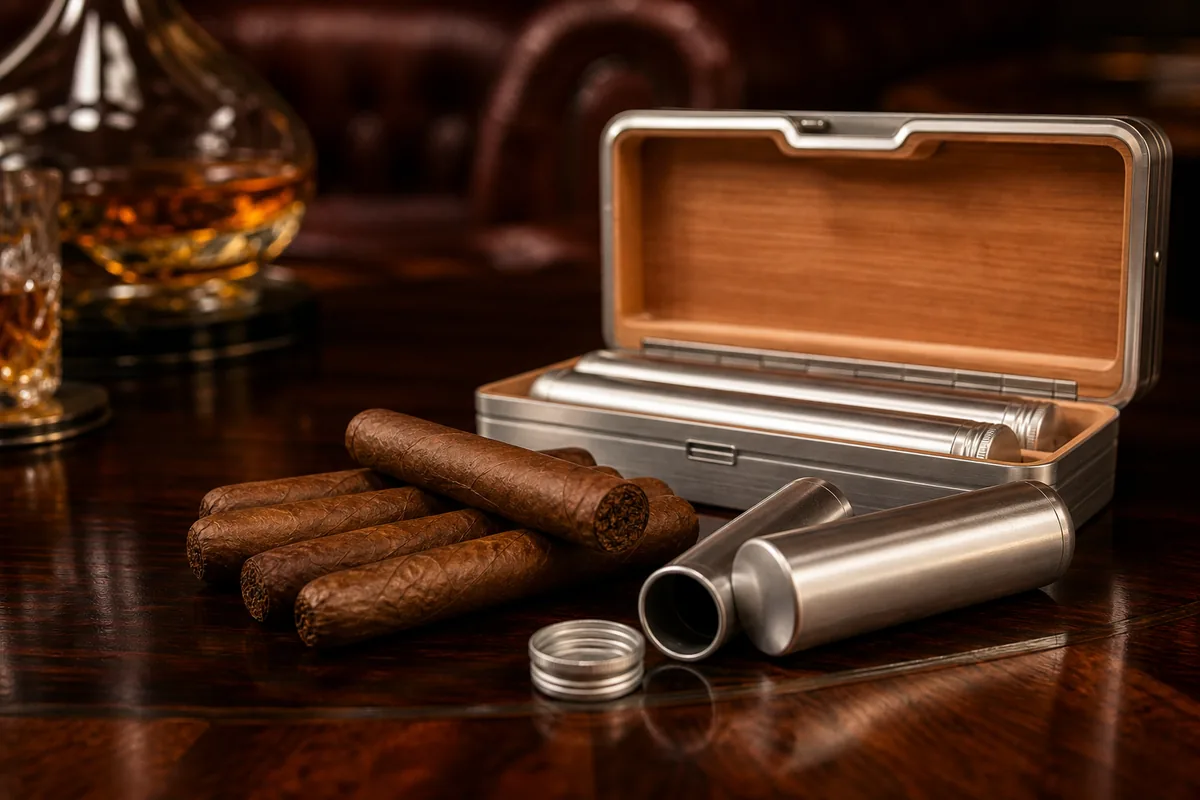
Cigar Tubes: Are They Worth It?
Cigar tubes are worth it for travel and pocket carry — they prevent physical damage that no wrapper can survive. They're not worth it for long-term storage, where they trap stale air and prevent proper humidity circulation. The distinction matters because using tubes wrong can ruin the cigars they're meant to protect.
What Cigar Tubes Actually Do
A tube is armor. It prevents crushing, cracking, and friction damage when a cigar rides in a jacket pocket, briefcase, or travel bag. A naked cigar in a pocket gets compressed by your body, nicked by keys, and dried out by ambient air. A tubed cigar arrives intact.
That's the entire value proposition: physical protection during transit. Tubes don't humidify. They don't age cigars. They don't improve flavor. They keep your cigar from getting destroyed between point A and point B.
Types of Cigar Tubes
Factory Tubes (Aluminum/Cedar-Lined)
Many premium cigars ship in individual aluminum tubes with cedar-lined interiors. Montecristo, Romeo y Julieta, H. Upmann, and others offer tubed versions of their popular vitolas. The tube is part of the packaging — the cigar is placed inside at the factory and sealed.
Factory tubes have a cedar sleeve that provides minimal humidity buffering. They're designed for retail shelf life and transport, not long-term cellaring. A cigar can live in its factory tube for 2–4 weeks without noticeable drying, assuming the cap was tight.
Aftermarket Tubes (Metal/Plastic)
These are reusable containers you buy separately and fill with cigars from your humidor. Aluminum tubes from brands like Xikar and Visol are the most common. Plastic tubes exist but offer less crush protection and no humidity buffering.
Aftermarket tubes usually lack cedar lining. The cigar sits directly against metal or plastic. For short trips (same day, overnight), this is fine. For longer journeys, wrap the cigar in a small strip of cedar before inserting.
Glass Tubes
Primarily decorative or used for special editions. They show off the cigar but offer less impact protection than metal. You'll see these on gift sets and limited releases. Treat them as display packaging, not travel gear.
When Tubes Are Worth Using
- Daily pocket carry: One cigar for the commute or lunch break. A tube in your jacket pocket keeps it safe all day.
- Air travel: Checked luggage gets thrown. Even in a travel humidor, individual tubes add a layer of crush protection for your best sticks.
- Golf, hiking, outdoor events: Any situation where your cigar might get knocked around, sat on, or compressed.
- Gifting: A tubed cigar looks intentional and arrives in perfect condition. It says you thought about the presentation.
When Tubes Cause Problems
- Long-term storage in a humidor: Keeping cigars in sealed tubes inside your humidor defeats the purpose of the humidor. Humidified air can't reach the cigar. Over months, the cigar dries out inside its own tube while your humidor reads a perfect 67%.
- Aging: Cigars need air exchange to age properly. The subtle chemical transformations that mellow tobacco over years require some oxygen circulation. A sealed tube stops that process.
- Moisture trapping: If you tube a cigar immediately after removing it from a well-humidified environment and the tube seals tight, condensation can form inside during temperature changes. That moisture sitting against the wrapper invites mold.
The Storage Compromise
If you want to store tubed cigars in your humidor, remove the cap. Leave the tube open so humidified air circulates through. The tube still provides physical separation (no wrapper-on-wrapper contact) while allowing humidity access. Many smokers store their tubed cigars this way — cap off, standing upright in the humidor.
For tubes without removable caps (some factory tubes are crimped), either transfer the cigar to your humidor naked or poke a small hole in the cap. The goal is airflow.
How Long Can a Cigar Stay in a Sealed Tube?
Here's a realistic timeline:
- 1–2 days: No perceptible change. Smoke as normal.
- 1–2 weeks: Minimal drying at the foot. Most smokers won't notice.
- 3–4 weeks: Noticeable dryness, especially in thinner ring gauges. The wrapper may feel papery.
- 2+ months sealed: Significant moisture loss. The cigar will burn hot and taste flat. Needs rehumidification before smoking.
Factory tubes with tight caps and cedar lining extend these timelines slightly. But no tube is a substitute for a humidor.
Best Practices for Tube Use
- Load the tube the morning you plan to smoke. Don't pre-tube days in advance.
- Remove factory tubes when cigars enter your humidor. Let them breathe.
- For overnight trips, a Boveda pack in a ziplock bag with your tubed cigars adds insurance.
- Check the tube interior for rough spots or burrs that could scratch delicate wrappers.
- Cedar strips inside aftermarket metal tubes add humidity buffering and prevent the cigar from rattling.
Common Mistakes
- Storing sealed tubes in a humidor for months: Your hygrometer reads 67% while the cigar inside the tube dries to 55%. Open or remove tubes for long-term storage.
- Forcing oversized cigars into tubes: If the cigar fits tight enough to compress the wrapper, the tube is too small. You'll crack the wrapper pulling it out. Choose tubes with 2–3mm clearance around the cigar.
- Reusing tubes without cleaning: Old tar, oils, and tobacco residue accumulate inside after multiple uses. Wipe the interior with a dry cloth between cigars. Metal tubes can be rinsed and fully dried.
- Trusting a tube as a humidor replacement: A tube in a hot car for a day will cook your cigar regardless of the cedar lining. Temperature matters as much as humidity.
Alternatives to Traditional Tubes
If you're carrying 2–3 cigars, a small leather or hard-shell travel case with a Boveda pack offers better protection than individual tubes. Cases hold humidity, cushion impacts, and keep multiple cigars organized. For single-cigar carry, a tube remains the most compact option.
Another option gaining popularity: telescoping cigar cases that adjust to different ring gauges. One case fits anything from a lancero to a 60-ring gordo. More versatile than a fixed-diameter tube.
Bottom Line
Tubes are travel gear, not storage solutions. Use them to get cigars from your humidor to the smoking spot safely, then forget about them until the next trip. For proper storage and aging, your cigars need open air, stable humidity, and the environment your humidor provides.
Setting up that environment? Our guide to choosing your first humidor covers sizing, seal quality, and what to look for. Already have a humidor but building a travel kit? Check our essential cigar accessories list for what else to carry.
Frequently asked questions
Should I remove cigars from their factory tubes when I buy them?
Yes, if they're going into your humidor for storage. Remove the cigar from the tube so it can breathe and benefit from your humidor's environment. Keep the tube for travel later.
Can mold grow inside a cigar tube?
Yes, if the cigar was over-humidified when sealed and temperature fluctuates. Condensation forms inside the tube and sits against the wrapper. Always ensure cigars are at proper humidity (not wet) before tubing, and avoid temperature swings.
Are expensive tubes better than cheap ones?
For physical protection, a $5 aluminum tube works as well as a $30 designer one. The premium goes toward finish quality, threading smoothness, and materials (titanium, carbon fiber). Function-wise, any solid metal tube with a tight cap does the job.
How do I pick the right tube diameter for my cigars?
Measure your cigar's ring gauge and add 2-3mm clearance. A 50 ring gauge cigar (about 20mm diameter) needs a tube with roughly 22-23mm internal diameter. Too tight risks wrapper damage; too loose lets the cigar rattle and scuff.
Community tasting notes
No community notes yet. Be the first to share how this smoked for you.
Log in to share your tasting notes and photos.