
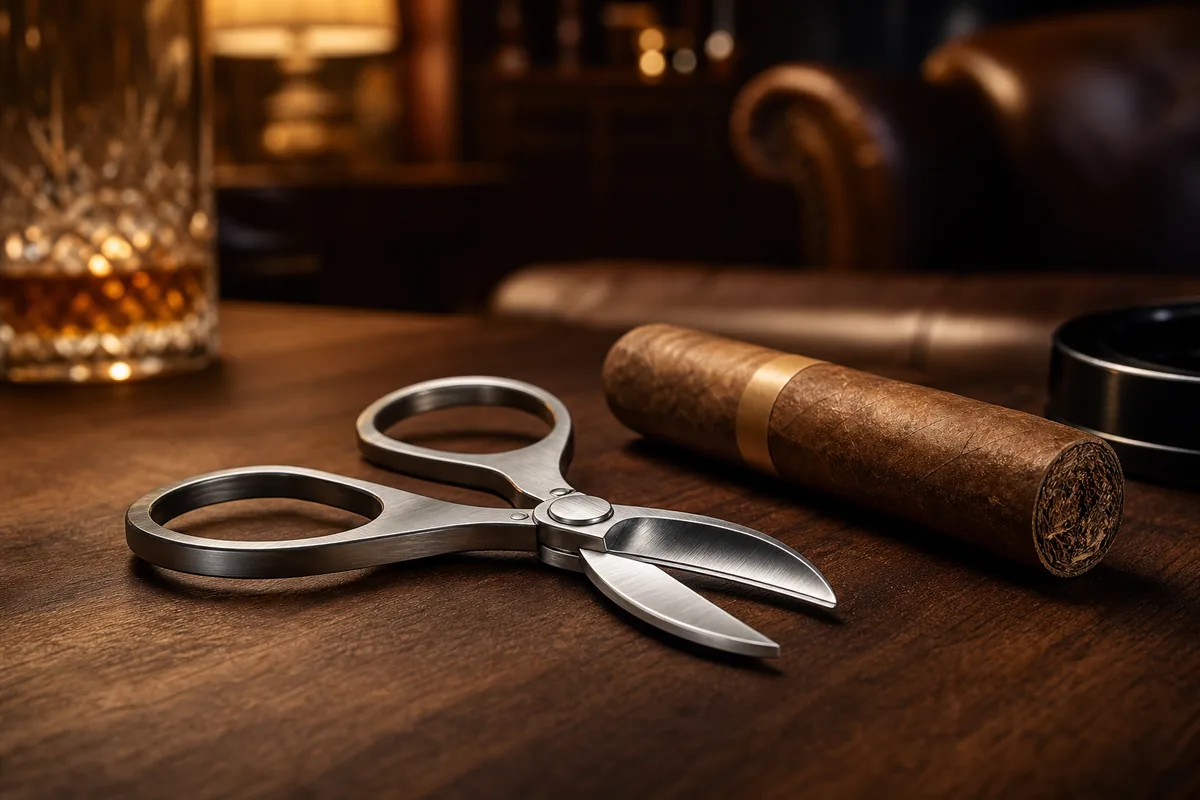
Cigar Scissors: When to Use Them
Cigar scissors give you the most controlled, precise cut available — you see exactly where the blade meets the cap, you control the pressure, and the scissor action compresses the cigar less than any guillotine. Use them when precision matters more than speed: on expensive sticks, delicate wrappers, and larger ring gauges where a guillotine might struggle to cut clean in one pass.
How Cigar Scissors Differ from Guillotines
A guillotine works by driving one or two blades through the cigar in a single motion. Your hand squeezes, the spring provides speed, and the cut happens in a fraction of a second. It's fast and effective — but you commit to the cut the instant you squeeze. There's no halfway.
Scissors let you approach gradually. You position the blades around the cap, see exactly where the cut line falls, and close with whatever speed and pressure you choose. You can stop mid-cut, reposition, or shave off less cap than you initially intended. It's a surgical approach versus a quick-draw approach.
The scissor action also distributes pressure differently. Instead of compressing the cigar between a blade and a backstop (single-blade guillotine) or between two converging blades, scissors apply opposing lateral force that's more like shearing than crushing. On soft-packed cigars, this distinction prevents the filler from deforming at the cut point.
When Scissors Are the Best Choice
Large Ring Gauge Cigars (54+)
Most guillotine cutters have an aperture that maxes out around 54-56 ring gauge. A 60-ring gordo may not fit into the opening at all — or it fits so tightly that the blades compress the wrapper before cutting. Scissors have no size limitation. They cut a 70-ring cigar as easily as a 42.
Delicate Wrappers
Connecticut Shade, Cameroon, and aged wrappers with visible oil sheen are prone to cracking under pressure. The gradual, controlled approach of scissors lets you cut through the cap without transmitting stress to the wrapper below the cut line. If your wrapper cracks every time you use a guillotine, try scissors.
Aged or Rare Cigars
When you're opening a cigar that's been aging for five or ten years, you want the cleanest possible cap removal. Aged wrappers become brittle. The cap adhesive may have weakened. Scissors let you control every millimeter of the cut, stopping if you feel the wrapper starting to resist.
Figurados and Torpedos
The tapered tip of a torpedo gives you no flat surface for a punch and an awkward angle for a guillotine. Scissors can cut at any point along the taper — exactly where you want the opening — without requiring the cigar to sit in a fixed aperture. You choose the draw aperture by choosing where to cut.
When a Guillotine Is Better
Scissors aren't always the right tool:
- Speed: If you're cutting multiple cigars for a group, a guillotine is 2–3 times faster per cut.
- Consistency: A guillotine with a backstop gives you the same depth every time. Scissors rely on your eye and hand — inconsistency creeps in if you're not paying attention.
- Portability: Most cigar scissors are bulkier than pocket guillotines. They don't clip onto a keychain or slide into a credit card slot.
- Cold weather: Thick gloves and precision scissors don't mix. A spring-loaded guillotine works with clumsy fingers.
How to Use Cigar Scissors Properly
Grip
Hold the scissors like you hold sewing scissors — thumb and middle finger in the rings, index finger resting on the joint for stability. Don't hold them like a guillotine (squeezing with your whole hand). The finger placement gives you fine control over closing speed and pressure.
Positioning
Open the blades wide enough to accept the cigar without touching it. Bring the cigar into position between the blades. Identify the cap line — that faint seam where the cap was glued to the body. Position your blades 1–2mm above that line.
The Cut
Close the blades with steady, moderate pressure. Don't snap them shut — that defeats the purpose of using scissors. Feel the resistance as the blades engage the wrapper. If you feel cracking or uneven resistance, stop, reposition, and try from a slightly different angle.
One smooth closing motion produces a cleaner edge than multiple nibbling cuts. Aim for a single decisive close once you're positioned correctly.
After the Cut
Inspect the cut surface. You should see a clean edge with no visible wrapper fibers or filler displacement. If there's a small flap of cap remaining, a gentle pass with the scissors trims it flush. Don't over-trim — taking too much cap below the shoulder risks unraveling.
Choosing Quality Cigar Scissors
Not all scissors are created equal. For cigars, you need:
- Thick, short blades: Long blades flex. Cigar scissors have stubby, thick blades that maintain rigidity under the lateral force of cutting compressed tobacco.
- Surgical-grade steel: The blade edge needs to stay sharp for thousands of cuts. Stainless surgical steel holds an edge far longer than stamped carbon steel.
- Tight pivot with no play: Any wobble at the pivot translates to uneven cuts. Test by closing the scissors slowly — the blades should meet uniformly along their entire length without gaps.
- Comfortable rings: Your fingers live in those rings for 10–15 seconds per cut. Sharp internal edges or undersized rings cause fatigue and calluses over time.
Expect to spend $40–80 for a quality pair. Brands to consider: Xikar (MTX series), Credo, and Davidoff. Below $30, blade quality drops noticeably — you'll be replacing rather than maintaining.
Maintenance
Cigar scissors need less maintenance than guillotines because the shearing action is self-cleaning — each cut wipes the blade face against its partner. Occasional care keeps them sharp:
- Wipe blade faces with a dry cloth after each session to remove tar residue
- Drop a small amount of pivot oil on the screw joint every few months
- Store closed, blades together, in a pouch that prevents impact on the cutting edge
- Sharpening follows the same principles as any scissors — a fine ceramic rod drawn along the beveled edge, maintaining factory angle
Common Mistakes
- Snapping the blades shut like a guillotine: You lose all the precision advantage. Close with control — the whole point is the gradual approach.
- Cutting too deep on torpedos: With no backstop to limit depth, scissors can take too much off a torpedo tip. Start conservative — you can always trim more, never less.
- Using kitchen or craft scissors: Blade geometry matters. Regular scissors have long, thin blades that flex against the density of compressed filler. Cigar scissors are short and rigid for a reason.
- Ignoring blade alignment: If your scissors leave a small uncut flap at the end of the stroke, the blades have developed a gap at the tips. Tighten the pivot screw or have them professionally adjusted.
Where Scissors Fit in Your Kit
Think of scissors as the precision tool and a guillotine as the everyday carry. Keep scissors at home for your best smokes, travel with a compact guillotine for convenience. Together with a punch for large-format robustos, you're covered for any cigar and any scenario.
For the full picture of cutting options, see our guide to every cigar cutter type. And for technique regardless of tool, how to properly cut a cigar covers cap anatomy and depth control.
Step by step
- Grip the scissors properlyThumb and middle finger in the rings, index finger on the pivot joint for stability. This gives fine motor control over closing speed.
- Position blades around the capOpen blades wide enough to accept the cigar without touching. Identify the cap line (glue seam) and position blades 1-2mm above it.
- Close with steady, controlled pressureOne smooth closing motion, not a snap. Feel resistance as blades engage the wrapper. Stop and reposition if you sense cracking.
- Inspect and trim if neededCheck for a clean edge with no wrapper fibers. Trim any small cap flaps with a gentle secondary pass. Don't over-trim below the cap shoulder.
Frequently asked questions
Are cigar scissors better than a guillotine?
Not universally — they're better for specific situations. Scissors excel on large ring gauges, delicate wrappers, and when you need surgical precision. Guillotines are faster, more consistent, and more portable. Most serious smokers own both.
Can I sharpen cigar scissors at home?
Yes. Use a fine ceramic honing rod drawn along each blade's beveled edge at the factory angle. 5-8 passes per blade. Unlike guillotines, scissors are easy to sharpen because you can access each blade individually when open.
Why are cigar scissors so expensive compared to guillotines?
The engineering is more demanding. Short, thick blades with surgical-grade steel, a precision pivot with zero play, and ergonomic rings all cost more to manufacture than a spring-loaded straight cutter. You're paying for blade rigidity and pivot precision.
Do cigar scissors work on small ring gauge cigars like lanceros?
They work, but a guillotine is easier for thin cigars. A 38-gauge lancero gives you a tiny cap target — scissors require steady hands at that scale. The guillotine's fixed backstop provides more consistency on small targets.
Community tasting notes
No community notes yet. Be the first to share how this smoked for you.
Log in to share your tasting notes and photos.