
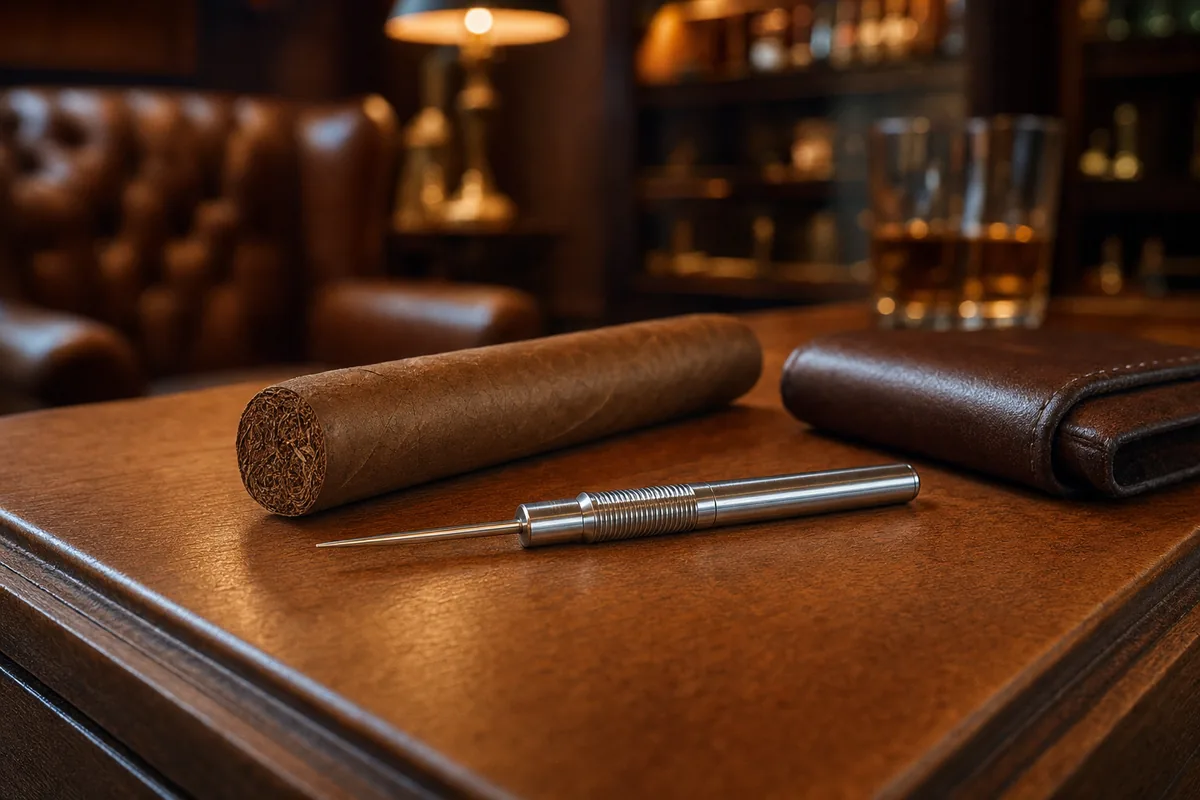
Cigar Draw Tool (Needle): How It Works
A cigar draw tool is a long, thin needle you push through the length of a plugged cigar to create an air channel through compacted filler. It turns an unsmokeable, plugged cigar into a salvageable smoke in about ten seconds. If you've ever struggled to draw on a tight cigar and considered tossing it, this tool saves that cigar.
The concept is simple — poke a hole through the obstruction. The execution requires some care to avoid cracking the wrapper or making the draw too open.
What Causes a Plugged Draw
A cigar draws tight (or not at all) when something blocks airflow through the filler column. Common causes:
- Over-packed filler: The roller bunched too much tobacco into the binder, creating a section too dense for air to pass through. This is a construction defect from the factory.
- A knot in the ligero: Ligero leaves (the thickest, strongest priming) can form dense clusters that resist airflow. Common in full-bodied blends that use a high proportion of ligero.
- Tobacco swelling from over-humidification: If a cigar was stored above 72% RH, the filler absorbs moisture and expands, closing air passages that existed at proper humidity.
- Stem fragment: Occasionally, a piece of the leaf's central vein makes it into the bunch. It acts like a valve, blocking the draw at one specific point.
You can identify a plug by where resistance occurs. If the entire cigar is uniformly tight, it's likely over-packed throughout. If draw is fine until a certain point, then stops — that's a localized plug you can target.
How a Draw Tool Works
The tool is essentially a long, thin stainless steel needle (some call it a "poker" or "draw poker") — typically 5–7 inches long, about 1.5mm in diameter, with a sharp point and a handle. You insert it through the head of the cigar (after cutting), push it down the center of the filler column, and withdraw it.
The needle displaces tobacco as it passes through, creating a narrow channel. Air flows through this channel. The displaced filler doesn't disappear — it compresses outward against the surrounding tobacco. The result is a central pathway for draw without removing any material from the cigar.
Some tools have a slight corkscrew or spiral at the tip that grabs and loosens packed filler as it passes. Others are smooth needles that rely purely on displacement. Both work — the spiral variant is gentler on stubborn plugs because it loosens rather than just pushing.
How to Use a Cigar Draw Tool
Step 1: Cut the Cigar First
You need an opening to insert the needle. Cut the cap using your preferred method — guillotine, punch, or scissors. The cut must be made before the tool goes in. Don't try to push the needle through an uncut cap.
Step 2: Test the Draw Before Inserting
Take a cold draw (unlit). This tells you how tight the cigar is and roughly where the plug lives. If draw is completely blocked, the plug could be anywhere. If it's tight but passable, you might not need the tool at all — some cigars loosen up after the first inch burns.
Step 3: Insert Slowly and Centered
Hold the cigar at the foot (or lay it on a flat surface). Insert the needle into the head, aiming for dead center. Push slowly — about one inch per second. You'll feel resistance increase when you hit packed filler. That's the plug.
Don't force through heavy resistance. If the needle won't advance, pull back half an inch and try again at a very slight angle offset. Sometimes approaching the knot from a marginally different trajectory lets you pass through rather than against it.
Step 4: Push to Full Depth
Advance the needle 70–80% of the cigar's length. You don't need to go all the way to the foot — the open channel just needs to bypass the plugged section. On a 5-inch robusto, pushing 3.5–4 inches is sufficient.
Step 5: Withdraw and Test
Pull the needle out slowly. Rotate it slightly as you withdraw — this widens the channel marginally and prevents the displaced filler from immediately closing back over the path. Don't spin aggressively; a quarter-turn during withdrawal is plenty.
Take another cold draw. The improvement should be immediate and obvious. If draw is now too open (feels like sucking through an empty straw), you've displaced too much filler or hit a void. This is rare with a standard needle — the channel is too narrow to over-correct in one pass.
Step 6: Repeat if Needed
One pass usually solves the problem. If draw is improved but still tighter than you'd like, insert a second time at a slightly different angle to create an additional channel. Two passes is the maximum — beyond that, you risk structural compromise that creates burn issues.
Which Draw Tools to Consider
- PerfecDraw: The most popular dedicated cigar draw tool. Stainless steel with a comfort handle and a thin profile designed specifically for this purpose. About $25.
- Modus by Xikar: Combines a draw tool needle with a cigar rest and nubber. Multi-function, well-made. Around $30.
- DIY option: A long, thin bamboo skewer works in a pinch. It won't last (bamboo splinters with repeated use), but if you're stuck with a plugged cigar and nothing else, a skewer saved from takeout has cleared many a plug.
Avoid using toothpicks (too short, too thick), sewing needles (too thin, no handle), or anything with a rough surface that could leave debris inside the cigar.
When NOT to Use a Draw Tool
- On an already-lit cigar: Inserting a metal needle into a burning cigar is dangerous (conducting heat to your hand) and ineffective (the burn zone's structure is already compromised). If a plug appears mid-smoke, let the cigar go out, let it cool for a minute, then try the tool. Relight after.
- On thin ring gauge cigars (under 38): A lancero or petit corona has too little filler mass to displace. The needle takes up a disproportionate percentage of the cross-section, creating an oversized channel that makes the draw too open and causes wrapper burn-through.
- On cigars with wrapper cracks: The outward pressure of displaced filler can widen existing cracks. If the wrapper is already compromised, the tool may make it worse.
- As preventive maintenance: Don't pre-poke cigars that draw fine. You're creating a structural weakness for no benefit.
Common Mistakes
- Inserting too fast: Speed creates lateral pressure that can crack the wrapper from inside. Go slow — one inch per second maximum.
- Going off-center: If the needle drifts toward the wrapper, it can puncture through the side of the cigar. Aim dead center and correct if you feel the needle brushing against the binder wall.
- Using excessive force on a hard plug: If the needle won't advance, the plug is exceptionally dense. Force risks snapping the needle inside the cigar (rare but possible with thin tools) or splitting the cigar longitudinally. Try multiple light-pressure passes from slightly different angles instead.
- Expecting miracles on construction-defect cigars: If the entire cigar is uniformly over-bunched from cap to foot, a needle creates one narrow channel in an otherwise impenetrable mass. Draw improves, but the cigar still won't smoke like a properly constructed one. Manage expectations.
Prevention: Reducing Plug Risk
A draw tool is a rescue device, not an everyday necessity. Reduce your need for it:
- Store cigars at 62–67% RH. Over-humidification is the most common cause of swollen filler and tight draw in otherwise well-constructed cigars.
- Let refrigerated or recently shipped cigars acclimate for a week before smoking. Temperature shock can cause uneven moisture distribution that mimics a plug.
- Roll test before buying: gently squeeze along the length. Hard spots indicate dense packing that may become a plug.
- Avoid heavily ligero-forward blends from manufacturers with inconsistent QC. Some brands are notorious for tight draw; others have it dialed in.
What's Next
A draw tool pairs with good cutting technique — the cut gives you access, the tool opens the channel. For cutting fundamentals, see how to properly cut a cigar. And if humidity might be causing your tight draws, review our guide on calibrating your hygrometer to make sure your humidor readings are honest.
Step by step
- Cut the cigar capMake your preferred cut (guillotine, punch, or scissors) to create an opening for the needle to enter.
- Test the cold drawDraw air through the unlit cigar to confirm the plug exists and estimate its location based on where resistance increases.
- Insert needle slowly through centerPush the draw tool into the head opening, aimed dead center, at about one inch per second. Feel for increased resistance — that's the plug.
- Advance to 70-80% depthPush past the plug to about three-quarters of the cigar's length. Don't force through heavy resistance — pull back and try a slightly different angle.
- Withdraw with a slight rotationPull the needle out slowly with a quarter-turn. This widens the channel marginally and prevents immediate closure.
- Test draw and lightTake another cold draw to confirm improvement. If satisfactory, light the cigar normally. If still tight, one additional pass at a different angle.
Frequently asked questions
Can a draw tool fix any plugged cigar?
Most, but not all. A localized plug from a knot or stem responds well. A cigar that's uniformly over-packed from end to end will improve somewhat but won't draw like a properly constructed cigar. The tool creates one channel — it can't restructure the entire filler column.
Will using a draw tool affect the cigar's flavor?
Minimally. The channel is narrow enough that it doesn't significantly change the ratio of air to smoke. What it does change: combustion temperature. A plugged cigar burns hot because you puff harder. Opening the draw lets you puff normally, which keeps combustion cooler and flavor cleaner.
Can I use the draw tool on a cigar that's already lit?
Let it go out first and cool for at least a minute. A metal needle conducts heat from the burning zone to your hand, and inserting anything into an actively combusting cigar disrupts the burn structure. Cool it, tool it, relight.
How is a draw tool different from just using a toothpick?
Length and diameter. A toothpick is 2-3 inches — too short to reach a plug in the middle of a 5-inch cigar. It's also too thick relative to its length, creating an oversized channel in the first inch while leaving the plug untouched. A proper draw tool is 5-7 inches with a consistent 1.5mm profile.
Community tasting notes
No community notes yet. Be the first to share how this smoked for you.
Log in to share your tasting notes and photos.